24/7 Call Answering for HVAC & Roofing: Why 64% of Leads Call After Hours
 by Parvez Zoha
Most HVAC and roofing leads call when your office is closed. A 24/7 call answering HVAC roofing business solution picks up every ring, qualifies the caller, and books the appointment before a competitor can. Without it, you are paying for marketing that rings into voicemail.
Key takeaways
- Over half of HVAC service calls arrive outside the traditional 9-to-5 window, making after-hours coverage a revenue requirement rather than a luxury.
- 78% of buyers hire the first business that responds, so speed-to-answer directly determines close rate.
- AI-powered call answering operates 24/7/365 at a fraction of the cost of a night-shift receptionist or answering service.
- Novacall AI responds to inbound leads in under 60 seconds with voice, SMS, and email follow-up—no voicemail, no callback delay.
- The ROI math is straightforward: if your average HVAC or roofing job is worth several thousand dollars, one recovered after-hours booking per week pays for the entire system.
Why does a 24/7 call answering HVAC roofing business strategy matter now?
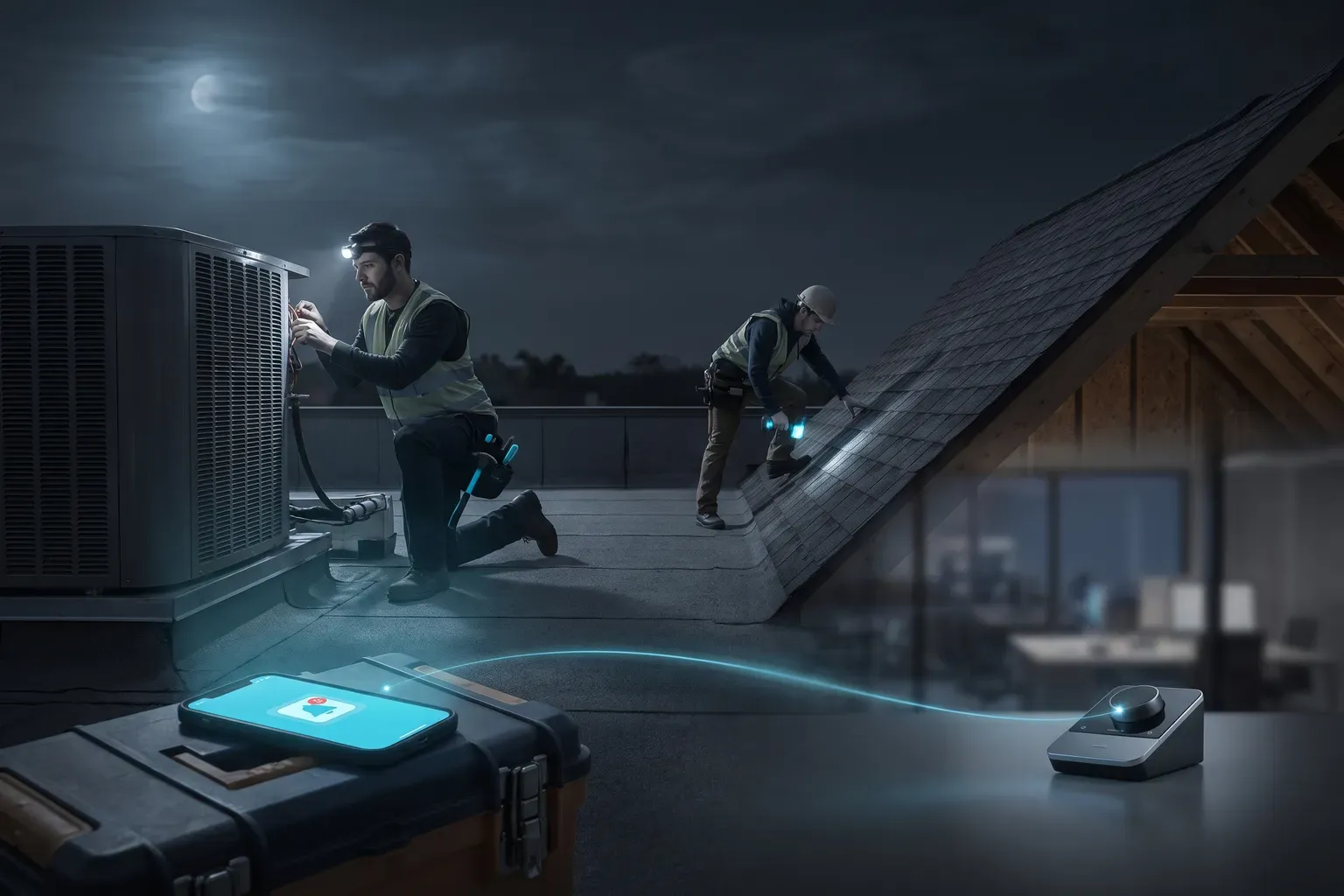
Homeowners do not schedule their emergencies around your office hours. A burst pipe at 6 AM, an AC failure at 9 PM on a Saturday, a roof leak during a midnight storm—these callers need help immediately. If your phone rings six times and hits voicemail, the caller hangs up and dials the next contractor on the list.
According to RapportAgent (After-Hours Lead Study), 64% of HVAC calls arrive outside standard business hours, with peak windows at 7–9 AM and 5–8 PM and emergency spikes on weekend afternoons in summer.
That is not a marginal slice of your pipeline. That is the majority of it. And every one of those callers who reaches voicemail represents a job you paid to generate—through SEO, Google Ads, yard signs, referrals—that you then failed to capture.
Data from Pipelineon.com (Home Service Marketing Statistics) shows an average HVAC cost-per-lead near $45, plumbing CPL near $52, and roofing CPL near $79, alongside a 14% missed call rate in home services and 78% of buyers hiring the first responder.
Think about what that means in practice. You spend $79 to get a roofing lead to call you. The phone rings at 6:30 PM. Nobody answers. The homeowner calls the next roofer. You just lit $79 on fire—and lost a job that might be worth thousands.
The compounding cost of missed calls
Missed calls do not just cost you one job. They cost you the referral that job would have generated, the five-star review that homeowner would have left, and the repeat business when they need their next service. A single unanswered call has a downstream revenue impact that extends far beyond the immediate ticket value.
In practice, the first sixty seconds of an inbound call decide whether it books. Callers who reach a live voice—human or AI—stay on the line. Callers who hear a recorded greeting with a "leave a message" prompt hang up at alarming rates, especially for urgent service needs.
What happens when HVAC and roofing companies ignore after-hours calls?
According to LiveVoice (43 Percent of HVAC Companies Don't Return Phone Calls), 43 percent of HVAC companies do not return phone calls—ever.
That statistic is from a study of service companies, and it reveals a systemic problem in the trades. Contractors get busy during the day, calls pile up, and by the time the truck rolls back to the shop, returning calls feels impossible. The next morning brings new emergencies, and yesterday's missed calls get buried.
This is not laziness. It is a structural capacity problem. A two-person HVAC crew running four service calls per day simply cannot answer the phone while they are on a roof or in a crawlspace. The owner is often the lead technician, the estimator, and the office manager rolled into one.
But homeowners do not care about your staffing constraints. They care about their problem. And they will hire whoever answers first.
As reported by Housecallpro.com (Home Service Customer Trends), a survey of over 1,000 U.S. homeowners reveals how customers choose who to hire, who to trust, and who they call again.
The pattern is clear: responsiveness is the top filter. Before price, before reviews, before brand recognition—did you pick up the phone?
The competitor advantage gap
Every call you miss is a call your competitor answers. In markets with dozens of HVAC and roofing companies competing for the same homeowners, the business that picks up first wins. Not the cheapest. Not the one with the most trucks. The one that answers.
This is why a 24/7 call answering HVAC roofing business approach is not optional for growth-minded contractors. It is the minimum viable infrastructure for competing in a market where leads expect instant response.
How does AI-powered 24/7 call answering work for contractors?
Modern AI call answering is not the robotic phone tree of ten years ago. Today's systems use streaming speech recognition and neural voice synthesis to hold natural conversations with callers. They ask qualifying questions, capture job details, and book appointments directly on your calendar—all without a human touching the phone.
Here is what a typical after-hours call flow looks like with Novacall AI:
- Caller dials your business number at 8:47 PM. The AI answers in under 60 seconds—no rings to voicemail, no hold music.
- AI greets the caller by your company name. The voice matches your brand tone. The caller does not know they are speaking with an AI system.
- Qualification happens on the call. The AI asks about the problem (leaking roof, AC not cooling, furnace noise), timeline (emergency vs. scheduled), property type, and budget range.
- Appointment books automatically. The AI checks your connected calendar and offers available slots. The caller confirms, and the booking appears in your CRM.
- Multi-channel follow-up fires immediately. The caller receives an SMS confirmation and an email with appointment details. You receive a notification with the full call summary.
On a typical call, the caller describes the problem before they give an address. The AI handles this naturally, gathering details in conversational order rather than forcing a rigid script. This feels more like talking to a dispatcher than navigating a phone menu.
What the AI qualifies on every call
Novacall AI covers budget, timeline, property or job type, and pre-approval status during the qualification conversation. For HVAC and roofing specifically, this means the AI captures:
- Whether the call is an emergency or a scheduled estimate request
- The type of system or roof involved
- The homeowner's timeline expectations
- Whether they have insurance involvement (for storm damage claims)
This information flows directly into your CRM, so your team starts the next morning with a full pipeline of qualified, booked appointments rather than a stack of voicemails to return.
What are the real costs of 24/7 call answering HVAC roofing business solutions?
Let us compare the three main approaches to round-the-clock phone coverage: hiring staff, using a traditional answering service, or deploying an AI system.
Option 1: Hire a night-shift receptionist
A fully loaded human inside sales agent costs $50,000 to $80,000 per year. That covers salary, benefits, payroll taxes, and training. This person works 8 hours a day, 5 days a week, and handles 30 to 50 calls per day. They take 2 to 4 weeks to ramp up before they are effective.
For true 24/7 coverage, you need multiple people to cover nights, weekends, and holidays. The cost doubles or triples quickly. Most small HVAC and roofing companies cannot justify this expense.
Option 2: Traditional answering service
Traditional answering services use human operators who answer your phone with a script. They take messages and forward them to you. The limitation: they typically cannot book appointments, qualify leads in depth, or integrate with your CRM. They are message-takers, not closers.
Per Nextiva (Latest Answering Service Trends), answering service features that once justified premium pricing for enterprises are now standard requirements for even SMBs.
The market has shifted. Basic message-taking is no longer sufficient. Homeowners expect the person who answers to actually help them—schedule the appointment, confirm the time, send a text confirmation.
Option 3: AI-powered call answering
Novacall AI operates 24/7/365 with identical call quality on every call. There is no ramp period—setup happens same-day. The system handles voice, SMS, email, and WhatsApp workflows in 15+ supported languages.
Here is how the pricing breaks down by daily call volume:
Novacall AI pricing is by custom quote. Scope depends on lead and call volume, channels, integrations, and workflow. Book for a quote; current commercial terms are confirmed in a written proposal.
Year 2 onward is lower because the one-time setup fee is not repeated.
Cost comparison: AI vs. human ISA
The equivalent human inside sales agent cost at each tier's call volume tells the real story:
How does 24/7 call answering HVAC roofing business coverage handle seasonal spikes?
HVAC and roofing are inherently seasonal businesses. An HVAC company might handle 15 calls per day in spring and 80 per day during a July heat wave. A roofing company might go from 10 calls per day in winter to 200 per day after a hailstorm.
Human staff cannot scale this way. You either overstaff for peak season (expensive) or understaff and miss calls during your highest-revenue windows (more expensive).
In our experience, teams underestimate how many callers abandon a phone menu or hold queue during peak periods. When four homeowners call simultaneously about storm damage, the fifth caller who gets a busy signal calls your competitor. With concurrent call capacity, every caller gets an immediate answer.
Outbound number rotation for follow-up
For outbound follow-up calls—reaching back out to leads who filled out a web form or requested a callback—Novacall AI rotates numbers at 50 calls per number per day on a round-robin to protect caller reputation. This prevents your business number from being flagged as spam.
What does each plan include beyond voice minutes?
Every Novacall AI plan includes multi-channel follow-up, CRM integration, and calendar booking. Here is the full breakdown:
| Feature | Starter | Growth | Pro | Enterprise |
|---|---|---|---|---|
| Voice Minutes | 500 | 2,000 | 5,000 | 12,000 |
| SMS Messages | 200 | 750 | 2,000 | 5,000 |
| Emails | 500 | 2,000 | 5,000 | 12,000 |
| AI Agents | 2 | 3 | 5 | 8 |
| Concurrent Calls | 2 | 3 | 5 | 8 |
| Phone Numbers | 1 | 1 | 1 | 2 |
| Support Level | 24/7 | Priority | Dedicated | Premium |
| CRM Integration | ✓ | ✓ | ✓ | ✓ |
| Calendar Booking | ✓ | ✓ | ✓ | ✓ |
| Multi-Channel Follow-Up | ✓ | ✓ | ✓ | ✓ |
The multi-channel follow-up is critical for home services. After the AI books an appointment by phone, the homeowner receives an SMS confirmation and an email with details. This reduces no-shows and gives the homeowner a written record they can reference.
Novacall AI capacity, included usage, and implementation scope are confirmed in your proposal. Book for a quote.
Overage rates if you exceed your plan
If a hailstorm hits and your call volume spikes beyond your included minutes, overage rates apply:
Why is speed-to-answer the deciding factor in home services?
The data is unambiguous: the first contractor to respond wins the job. This is not about being the cheapest or having the best reviews—though those matter. It is about being first.
Data from Pipelineon.com (Home Service Marketing Statistics) confirms that 78% of buyers hire the first responder.
Think about what happens when a homeowner's AC dies at 7 PM in August. They search "HVAC repair near me," find three companies, and call all three. The first company that answers gets the job. The other two get voicemail messages that will be returned tomorrow morning—by which time the homeowner already has a technician scheduled.
Novacall AI responds to inbound leads in under 60 seconds. That is not "within a few minutes" or "as soon as possible." It is sub-60-second response, 24 hours a day, 365 days a year. No lunch breaks, no sick days, no holidays.
This speed advantage compounds over time. Assume a hypothetical roofing company receives 10 after-hours calls per week and currently misses 7 of them. If each missed call represents a potential job, and even 30% of those callers would have booked, that is roughly 2 lost jobs per week. Over a year, that adds up to over 100 lost opportunities—all because nobody answered the phone.
The psychology of the after-hours caller
Homeowners who call outside business hours are often dealing with urgent situations. Their roof is leaking. Their furnace stopped working in January. Their AC died during a heat wave. These are not price-shopping calls—these are "I need help now" calls.
Urgent callers have the highest close rates because their buying decision is already made. They are not comparing three bids. They are hiring whoever answers. A 24/7 call answering HVAC roofing business system captures these high-intent callers at their moment of maximum motivation.
When we look at the call patterns, emergency calls convert at dramatically higher rates than estimate requests. The homeowner with water pouring through their ceiling at 11 PM is not going to wait until Monday to get three quotes. They are hiring the first roofer who picks up.
How do you choose the right plan for your HVAC or roofing company?
Plan selection is based on daily call volume—that is the only published sizing basis. Here is how to think about it for different business stages:
A real limitation to acknowledge
AI call answering handles the vast majority of routine inbound calls effectively—scheduling, qualification, information gathering, and follow-up. However, it has a genuine limitation: highly complex or emotionally charged conversations where a caller needs extensive reassurance, detailed technical troubleshooting, or sensitive negotiation still benefit from human involvement.
For example, a homeowner whose roof collapsed and who is simultaneously dealing with an insurance adjuster, a temporary housing situation, and emotional distress may need a human project manager on the line. The AI excels at the initial capture and qualification, but the relationship-building phase of complex projects still requires your team's expertise.
The practical solution: let the AI handle the first touch 24/7, qualify the lead, book the appointment, and route complex situations to your team during business hours with full context. You get the speed advantage without sacrificing the human touch where it matters most.
What does the 2026 landscape look like for 24/7 call answering HVAC roofing business solutions?
The market has shifted decisively. Round-the-clock coverage is no longer a differentiator—it is table stakes.
According to Myquoteiq.com (Best Answering Service Software), the choice in 2026 is not "should I have a 24/7 answering service" but "which model fits my roofing operation."
This reflects a broader industry reality: homeowners now expect instant response from every service provider. The businesses that still rely on voicemail and next-day callbacks are losing market share to competitors with automated systems.
Research from HVACKnowItAll (Why Your HVAC Business Loses Money) shows the average HVAC business owner earns $598,000 annually, but the median is just $76,000—meaning half of all owners take home roughly what a senior technician earns.
That gap between average and median tells you something important: the top-performing HVAC businesses are capturing dramatically more revenue than the median ones. One major differentiator is operational efficiency—including whether they capture every lead that calls.
A 24/7 call answering HVAC roofing business system is one of the highest-leverage investments a contractor can make because it addresses the single biggest revenue leak: unanswered phones.
The text message factor
Phone calls are not the only channel. According to AccuLynx (Text Messaging Statistics Roofing), 84% of customers do not answer calls from unknown numbers, but 98% of texts get answered.
This is why multi-channel follow-up matters. When Novacall AI books an appointment by phone, it sends an SMS confirmation immediately. When a lead fills out a web form, the system can reach out via text rather than calling from an unknown number. The combination of voice, SMS, and email covers every communication preference.
How do you implement 24/7 call answering without disrupting your current operations?
Implementation with Novacall AI happens same-day with no ramp period. There is no 2-to-4-week training cycle like you would have with a new hire. The system is SOC 2 and GDPR compliant, integrates with your existing CRM, and connects to your calendar for real-time availability.
Here is a practical implementation sequence for an HVAC or roofing company:
Day 1: Setup and configuration. Your business information, service areas, qualification criteria, and calendar availability are configured. The AI learns your company name, services offered, and booking rules.
Day 1: Call routing. Your existing business number forwards to Novacall AI after hours (or 24/7 if you prefer). No number change required for your customers.
Day 1: CRM connection. New leads and booked appointments flow directly into your existing CRM. Your team sees qualified leads with full context when they start work each morning.
Ongoing: Optimization. Call recordings and transcripts let you review how the AI handles different scenarios. Qualification questions can be adjusted as you learn what information your team needs most.
The same-day setup means you can be capturing after-hours calls tonight. There is no waiting for a new hire to learn your business, no training manuals to write, no ramp period where calls get handled poorly.
Integration with your existing workflow
The CRM integration is particularly important for HVAC and roofing companies that already use field service management software. When the AI books an appointment, it appears in your scheduling system. Your dispatcher sees it alongside your existing jobs. There is no double-entry, no sticky notes, no "check the other system" friction.
Calendar booking means the AI only offers time slots that are actually available. If your Tuesday is fully booked, the AI will not schedule a Tuesday appointment. This prevents the double-booking problems that plague traditional answering services where operators take messages without visibility into your schedule.
Making the decision: is 24/7 call answering HVAC roofing business coverage right for you?
If you answer yes to any of these questions, you are leaving money on the table without 24/7 coverage:
- Do you receive calls after 5 PM or before 8 AM?
- Do you miss calls while on job sites during the day?
- Do you have voicemails from the weekend that you return on Monday?
- Do your Google Ads run 24/7 but your phone coverage does not?
- Have you ever lost a job because a competitor responded faster?
For roofing companies with higher average ticket values, the math is even more compelling. A single recovered storm-damage job can pay for months of AI call answering.
The question is not whether you can afford 24/7 call answering. The question is whether you can afford to keep sending callers to voicemail.
Book a call to see how Novacall AI handles your specific call flow—including after-hours scenarios, emergency routing, and seasonal volume spikes.
Frequently asked questions about 24/7 call answering for contractors
Does the AI sound robotic to callers?
Modern neural voice synthesis produces natural-sounding speech that callers rarely identify as AI. The system uses your company name, speaks conversationally, and handles interruptions and pauses naturally. It does not sound like the robotic phone trees of five years ago.
Can the AI handle emergency vs. non-emergency calls differently?
Yes. The qualification flow distinguishes between emergencies (active leak, no heat in winter, AC failure in extreme heat) and routine requests (seasonal maintenance, estimate for a future project). Emergency calls can trigger immediate notifications to your on-call technician while routine calls book standard appointments.
What happens if the AI cannot answer a caller's question?
The system is designed to qualify and book, not to provide technical support. If a caller asks a question outside the AI's scope, it acknowledges the question, notes it in the call summary, and offers to have a team member follow up during business hours. The caller still gets a booked appointment and a human callback—they are not left hanging.
Do I need to change my business phone number?
No. Call forwarding routes your existing number to Novacall AI. Your customers, your Google Business Profile, your truck wraps, and your yard signs all keep the same number. The transition is invisible to callers.
How does billing work during slow months vs. peak season?
Your base plan rate stays the same monthly. During slow months, you likely stay within your included minutes and pay only the base rate. During peak months, overage rates apply for minutes beyond your allocation. This natural scaling means you pay less during slow periods without needing to cancel and re-subscribe seasonally.
The 24/7 call answering HVAC roofing business model works because it matches the reality of how homeowners buy services: urgently, after hours, and from whoever answers first. The contractors who recognize this and build their phone infrastructure accordingly capture more revenue from the same marketing spend. Those who do not continue to wonder why their cost-per-lead keeps climbing while their close rate stays flat.