AI missed-call response for electrical contractors—60s
 by Parvez Zoha
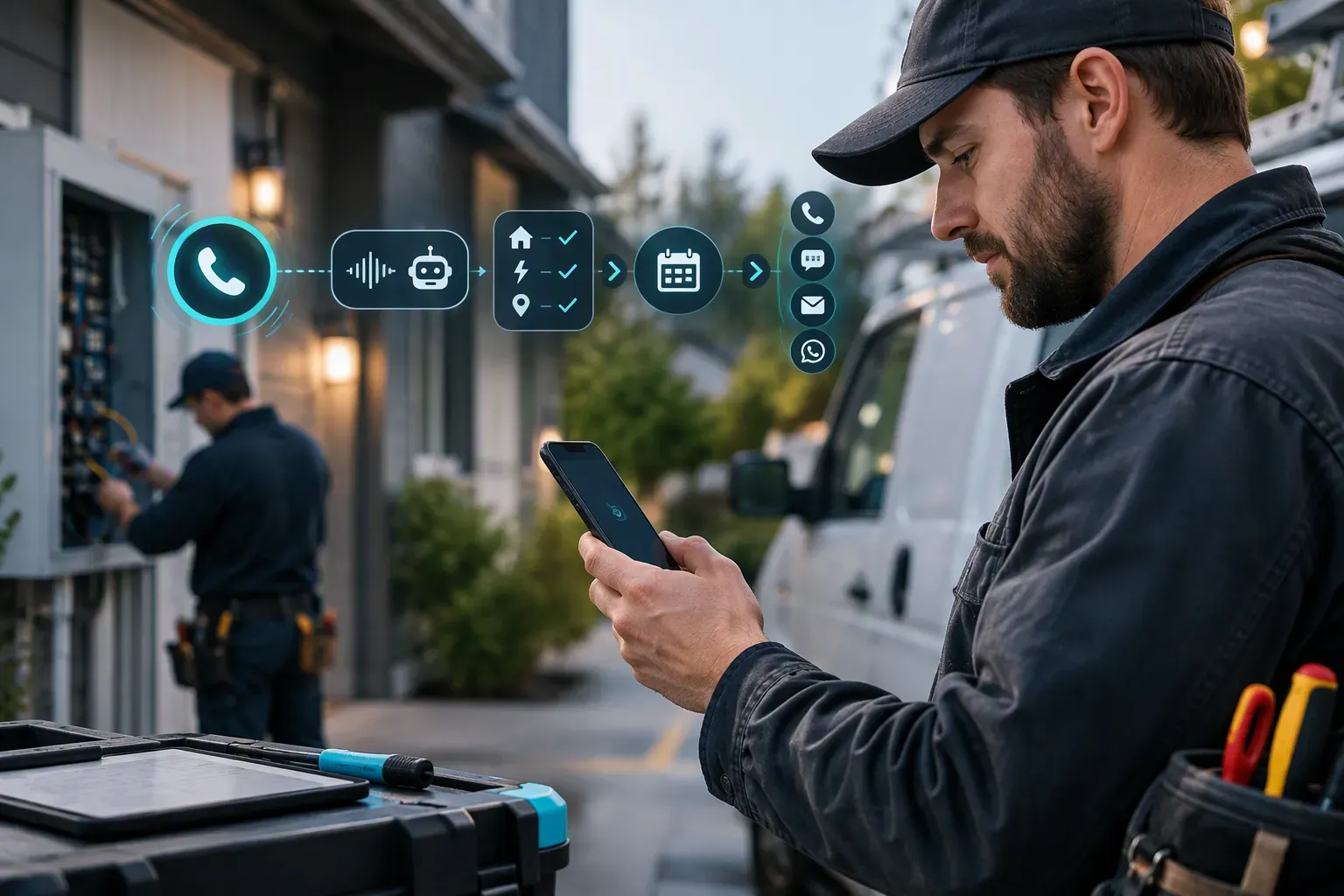
AI missed-call response for electrical contractors answers an unanswered service enquiry in under 60 seconds, qualifies the issue, property type, urgency, and address, then books an estimate on the connected calendar or routes urgent work. Voice, SMS, email, and WhatsApp follow-up keeps the lead moving when the electrical team is on a job.
Key takeaways
- Respond to the enquiry in under 60 seconds and give the caller a clear next step.
- Capture the issue, property or job type, urgency, and address before asking the team to call back.
- Use on-call qualification for budget, timeline, and pre-approval status where those details help the team prepare.
- Book routine estimates on the connected calendar instead of leaving the lead in a callback queue.
- Use a separate route for emergencies, complex requests, existing jobs, and callers who need a person.
Why AI missed-call response for electrical contractors matters after the ring stops
An unanswered call is not just a phone problem. It is an enquiry with no next step. A homeowner, landlord, or property manager wants to know whether you handle the work, whether it is urgent, and how to arrange an estimate. Voicemail puts the burden back on the caller.
According to Beginbound.com Missed Call Statistics AI (missed-call research), 85% of callers who reach voicemail never call back.
That finding is an external benchmark, not a Novacall AI customer result. Use it as a reason to inspect your own call flow, not as a forecast of your close rate.
Data from Pitchit.ai Electrical Industry Phone Statistics (field data) says field data indicates electrical contractors miss approximately 24% of incoming calls during standard work hours, usually because technicians are occupied on active job sites.
Published by Getlocalcall.com Does Missed Call Cost (research page), the page identifies itself as research on missed-call cost for a contractor.
Start with the missed-call path, not the tool
The practical question is not simply whether an AI assistant answers. Ask what happens from the missed ring to the next human decision. Does the caller receive a useful response? Does the workflow collect enough context to distinguish a routine estimate from a dangerous situation? Does the team know what the caller said and what action is expected?
In a typical electrical enquiry, the caller may describe the fault before giving a full address. Build the intake around that order: understand the problem, confirm the property or job type, clarify urgency, and then capture the location and preferred next step. Keep the questions natural rather than forcing the caller to translate a problem into an internal service code.
| Missed-call moment | Next action |
|---|---|
| Caller reaches voicemail | Start the configured follow-up workflow |
| Caller needs an estimate | Gather qualification details before booking |
| Caller describes urgent work | Use the urgent-work route instead of a routine estimate |
| Caller is ready to proceed | Offer an appointment on the connected calendar |
Finding: A missed call needs a useful next step, not just a recorded message.
What AI missed-call response for electrical contractors does after a missed call
Novacall AI turns missed-call handling into a connected workflow. The response uses voice, SMS, email, or WhatsApp, so the caller receives a path forward even when the electrical team is on an active job.
Novacall AI responds to inbound leads in under 60 seconds.
For electrical contractors, the workflow should follow this order:
- Respond: Acknowledge the enquiry and make clear that the caller reached the right business.
- Qualify: Ask about the issue, property or job type, urgency, and address. Add budget, timeline, and pre-approval questions when they help the team prepare.
- Book: Offer an estimate appointment through the connected calendar.
- Follow up: Continue the selected voice, SMS, email, or WhatsApp workflow until the caller replies, books, reaches an escalation path, or asks to stop.
- Record: Use CRM integration so the captured context is available when the team reviews the enquiry.
Novacall AI supports voice, SMS, email, and WhatsApp workflows.
Automatic follow-up matters because a callback request leaves the next action undefined. A booked estimate gives the contractor a scheduled opportunity to inspect the work and decide what happens next. It still does not guarantee that the caller will attend, accept the quote, or proceed with the job.
Design the intake around electrical intent
A useful intake is short enough for a caller who is busy, worried, or standing beside a fault. Start with the reason for the call, then establish whether the request concerns a new estimate, an existing job, planned work, or an urgent problem. The business can then decide which questions are necessary.
Consider a caller who missed the technician while requesting a consumer-unit replacement. The follow-up can acknowledge the missed call, confirm that the request is for a new estimate, ask about the property or job type, capture the desired timeline and pre-approval status, and offer a suitable appointment. If the caller instead describes smoke, active sparking, or immediate danger, the workflow should leave routine scheduling and follow the approved safety process.
When I review a single-call scenario, I listen for repetition. If the caller has already explained the issue, the next step should use that context rather than asking for the same description again. That is where CRM integration and a clear handoff improve the team's experience: the technician or office staff can see why the caller contacted the business before returning the call.
Finding: The best missed-call workflow captures enough detail to route the enquiry before a person has to repeat the intake.
Can AI missed-call response for electrical contractors book the right next step?
Yes. Novacall AI automatically books appointments on the connected calendar. The quality of that booking depends on the questions and rules used before the calendar appears. A generic appointment link does not replace qualification.
Novacall AI automatically books appointments on the connected calendar.
| Caller signal | Recommended next step |
|---|---|
| The caller describes a routine electrical issue | Capture the issue, property or job type, urgency, and address, then offer an estimate slot |
| The caller needs work handled urgently | Route the enquiry to the urgent-work process |
| The caller has an existing job | Ask for the job context and avoid a blind new-lead sequence |
| The caller is unsure what service is needed | Capture the description and route it for team review |
The qualification flow also supports budget and timeline questions where those details matter. Keep the questions in plain language. Callers describe problems in their own words, not in the categories used by a CRM.
Booking is not a won job. It is a scheduled chance to inspect, quote, and earn the work. Track what happens after the appointment instead of treating every calendar entry as revenue.
Treat booking as a handoff, not a win
Before opening calendar availability, decide which appointments the team actually wants. A routine estimate may need a different duration, location, or technician skill set from a fault-finding visit. If the calendar offers every slot to every caller, the automation can create scheduling work instead of removing it.
I treat the booked appointment as the beginning of an operational handoff. The record should make clear what the caller requested, what qualification information was captured, whether the request is urgent, and whether a person must review it before attendance. That review is particularly important when the caller is uncertain about the service required.
Finding: Appointment booking removes a handoff from the response path, but it does not guarantee a completed job.
How do you follow up without annoying returning customers?
An existing customer should not receive a blind sales sequence. Use CRM integration and the caller's reply to separate an existing job from a new electrical service enquiry. The first message should show that the business understands the difference.
Use a respectful follow-up sequence:
- Ask whether the caller needs help with an existing job or a new issue.
- Ask a useful question at a time instead of sending a long intake form.
- Stop routine reminders after a reply, booking, human escalation, or opt-out request.
- Offer a clear route to the team when the caller does not want automation.
Voice, SMS, email, and WhatsApp give the workflow more than one way to continue the conversation. The right channel is the one that matches the caller's response and the business's consent process.
Keep the return path clear
A returning customer may be calling about an invoice, a delayed visit, a warranty question, or a change to an existing appointment. Those requests should not be treated like a new sales opportunity. The workflow should identify the existing-job path early and make it easy for the caller to reach the team.
In a practical review, I test the same phone number as both a new enquiry and an existing-customer request. The important question is whether the conversation creates useful context or sends both callers through identical reminders. A short acknowledgement and a clear handoff usually serve the customer better than a long automated sequence.
Finding: Respectful automation gives returning customers a fast exit to a human or an existing-job path.
How fast should AI missed-call response for electrical contractors act?
Novacall AI provides 24/7/365 operation.
Novacall AI responds to inbound leads in under 60 seconds. That response standard covers the initial contact, not a guaranteed estimate arrival or job award.
After-hours and weekend calls need the same practical structure as daytime calls. The workflow should identify the business, collect the essential details, state the next step, and separate urgent work from routine scheduling. Around-the-clock operation helps only when the rules remain clear outside the office schedule.
Fast response earns attention. Relevant intake earns a usable lead. A short, specific first message is more useful than a fast message that asks the caller to start over.
I test after-hours behaviour separately from daytime behaviour because the available staff, calendar rules, and escalation contacts may be different. The caller should not be promised a response from a person who is not on call, and the workflow should not imply that routine scheduling is appropriate when the language indicates immediate danger.
Finding: Response speed opens the conversation; relevant qualification moves it toward a decision.
Can your team take over the conversation?
Your team should own exceptions, not every repetitive intake. Configure escalation rules for emergency language, existing jobs, unclear requests, upset callers, and direct requests for a person. Use CRM integration to keep captured details with the enquiry before the team takes over.
Do not assume that every AI tool supports live transfer in the same way. Confirm the handoff method during setup. The workflow should tell the team what happened, what the caller needs, and what action is expected next.
Define escalation ownership before launch
An escalation rule is only useful when someone owns the response. Decide who reviews urgent enquiries, who handles existing jobs, who checks unclear service descriptions, and what happens when the normal contact is unavailable. Write those decisions into the operating process instead of leaving them in an informal team conversation.
When we build a workflow, we put escalation rules beside the qualification questions so the system does not treat an urgent caller like a routine estimate request. I also check the wording of the handoff: “needs a person” is more useful when the team can see why the caller asked and what has already been captured.
What about gas leaks, burst pipes, or other emergencies?
Gas leaks, burst pipes, smoke, fire, active sparking, shock, or immediate danger must leave the normal booking flow. Set approved trigger words and route those calls according to your safety policy, on-call process, or emergency-services guidance.
AI cannot replace trained emergency judgment. That is a real limitation of this type of product. Use automation for structured intake and routing, not for diagnosing dangerous conditions or giving improvised technical instructions.
For an electrical contractor, the safest design is usually a clear boundary: routine enquiries can progress toward qualification and scheduling, while safety-related language triggers the approved emergency message and human or emergency-services route. The automation should not attempt to reassure the caller beyond what the business has reviewed.
Finding: Emergency handling is a separate intent and route, never a longer sales script.
How AI missed-call response for electrical contractors differs from an answering service
An answering service and an AI workflow address missed calls through different operating models. A traditional answering service focuses on answering, taking messages, or following a human-led script. Novacall AI adds on-call qualification, automatic calendar booking, CRM integration, and multi-channel follow-up.
| Work area | Practical difference |
|---|---|
| Initial response | A traditional service answers or takes a message; Novacall AI responds through a configured workflow |
| Qualification | A traditional service follows its script; Novacall AI supports AI qualification on the call |
| Booking | A traditional service depends on its calendar process; Novacall AI books on the connected calendar |
| Follow-up | A traditional service follows its staff process; Novacall AI supports voice, SMS, email, and WhatsApp workflows |
| Capacity planning | A traditional service uses a staffing arrangement; Novacall AI plans are tiered by daily call volume |
Novacall AI plans are quote-only. Every plan includes multi-channel follow-up, CRM integration, and calendar booking. Higher tiers include more voice minutes, more concurrent calls, and more AI agents. Match the plan to your call flow through a short quote call rather than guessing from a public price list.
Novacall AI plans are tiered by daily call volume and are quote-only.
Choose the operating model that fits the work. If the main need is message-taking, a traditional service may fit. If the goal is qualification, booking, follow-up, and structured routing, an AI workflow addresses more of the revenue path.
What conversion improvement is realistic after missed-call automation?
Do not use a generic conversion-rate promise. Electrical contractors have different service mixes, call sources, seasons, schedules, and definitions of a qualified lead. A benchmark from another business does not replace your own baseline.
The value of AI missed-call response for electrical contractors is measured by the enquiries that progress, not by how busy the assistant sounds.
| Measure | What it tells you |
|---|---|
| Responded enquiries | Whether missed calls receive a usable first response |
| Qualified enquiries | Whether the workflow captures enough context for review |
| Booked estimates | Whether callers reach a scheduled next step |
| Completed estimates | Whether scheduled opportunities survive the handoff |
| Won jobs | Whether the full sales and service process produces work |
Compare these stages by service type, urgency, call source, business hours, and existing-customer status. Record why an enquiry was lost. That shows whether the issue is response speed, service fit, schedule availability, price, or follow-through.
Novacall AI does not publish savings figures, ROI multiples, or payback periods. Measure your own response coverage and job progression instead of accepting an unsupported promise.
A sensible review starts with call records and ends with job outcomes. Listen to missed-call responses, inspect the captured fields, and check whether the appointment reached the right person. If the workflow produces many bookings but few completed estimates, the problem may sit in availability, travel time, qualification, or the team's follow-up rather than in the initial response.
Finding: Judge the workflow on booked, completed, and won stages rather than response volume alone.
What to check before choosing AI missed-call response for electrical contractors
Before choosing a tool, review the workflow from the caller's point of view and the team's point of view. Confirm that it handles the details an electrical service enquiry actually requires.
- Response: Inbound leads receive a response in under 60 seconds.
- Qualification: AI qualification on the call covers budget, timeline, property or job type, and pre-approval status; define how the business will also capture the issue, urgency, and address.
- Booking: The connected calendar shows the right estimate options.
- Routing: Urgent work, existing jobs, and requests for a person leave the normal sales path.
- Channels: Voice, SMS, email, and WhatsApp fit the way your customers communicate.
- Integration: Captured context reaches the CRM instead of staying in a separate inbox.
- Languages: Check whether the available language support suits the markets and callers the business serves; Novacall AI supports 15+ languages.
- Setup: Confirm whether same-day setup with no ramp period fits the launch plan.
- Consistency: Test whether the call experience remains consistent across routine scenarios.
- Privacy: Review consent, data handling, retention, and compliance requirements; Novacall AI is SOC 2 and GDPR compliant.
Listen to the actual voice experience. Read the follow-up messages. Test an ordinary service enquiry, an existing-job request, and an emergency route. The goal is not to make every call sound impressive. The goal is to give each caller a clear, safe, and useful next step.
I also recommend testing the calendar and CRM as a single process rather than reviewing them separately. A good conversation can still fail if the appointment lands with the wrong team, the time zone is unclear, or the captured context is not visible to the person preparing the estimate.
If unanswered electrical enquiries are leaving money on the table, book a discovery call to discuss how AI missed-call response for electrical contractors could fit your call flow.