AI Voice Agent for Home Services: 2026 Costs, Plans & ROI
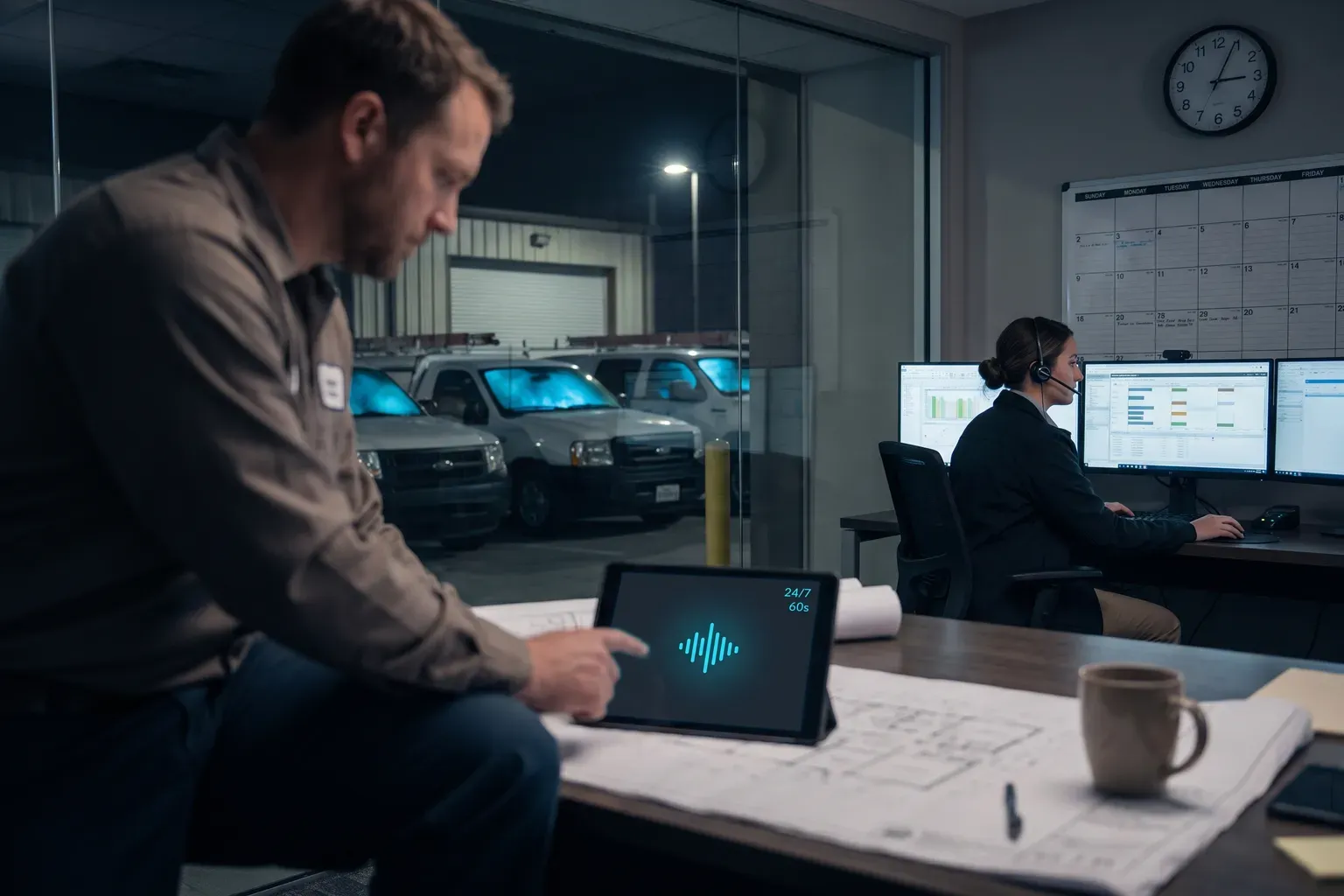 by Parvez Zoha
An AI voice agent for home services answers every inbound call in under 60 seconds, qualifies the caller on budget, timeline, and job type, then books the appointment directly on your calendar—all without a human touching the phone. It runs 24/7/365, speaks 15+ languages, and costs a fraction of a salaried inside sales agent. For HVAC, plumbing, and electrical contractors losing revenue to unanswered after-hours calls, this is the single highest-ROI investment available in 2026.
Key takeaways
- Novacall AI responds to inbound leads in under 60 seconds, operates around the clock, and handles voice, SMS, email, and WhatsApp follow-up automatically.
- Novacall AI pricing is by custom quote. Scope depends on lead and call volume, channels, integrations, and workflow. Book for a quote; current commercial terms are confirmed in a written proposal.
- The platform qualifies callers on budget, timeline, property or job type, and pre-approval status—on the call itself—then books directly to your connected calendar.
- Same-day setup with no ramp period means you capture calls the day you go live, unlike a human hire that takes 2 to 4 weeks to ramp.
Why are home-services businesses adopting AI voice agents now?
The labor math no longer works.
That shortage does not just affect field crews. It hits the phones too. When your two-person HVAC crew is on a rooftop at 2 p.m. and three calls come in simultaneously, nobody picks up. The caller moves to the next Google result. You paid for that click or that referral, and the revenue evaporated because a phone rang in an empty office.
In practice, the first sixty seconds of an inbound call decide whether it books. Callers with a burst pipe or a dead AC unit are not patient shoppers. They call the first three numbers they find, and the one that answers—with competence—wins the job.
How does an AI voice agent actually work on a service call?
Let's walk through what happens when a homeowner calls your number at 9:47 p.m. on a Tuesday because their furnace quit:
- Instant pickup. The AI agent answers in under 60 seconds—typically on the first ring. No hold music, no phone tree.
- Natural conversation. The caller describes the problem. The agent uses streaming speech recognition and neural voice synthesis to hold a natural, two-way conversation.
- Qualification. On the call itself, the agent asks about budget range, timeline urgency, property type, and (where relevant) pre-approval status. This is not a rigid script; it adapts based on what the caller says.
- Appointment booking. The agent checks your connected calendar for the next available slot and books the appointment right there—no callback needed.
- Multi-channel follow-up. After the call, the system sends a confirmation via SMS, email, or WhatsApp depending on the workflow you configured.
- CRM sync. The lead, qualification data, and appointment details push into your CRM automatically.
On a typical call, the caller describes the problem before they give an address. The AI handles that gracefully—it gathers the service need first, then circles back to location and scheduling details. That mirrors how a skilled dispatcher naturally converses, and it keeps the caller engaged instead of feeling interrogated.
What about outbound follow-up?
Novacall AI does not just wait for inbound calls. The platform executes outbound voice, SMS, and email sequences to re-engage leads who did not book on the first touch. Outbound numbers rotate at 50 calls per number per day on a round-robin to protect caller reputation—a detail that matters because carriers flag numbers that dial too aggressively.
What does an AI voice agent for home services cost in 2026?
Pricing is transparent and plan-based. Here is the full breakdown:
Every plan includes multi-channel follow-up, CRM integration, calendar booking, unlimited inbound calls, and 24/7 support (priority on Growth, dedicated on Pro, premium on Enterprise).
How do you pick the right plan?
The published sizing basis is daily call volume—nothing else. There is no lead-count cap, no headcount boundary, no revenue threshold.
| Plan | Daily Call Volume | Best Fit |
|---|---|---|
| Starter | ~20 calls/day | Solo operator, single-trade |
| Growth | ~60 calls/day | Small team, growing book |
| Pro | ~160 calls/day | Active team, multi-crew |
| Enterprise | ~450 calls/day | Multi-location or brokerage |
That maps directly to the Starter or Growth tier.
What are the overage rates?
If you exceed your included minutes, SMS, or emails, overages apply per unit:
Novacall AI capacity, included usage, and implementation scope are confirmed in your proposal. Book for a quote.
What is the realistic all-in cost?
Factoring in typical overages and add-ons at the daily call volumes above:
How does an AI voice agent compare to hiring a human inside sales agent?
This is the comparison that matters for an owner writing checks. A fully loaded human inside sales agent costs $50,000 to $80,000 per year (BLS and Glassdoor), works 8 hours a day, 5 days a week, handles 30 to 50 calls per day, and takes 2 to 4 weeks to ramp.
Novacall AI works 24/7/365, handles unlimited inbound calls, delivers identical call quality on every call, and requires same-day setup with no ramp period.
The platform is 3–6x cheaper than a human ISA from day one. The savings compound in year 2 onward:
human equivalent
human equivalent
human equivalent
human equivalent
Those are not hypothetical projections—they are arithmetic comparisons between published plan costs and published BLS/Glassdoor salary ranges for the number of human agents you would need to cover the same daily call volume.
HVAC contractors
An AI voice agent absorbs that spike without overtime, burnout, or dropped calls.
Plumbing companies
Plumbing emergencies happen at 2 a.m. A burst pipe does not wait for business hours. The AI agent picks up instantly, confirms the emergency, books the next available slot, and sends the homeowner a confirmation text—all while your team sleeps. In the morning, the calendar is populated and the CRM has full qualification notes.
Electrical contractors
Electrical work often involves permit timelines and inspection scheduling. The AI qualifies whether the caller needs a panel upgrade, outlet install, or whole-home rewire, captures the property type, and books the estimate appointment. That pre-qualification means your estimator arrives prepared, shortening the sales cycle.
What are the real limitations of AI voice agents?
But edge cases exist. A caller with a complex multi-system problem who needs a 15-minute consultative conversation with a senior technician will not get that from an AI agent today. The right architecture is AI-first for speed and coverage, with a warm-transfer path to a human for the calls that genuinely need one.
In our experience, teams underestimate how many callers abandon a phone menu. The AI eliminates that friction entirely—no menus, no hold queues—but it does not replace the deep technical consultation that a master plumber or journeyman electrician provides. It replaces the dispatcher and the after-hours answering service, not the expert.
How does Novacall AI compare to other solutions?
The market now has several AI voice agent providers targeting home services.
Here is how Novacall AI differentiates:
| Capability | Novacall AI | Traditional Answering Service | Basic IVR/Phone Tree |
|---|---|---|---|
| Response time | Under 60 seconds | Varies by operator availability | Immediate but menu-driven |
| Qualification on call | Budget, timeline, job type, pre-approval | Message-taking only | No qualification |
| Appointment booking | Direct calendar integration | Callback required | No booking |
| After-hours coverage | 24/7/365 | Often limited overnight | 24/7 but no conversation |
| Multi-channel follow-up | Voice, SMS, email, WhatsApp | None or SMS only | None |
| Languages | 15+ | Depends on staff | Limited |
| CRM integration | Included every plan | Rarely included | Rarely included |
| Consistency | Identical every call | Variable by operator | Consistent but rigid |
The key difference is that Novacall AI does not just answer—it qualifies, books, and follows up. A traditional answering service takes a message and hopes someone calls back. A phone tree routes but never converses.
How do you implement an AI voice agent without disrupting operations?
Novacall AI offers same-day setup with no ramp period. Here is the practical implementation path:
Step 1: Forward your number or port it. Most contractors start by forwarding overflow or after-hours calls to the AI number. This lets you test without changing your main line.
Step 2: Configure qualification questions. Tell the system what you need to know: service type, urgency, property size, budget range. The AI adapts its conversation flow accordingly.
Step 3: Connect your calendar. The agent books directly into available slots. If you block Sundays, it will not offer Sundays.
Step 4: Connect your CRM. Lead data, call recordings, and qualification notes push automatically.
Step 5: Set up multi-channel follow-up. Define your SMS confirmation template, email follow-up sequence, and any WhatsApp workflows.
There is no 2-to-4-week ramp. The AI does not need to shadow your best dispatcher for two weeks. It is ready on day one.
What about compliance?
Novacall AI is SOC 2 and GDPR compliant. For home services businesses handling customer addresses, phone numbers, and payment discussions, that compliance baseline matters—especially if you serve commercial accounts with vendor security requirements.
What does the ROI math look like for a typical HVAC contractor?
- Year 1 total: about $16,700
- **Year 2 savings vs.
Now assume a hypothetical average job ticket of $500 (illustrative, not a product claim). If the AI captures even 2 additional jobs per week that would have gone to voicemail, that revenue recovery can substantially exceed the $14,700 year-2 cost. The math works even with conservative assumptions.
But the real ROI is not just cost savings. It is the revenue you stop losing. Every unanswered call is a customer who called your competitor instead. The AI ensures zero missed calls, 24/7/365.
How do outbound numbers and concurrent calls work?
Two add-ons deserve explanation because they affect how the system scales:
This rotation strategy is not cosmetic. Carrier spam filters have become aggressive. A number dialing 200 outbound calls in a day will get flagged, and your answer rates plummet. The round-robin keeps each number well under thresholds.
What should you look for when evaluating AI voice agents?
Not all AI voice agents are equal. Here is a decision framework:
1. Does it qualify on the call, or just take messages? Message-taking is a commodity. Qualification—budget, timeline, job type—is where value lives. Novacall AI qualifies on the call itself.
2. Does it book appointments directly? If the caller has to wait for a callback to schedule, you lose a percentage of them. Direct calendar booking eliminates that drop-off.
3. Does it handle multi-channel follow-up? A single touchpoint is not enough. The system should confirm via SMS, nurture via email, and re-engage via outbound voice.
4. What is the response time? Under 60 seconds is the standard Novacall AI delivers. Anything over two minutes and you are losing callers.
5. Is pricing transparent? You should know your monthly fee, included minutes, overage rates, and add-on costs before you sign. Novacall AI publishes all of this.
6. Is there a ramp period? A system that takes weeks to configure is weeks of missed calls. Same-day setup is the standard to demand.
7. Does it integrate with your CRM? If lead data does not flow automatically into your existing system, you are creating manual work that defeats the purpose.
The scale at which AI is entering home services is not experimental—it is operational.
How to get started with Novacall AI
If you are an HVAC, plumbing, electrical, or landscaping business losing calls after hours—or even during hours when your team is in the field—the path forward is straightforward:
- Identify your daily call volume. Count inbound calls over a typical week and divide by working days. That number tells you which plan fits.
- Calculate your current cost of missed calls. Even a rough estimate helps. If you miss 5 calls a day and your close rate is 30% on a $400 average ticket, that is illustrative lost revenue of $600/day—assume those numbers are hypothetical for your own business.
- Book a call with the Novacall AI team. They will walk through your call volume, configure qualification questions for your trade, and get you live the same day.
- Start with overflow or after-hours. You do not have to go all-in on day one. Forward calls that currently go to voicemail and measure the bookings that come back.
The businesses winning in 2026 are not the ones with the biggest crews. They are the ones that answer every call, qualify every lead, and book every appointment—automatically, around the clock. That is what an AI voice agent delivers.
Frequently asked questions about AI voice agents for home services
Can the AI handle emergency calls differently from routine maintenance requests?
Yes. The qualification logic distinguishes urgency. A caller reporting a gas smell or burst pipe gets flagged as emergency and routed to your on-call protocol. A caller requesting a spring tune-up gets booked into your next available maintenance slot. The system adapts its conversation based on what the caller describes.
What happens if the AI cannot answer a caller's question?
The platform supports warm transfer to a human. If a caller asks something outside the AI's configured knowledge—say, a detailed technical question about a specific furnace model's warranty—the system can transfer to your team or take a message with full context so the callback is informed.
Do callers know they are talking to an AI?
The neural voice synthesis is natural-sounding, but transparency matters. Most businesses configure a brief disclosure at the start of the call. In practice, callers care far more about getting their problem solved quickly than about whether the voice is human or AI. An AI that answers immediately beats a human who never picks up.
How does the system handle Spanish-speaking callers?
Novacall AI supports 15+ languages. If a caller begins speaking Spanish, the system responds in Spanish—qualification, booking, and follow-up all happen in the caller's preferred language. For contractors in markets with significant Spanish-speaking populations, this eliminates a major service gap without hiring bilingual staff.
What if my call volume is seasonal?
Home services are inherently seasonal. HVAC spikes in summer and winter. Landscaping peaks in spring. The plan structure handles this because you pay a base monthly fee with included minutes, and overages cover spikes. You are not locked into paying for peak-season staffing year-round the way you would be with a salaried hire.
Is there a contract or can I cancel monthly?
The published pricing is monthly with a one-time setup fee. The setup fee covers configuration, integration, and go-live support. Contact the team directly for contract terms specific to your situation when you Book a call.
The bottom line: an AI voice agent is not a future technology for home services. It is a present-tense operational tool that answers every call, qualifies every lead, and books every appointment—at a fraction of what a human team costs. The businesses deploying it now are capturing the calls their competitors are still sending to voicemail.
What integrations should your AI voice agent home services platform support?
Your AI voice agent needs to plug into the tools you already use, or it creates more work instead of less. Most home-services businesses run on a combination of scheduling software, CRM platforms, payment processors, and field-service management tools. The agent should write directly to these systems without requiring manual data entry.
Look for native integrations with ServiceTitan, Housecall Pro, Jobber, and FieldEdge if you're in HVAC, plumbing, or electrical work. Landscaping companies typically need connections to LMN, Aspire, or Service Autopilot. The integration should create job records, update customer profiles, and trigger dispatch workflows automatically when the AI books an appointment.
API access matters when your stack includes custom or niche software. A flexible platform will offer webhook support and Zapier compatibility so you can bridge gaps without hiring a developer. Calendar sync with Google Calendar, Outlook, or Apple Calendar prevents double-bookings when your techs update availability in the field.
Payment links and text-message confirmations should flow from the same conversation. If your AI voice agent home services solution can't send a booking confirmation with a deposit request immediately after the call, you'll lose jobs to competitors who can.
How do seasonal demand spikes affect AI voice agent pricing?
Home-services businesses face predictable surges—HVAC companies during summer heat waves, plumbers during freeze events, landscapers in spring. Your AI voice agent should scale instantly without requiring you to upgrade plans or negotiate with a vendor during a crisis.
This is usually still cheaper than missing calls or hiring temp staff, but it's not always predictable. Review your contract for surge pricing clauses or throttling policies that might kick in during peak periods.
Some providers offer reserved capacity plans where you pay a higher base rate in exchange for guaranteed concurrent-call limits and no overage penalties. This makes sense if your business has sharp seasonal peaks—think a roofing company after a hailstorm or a generator installer during hurricane season.
Test your system before peak season hits. Run a simulated high-volume day to confirm the AI maintains quality when handling back-to-back calls. Latency, dropped context, and booking errors become more common when systems are under load, and you won't know until it's too late if you wait for real demand to test it.
What call-quality metrics should you monitor after deployment?
Deployment is not the finish line. You need ongoing visibility into how your AI voice agent home services system performs in real conversations, not just vendor-provided uptime dashboards.
Track first-call resolution rate—the percentage of callers who get their question answered or appointment booked without needing a callback. Listen to the recordings of escalated calls to identify gaps in the AI's knowledge base or script logic.
Monitor average handle time, but don't optimize for speed alone. Compare handle time across call types—quote requests should take longer than simple reschedules.
Appointment no-show rate reveals whether your AI is setting clear expectations. If no-shows jump after you deploy the agent, the AI may be glossing over arrival windows, service fees, or preparation steps the customer needs to take. Cross-reference no-show rates with the specific phrases the AI uses during booking confirmation.
Caller sentiment scores, when available, help you catch tone problems early. Some platforms offer post-call surveys or sentiment analysis on recordings. A dip in sentiment often precedes a dip in conversion, giving you time to adjust scripts before revenue suffers.
How should you train your team to work alongside an AI voice agent?
Your technicians and office staff need to understand what the AI can and cannot do, or they'll either ignore it or blame it for problems it didn't cause. Start with a 30-minute walkthrough showing real call recordings—both successful bookings and escalations—so everyone hears how the AI represents your business.
Define clear handoff protocols for calls the AI transfers to a human. The AI should pass context—customer name, issue summary, and any scheduling constraints already discussed—so your team member doesn't make the caller repeat themselves. Frustration spikes when a customer explains their problem twice.
Establish a feedback loop where techs and dispatchers report AI mistakes directly into a shared tracker. If the AI consistently misquotes your service-call fee or books jobs in zip codes you don't serve, you need to catch that within days, not months. Assign one person to review this feedback weekly and update the AI's configuration.
Teach your team to listen for AI-generated bookings in your CRM and treat them as warm leads, not cold data. A customer who just spoke to an AI is expecting a confirmation text and a human follow-up if anything changes. Missed follow-through after a successful AI booking wastes the entire investment.
What compliance risks exist when using AI voice agents in home services?
Recording laws vary by state, and your AI voice agent home services platform must announce call recording in two-party consent states like California, Florida, and Pennsylvania. The AI should state "This call may be recorded" within the first few seconds, and the platform should log consent as part of the call metadata.
TCPA regulations apply to outbound calls, even when an AI makes them. You need documented prior express consent before your AI calls a customer's mobile number for marketing or appointment reminders. This usually means a signed service agreement or a web form with clear opt-in language.
Data retention policies matter when your AI stores recordings and transcripts. Some states require you to delete call recordings after a certain period unless you have a legitimate business reason to keep them. Your contract should specify where recordings are stored, who can access them, and how long they're retained.
ADA compliance is emerging as a concern for voice AI. If your system can't accommodate callers with speech impairments or hearing difficulties, you may need a clearly advertised human fallback option. This isn't yet heavily litigated, but the legal landscape is evolving quickly.
Why is workforce scarcity accelerating AI voice agent adoption in home services?
The skilled trades labor shortage has reached a structural tipping point that makes automation no longer optional. According to Marketintelo.com Vertical SaaS Home Services (direct report), Bureau of Labor Statistics projects shortfalls of more than 400,000 skilled trades workers across HVAC, plumbing, and electrical occupations by 2030, a structural constraint that is forcing home services businesses to extract greater output per existing technician rather than simply hiring their way to growth. This demographic reality means contractors cannot simply hire more dispatchers or inside sales representatives to handle call volume during peak season. AI voice agent home services solutions address this constraint by scaling intake capacity without adding headcount.
The economics shift when you cannot find qualified staff at any price. A contractor facing 30 missed calls per week during cooling season is not choosing between AI and a human receptionist—they are choosing between AI and lost revenue. The labor constraint makes the comparison moot.
What independent benchmarks exist for AI voice agent home services performance?
Third-party validation matters when evaluating mission-critical systems. According to Craftflow.com AI Voice Agent Benchmark (direct report), AI Voice Agent Benchmark for Home Services An evaluation of the four leading AI voice agent providers across 10,000 real production calls from HVAC, plumbing, and electrical companies. Independent benchmarks like this provide apples-to-apples comparisons on metrics that matter: booking rate, average handle time, escalation accuracy, and caller satisfaction scores.
Look for benchmarks that disclose methodology, sample size, and call mix. A provider-funded case study showing 95% booking rates on pre-qualified leads tells you nothing about performance on cold inbound calls from price shoppers. Real-world benchmarks include wrong-number calls, spam, customers calling to pay invoices, and other non-bookable interactions that inflate denominator counts but reflect actual operating conditions.
The best benchmarks segment performance by call type, time of day, and trade vertical. HVAC emergency calls at 9 PM require different handling than landscaping estimate requests at 2 PM. A single aggregate score obscures these differences.
When does it make sense to delay implementing an AI voice agent for home services?
Not every contractor should adopt AI voice agents immediately. If your current team answers 95% of calls within three rings and books 70% of qualified opportunities, the incremental gain from AI may not justify the implementation effort.
Shops with highly complex service menus that change weekly face integration challenges. If your pricing depends on real-time parts availability checks across multiple suppliers, or if you offer dozens of service tiers with conditional eligibility rules, the configuration burden may outweigh near-term benefits. These businesses should wait for more sophisticated integration capabilities or simplify their service catalog first.
Companies in the middle of major operational changes—switching field service management platforms, merging with another business, or restructuring service territories—should stabilize before adding another variable. Implementing AI voice agents during a CRM migration creates compounding risk and makes it impossible to isolate the source of any problems.
What market forces are making 2026 the critical adoption year for AI voice agent home services?
Multiple tailwinds are converging to make this year decisive. According to Leapingai.com Home Services Trends Why (direct report), Why 2026 Is the Inflection Point Several converging factors make 2026 the year that voice AI transitions from competitive advantage to competitive requirement for home services contractors. These factors include maturation of natural language models, widespread consumer acceptance of AI interactions, and the compounding effect of labor shortages as experienced dispatchers retire.
The technology itself has crossed a usability threshold. Early AI voice agents required extensive training, frequent intervention, and constant tuning. Current systems handle regional accents, background noise, and conversational interruptions without degrading performance. This reliability shift moves AI voice agents from "experimental" to "production-ready" in the eyes of risk-averse contractors.
Competitive pressure amplifies the urgency. When your competitor answers every call in 12 seconds while your customers wait on hold, the service gap becomes a market share gap. Contractors who delay adoption are not maintaining status quo—they are falling behind a rising baseline for customer experience expectations.
How do you audit your current call handling before implementing AI?
Baseline measurement prevents false attribution and sets realistic expectations. Record and categorize 200 consecutive inbound calls across different days and times. Tag each call by type: new customer inquiry, existing customer service request, payment question, wrong number, spam. Measure answer rate, average speed to answer, call duration, and outcome for each category.
Calculate your current booking rate only on bookable calls—exclude wrong numbers, payment inquiries, and calls requesting services you do not offer. This denominator correction prevents unfair comparisons when evaluating AI performance. If you book 40 jobs from 100 total calls but 30 calls were non-bookable, your true booking rate is 57%, not 40%.
Identify your most common failure modes. Do you miss calls during lunch? Do evening calls go to voicemail? Do callers abandon after 45 seconds on hold? These patterns reveal where AI delivers maximum impact and help you configure routing rules that complement rather than replace human strengths.