Do AI Phone Agents Work for Home Service Businesses? The Booking Test
 by Parvez Zoha
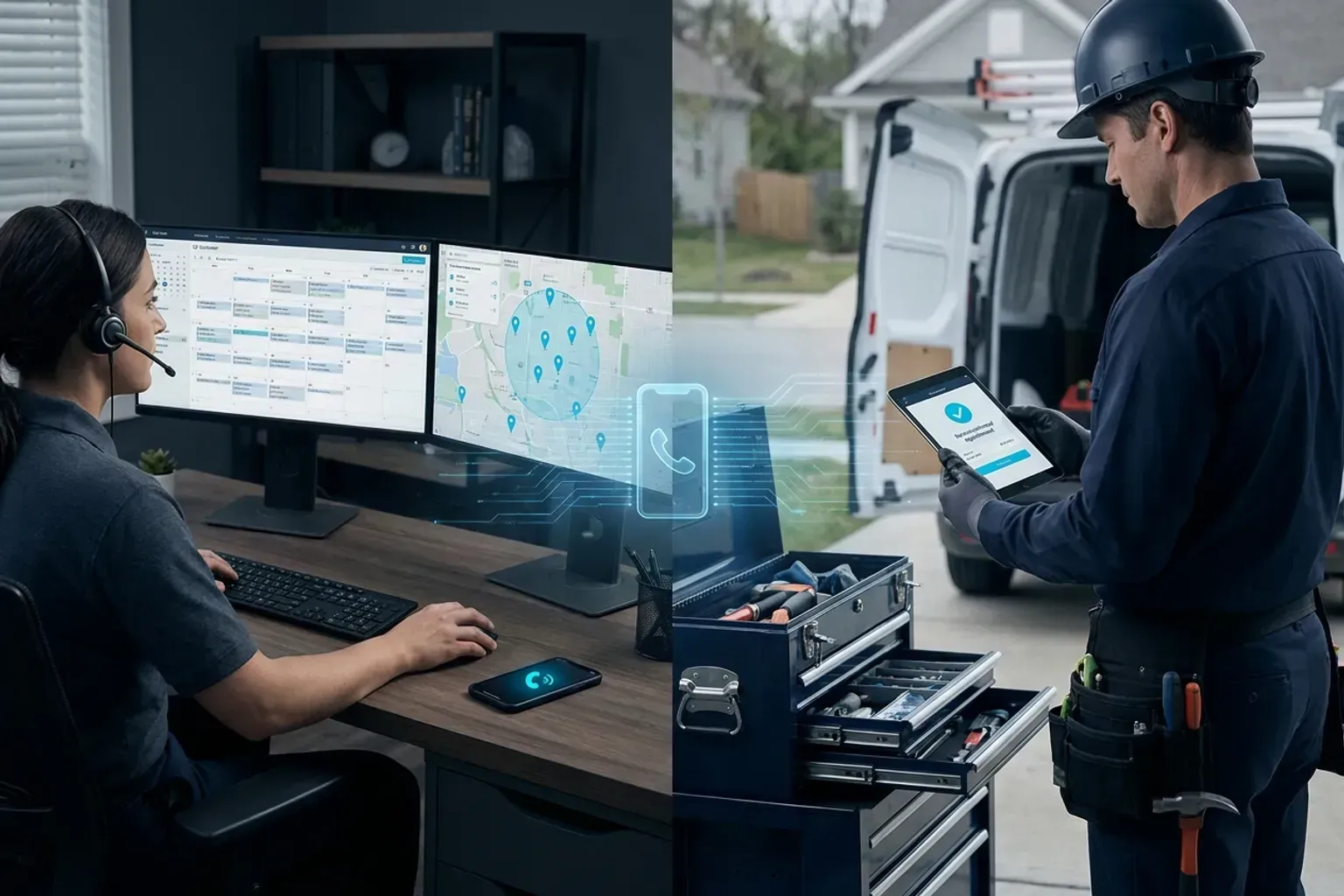
Yes—AI phone agents can book jobs for home-service businesses, but only when “book” means a clearly defined appointment workflow rather than an autonomous replacement for every dispatcher, estimator, or technician. The agent needs accurate service-area rules, job-type questions, calendar availability, pricing boundaries, and a reliable path to a human when the call falls outside those rules.
For a plumbing, HVAC, electrical, roofing, cleaning, landscaping, or similar company, the practical test is simple: can the caller be identified, qualified, matched to an appropriate appointment type, and given a confirmed next step without creating operational risk? If yes, an AI phone agent can handle that slice of demand. If the call requires diagnosis, negotiation, emergency judgment, or a custom estimate, the agent should collect context and hand the conversation to a person.
Key takeaways
- AI phone agents are best at structured inbound conversations: answering common questions, collecting job details, qualifying prospects, and booking from connected calendar availability.
- Booking quality depends more on business rules and calendar design than on a convincing voice.
- A useful agent must know service areas, job categories, hours, appointment types, preparation instructions, and escalation triggers.
- Human review remains important for emergencies, uncertain symptoms, disputed charges, unusual properties, vulnerable callers, and requests outside the approved service menu.
- Novacall AI states that its platform responds to inbound leads in under 60 seconds, operates 24/7/365, qualifies callers on budget, timeline, property or job type, and pre-approval status, and automatically books on a connected calendar.
- The safest rollout starts with one service line or call type, then expands after reviewing recordings, dispositions, booked appointments, cancellations, and handoffs.
- The target keyword is a useful buyer question, but the answer is operational: do AI phone agents work for home service businesses only when the workflow is designed around the business’s actual constraints?
What does “book a job” actually mean?
Owners often use “book a job” to describe several different outcomes. Separating them prevents inflated expectations and makes an AI phone agent easier to evaluate.
| Booking outcome | What the agent does | Human involvement |
|---|---|---|
| Lead capture | Records caller details and the reason for calling | Review may happen later |
| Qualified opportunity | Confirms service type, location, timing, and other approved questions | Review exceptions |
| Estimate appointment | Books an inspection or estimate slot | Estimator handles the visit |
| Service appointment | Books a defined service window for an eligible job | Dispatcher or technician handles fulfillment |
| Emergency escalation | Identifies a potential emergency and routes it according to policy | Immediate human or emergency process |
| Follow-up booking | Re-engages a missed or unready lead and schedules a next step | Review if the caller objects or changes scope |
The strongest initial use case is usually a defined appointment, not a promise that the agent can diagnose the problem or guarantee the final price. For example, an HVAC company might allow an agent to book a maintenance visit or a diagnostic appointment, while routing refrigerant leaks, unsafe conditions, warranty disputes, and complex commercial requests to a human.
A roofing company may allow the agent to book an inspection after confirming the property location and service area. A cleaning company may allow direct booking when the home size, service type, frequency, and access requirements fit approved categories. An electrician may book a standard service visit while escalating panel replacements, suspected hazards, and projects that require an estimate.
The important distinction is between scheduling a qualified next step and closing a technically complex job. Owners asking “do AI phone agents work for home service businesses” should define the intended booking event before comparing vendors.
Finding 1: The safest definition of an AI-booked job is a confirmed, qualified next step—not an unsupported promise about the final work, price, or outcome.
Why can an AI phone agent succeed on home-service calls?
Home-service calls contain recurring patterns. Customers often need the same basic information: whether the company serves their location, whether the company handles a particular job type, what appointment windows are available, what information to prepare, and what happens next.
That structure gives an agent a useful operating boundary. It can ask approved questions in a consistent order, identify missing information, and offer available appointment types. It can also send follow-up messages when the caller needs to provide an address, confirm a time, or continue after a missed call.
Novacall AI’s published product evidence says its workflows support voice, SMS, email, and WhatsApp, with CRM integration and calendar booking included on every plan. Those facts describe available platform functions; they do not mean every business should activate every channel or that every call should be automated.
External adoption signals suggest that AI is moving into customer-service workflows, but adoption is not proof that any particular implementation books good jobs. Calljolt reports that the share of home-service contractors using some form of AI-powered technology more than doubled between 2023 and 2026 among businesses with more than $500K in annual revenue: Calljolt.com AI Adoption Home Services. That supports testing the category, not skipping operational design.
Likewise, Worldmetrics reports that companies are rapidly adopting AI agents for support work and associates that adoption with improving satisfaction and cutting costs: Worldmetrics.org Ai Customer Service Agent. The excerpt does not establish that a voice agent will book a job for your company, so the practical conclusion remains conditional: validate your own workflow.
The repeatability advantage
A human dispatcher may know the business well but still face interruptions, call queues, schedule pressure, and inconsistent documentation. An AI agent can apply the same approved questions on each eligible call. That consistency is valuable when the business has a clear service catalog and appointment structure.
Consistency does not automatically equal correctness. If the rule is wrong, the agent can repeat the wrong rule consistently. If the calendar is stale, it can offer unsuitable availability. If the service area is vague, it can create leads the field team cannot serve.
The speed advantage
Speed matters most when a caller is ready to act. Novacall AI states that inbound lead response occurs in under 60 seconds and that the platform operates 24/7/365. Those are product claims from the published brand evidence, not a guarantee of booked-job performance for every business.
A fast answer is useful only if the next step is accurate. A rapid appointment booked with the wrong technician, wrong territory, or wrong job type can create more work than a slower but correct handoff.
Finding 2: Response speed is an advantage only when the agent can convert speed into a correct disposition, appointment, or escalation.
What rules must be configured before booking?
An agent should not be launched with a vague instruction such as “book more jobs.” It needs a working policy. The policy should be written in ordinary language, reviewed by the owner or operations lead, and tested against real call scenarios.
Service-area rules
Define the locations the business serves. Depending on the operation, that may include ZIP codes, cities, counties, travel zones, or distance limits. Specify what happens when an address is incomplete, outside the normal area, or close to a boundary.
The agent should not improvise whether a location is acceptable. If there are different fees, appointment windows, or technician assignments by territory, those rules need to be explicit.
Job-type rules
Create a controlled list of services the agent may schedule. Use customer-friendly names and internal appointment names. Include synonyms callers may use, but do not let the agent treat every vague description as an eligible job.
For example, “air conditioner not cooling” might map to a diagnostic visit, while “replace the entire system” might require an estimate. “Outlet sparks” may require immediate escalation rather than routine booking. The right outcome depends on the company’s safety policy and service model.
Qualification questions
Keep questions relevant to the booking decision. Novacall AI states that its AI qualification can cover budget, timeline, property or job type, and pre-approval status. For home services, the business may additionally need address, access details, equipment type, approximate age, number of affected areas, occupancy, and whether the issue is active or historical.
Do not turn qualification into an interrogation. Ask only what changes the next step, helps route the job, or protects the customer and field team.
Calendar rules
The calendar must reflect reality. Configure appointment types, durations, buffers, territories, technician skills, working hours, holidays, and any requirement for office review. If a visit requires a specific truck, certification, tool, or crew size, the calendar workflow needs to account for that constraint.
A connected calendar is not the same as a complete dispatch system. The agent may be able to book an available slot, but the business remains responsible for deciding which slots are genuinely bookable.
Pricing and promise rules
Decide what the agent may say about prices. If the business uses fixed service-call fees, published inspection prices, or approved ranges, document the wording. If final pricing depends on diagnosis or an onsite estimate, the agent should say so clearly.
Never allow the agent to invent discounts, warranties, arrival guarantees, refund promises, or technical conclusions. A customer who hears a confident but unauthorized promise will judge the business—not the software—when the promise fails.
Escalation rules
List the calls that must reach a person. Include emergencies, suspected gas or electrical hazards, active flooding, threats, complaints, payment disputes, legal questions, accessibility needs, language situations the workflow cannot support, and any caller who asks for a human.
The exact list will vary by trade. The principle does not: uncertainty should reduce automation, not increase it.
Which home-service calls should stay human-led?
AI phone agents work best when the company separates routine scheduling from judgment-heavy work. A human should usually review or handle calls involving safety, liability, emotional distress, complex diagnosis, unusual scope, or conflict.
| Call situation | Recommended handling | Why |
|---|---|---|
| Routine maintenance request | Agent may qualify and book | Defined service and appointment type |
| Standard cleaning request | Agent may qualify and book if scope fits | Repeatable questions and service menu |
| Property outside service area | Agent should decline or route | Avoids unusable appointments |
| Suspected gas, fire, electrical, or structural danger | Immediate human or emergency instruction | Safety judgment is outside routine booking |
| Angry customer or disputed invoice | Human review | Requires empathy, authority, and account context |
| Complex remodel or commercial project | Lead capture plus human follow-up | Scope and estimating may be custom |
| Caller cannot describe the issue | Human or carefully limited intake | Avoids false classification |
| Request for a guaranteed price | Human or approved price policy | Prevents unauthorized promises |
| Caller asks for a person | Prompt human handoff | Customer preference is itself a valid trigger |
The agent can still help before the handoff. It can collect the address, summarize the concern, identify urgency, and preserve the caller’s information. That makes the human conversation more productive without pretending the agent can resolve everything.
In practice, the quality of the handoff often matters more than the quality of the automated greeting. A short, accurate summary—service requested, location, urgency, availability, and caller concern—can save a dispatcher from repeating basic questions.
Emergency language needs special care
Home-service businesses should define what the caller must do immediately when a situation could be dangerous. The agent should not diagnose hazards or substitute for emergency services. The approved script should be written with the owner, operations lead, and—where appropriate—relevant safety professionals.
Avoid ambiguous language such as “we’ll get someone out soon” when the business cannot guarantee that outcome. Tell the agent exactly when to stop routine booking and follow the approved emergency path.
Human preference is a legitimate escalation
Some callers simply prefer a person. Fighting that preference can create friction without improving the workflow. A clear “press or say human” path, with context preserved, is usually more useful than forcing the caller through repeated automation.
Finding 3: A capable AI phone agent does not eliminate human involvement; it makes the boundary between routine work and judgment work explicit.
How should the booking conversation be designed?
A good conversation is short, purposeful, and transparent. It should tell the caller who—or what—is answering, understand the reason for the call, ask the minimum qualifying questions, present a valid next step, confirm the details, and explain what happens afterward.
A practical call structure
- Opening: Identify the business and the automated assistant.
- Intent: Ask what the caller needs help with.
- Eligibility: Confirm service area and job category.
- Qualification: Ask only the questions required for routing or booking.
- Safety check: Identify urgent conditions that require escalation.
- Appointment choice: Offer approved appointment types and available times.
- Confirmation: Repeat the date, time, address, service type, and preparation instructions.
- Handoff or follow-up: Explain whether a technician, estimator, or office team will contact the caller.
Do not hide the operational next step
The caller should know whether they booked a service visit, an estimate, a diagnostic appointment, or a callback. “You’re all set” is not enough if the business has several appointment types with different expectations.
Use plain confirmation language. For example: “You are scheduled for a diagnostic visit on Tuesday between 10 and 12 at the address you provided. The technician will assess the issue onsite; the final repair recommendation and price depend on that assessment.” The exact script should match the company’s policy.
Confirmation reduces avoidable errors
Have the agent repeat details that commonly cause dispatch problems: spelling of the name, street address, unit number, phone number, job category, access instructions, and appointment window. If the caller corrects a detail, the system should update the record before ending the call.
A confirmation message can also provide preparation instructions. For a cleaning appointment, that might mean access information. For an HVAC visit, it might mean having equipment access available. The business should approve every instruction.
Follow-up is part of booking
A caller who is not ready to schedule may still be a viable opportunity. A carefully timed SMS, email, or WhatsApp follow-up can provide the requested information and invite the caller to continue. Novacall AI states that every plan includes multi-channel follow-up, and its product evidence lists voice, SMS, email, and WhatsApp workflows.
Follow-up must respect the company’s consent practices and customer preferences. It should be relevant, easy to understand, and clear about the business sending it.
How do you evaluate whether the agent actually books good jobs?
Do not judge the system by whether it sounds human. Judge it by whether it produces operationally useful outcomes. The evaluation should cover the entire path from ringing phone to completed appointment or correctly escalated conversation.
Build a disposition framework
Use a small, consistent set of outcomes. Possible dispositions include:
- Booked eligible appointment
- Booked appointment requiring review
- Qualified lead awaiting human contact
- Outside service area
- Unsupported service
- Emergency escalation
- Caller requested human
- Duplicate or existing customer
- No appointment available
- Information-only call
- Incorrect or incomplete details
The categories should be specific enough to identify problems but not so numerous that the team stops using them consistently.
Review booking accuracy
Sample calls and compare the conversation with the resulting record. Check whether the service type, location, time, contact details, and appointment type are correct. Also check whether the booked slot was operationally feasible.
The key question is not “Did the agent book something?” It is “Did the agent book the right next step under the right conditions?”
Review handoff quality
A handoff should preserve useful context. Review whether the human received the caller’s intent, urgency, property or job type, key qualification answers, requested time, and reason for escalation. Listen for moments where the caller repeated information because the summary was incomplete.
Review customer experience
Look for interruptions, confusing wording, excessive questions, missed objections, repeated confirmations, and unclear promises. A caller may accept an appointment but still feel frustrated. Customer feedback, cancellation reasons, and complaint notes can reveal issues that booking counts miss.
The Digitalapplied.com Customer Service AI Agent report cites a small CSAT difference between pure-AI and human handling in its excerpt and says hybrid escalation flows narrow that gap: Digitalapplied.com Customer Service AI Agent. That external claim concerns the cited report’s broader customer-service context; it should not be treated as a forecast for a particular home-service deployment.
Review business impact without unsupported promises
Track the measures that matter to your operation: eligible calls answered, qualified opportunities, appointments booked, appointments canceled, appointments requiring correction, human escalations, missed handoffs, and completed jobs. Add revenue measures only when your attribution method is reliable.
Avoid comparing a raw appointment count with closed revenue unless the stages are defined. An agent can increase booked appointments while also increasing low-fit visits if the qualification rules are too loose.
Finding 4: The primary scorecard should measure correct appointments and useful handoffs, not merely call completion or booking volume.
What does implementation look like for a small operator?
A solo operator should begin with the narrowest workflow that relieves a real bottleneck. That might be after-hours inbound calls, missed-call follow-up, maintenance scheduling, or estimate-request intake.
Novacall AI pricing is by custom quote. Scope depends on lead and call volume, channels, integrations, and workflow. Book for a quote; current commercial terms are confirmed in a written proposal.
Those figures are published plan details, not a recommendation that every solo operator should choose Starter. Actual fit depends on the call mix, conversation length, channels used, and whether the business needs more concurrent conversations or agents.
A small-team workflow
A small team can use the agent to cover calls while office staff handle exceptions, estimates, and scheduling conflicts. The team should assign an owner to review the agent’s dispositions and update rules. Without an accountable reviewer, small errors can persist unnoticed.
An active team or multi-location operation
The plan figures should be checked against the business’s actual daily call volume and call distribution. A business with low daily volume but unusual routing requirements may need a different conversation with the vendor than a business with routine, evenly distributed calls.
How should owners think about cost and staffing?
Cost comparisons are useful only when the work being compared is defined. An AI phone agent subscription is not automatically equivalent to a fully loaded human inside sales agent. The human may handle judgment, relationship building, follow-up, and exceptions that the agent cannot.
Novacall AI’s published comparison states that a fully loaded human inside sales agent costs $50,000 to $80,000 per year and works 8 hours a day, 5 days a week, handling 30 to 50 calls per day, with a 2-to-4-week ramp. Those figures are brand-provided comparison assumptions and should be treated as a planning model rather than a universal labor-market fact.
The same published evidence describes the platform as 3-to-6x cheaper than a human ISA from day one and provides tier-level human-equivalent comparisons. Because the result depends on the assumptions, owners should recreate the comparison with their own staffing costs, call types, coverage hours, and required human review.
Published plan summary
The plan sizing basis is daily call volume. There is no published monthly lead-count, monthly call-count, headcount, or revenue boundary for choosing a plan, so do not use those as plan rules. Outbound numbers rotate at 50 calls per number per day on a round-robin, according to the brand evidence; that is why Pro typically adds one extra number and Enterprise typically adds four.
Cost questions to ask before buying
Ask what counts as a voice minute, how overages are reported, whether transferred calls continue to consume usage, and how SMS, email, and outbound numbers are charged. Ask how setup handles your existing calendar, CRM, service catalog, escalation scripts, and appointment types.
Also ask what your team is expected to review. A platform can be affordable while the process remains expensive if staff must correct many appointments. Conversely, a narrowly scoped workflow may create value even when it automates only part of the call journey.
What should the launch and review process include?
A controlled launch is more reliable than turning on every service, territory, and call type at once.
Phase one: map the current call flow
Collect the most common inbound intents and write down the current human process. Identify which calls are booked immediately, which require an estimate, which go to a technician, and which require owner approval.
Document the information that dispatchers use in practice—not merely the information that appears in a CRM field. Listen for informal rules, such as “we do not send a truck to that neighborhood after 4 p.m.” or “commercial work needs a site visit first.”
Phase two: create the approved knowledge base
Write short answers for common questions about services, hours, locations, appointment types, preparation, payment expectations, and next steps. Mark every answer as one of three categories:
- Safe to state: approved facts the agent can provide directly.
- Safe with qualification: information that depends on job type, location, or appointment category.
- Human required: questions involving diagnosis, disputes, exceptions, or authorization.
This classification helps prevent the agent from treating every question as a standard FAQ.
Phase three: test edge cases
Use scenarios that are easy to overlook: incomplete addresses, duplicate callers, wrong numbers, callers who change service type midway, callers who speak over the agent, callers who reject the available times, callers who ask for a discount, and callers who report a potentially dangerous condition.
Test calendar conflicts and cancellations as well. A booking workflow is incomplete if it can schedule but cannot correctly explain changes or route a cancellation.
Phase four: launch narrowly
Start with one territory, one service category, or one appointment type. Keep a human review loop. For each call, compare what the agent heard with what the business needed to know.
When we review an automation workflow in practice, the most revealing cases are rarely the straightforward calls. They are the boundary cases: the caller uses an unexpected description, the address is near a service boundary, or the requested time does not match the right appointment type.
Phase five: expand by evidence
Expand only after the first workflow is stable. Add services or territories one at a time, with a documented reason and a new test set. Update the rules when the team finds a recurring exception.
Do not treat a launch as finished when the agent goes live. The business has created a new operating process that needs ownership, review, and maintenance.
Finding 5: The best launch plan is narrow, measurable, and reversible; broad automation should be earned through reviewed call evidence.
How do you compare vendors without falling for a demo?
A polished demo shows what the agent says in an ideal conversation. A buying decision should examine what happens when the call is incomplete, emotional, ambiguous, or operationally inconvenient.
Request a scenario-based demonstration
Give the vendor realistic scenarios from your trade. Ask the agent to handle a standard booking, a service-area boundary, a complex request, a caller asking for a human, an emergency-style statement, and an unavailable calendar slot.
Watch whether the agent asks the right question, avoids unsupported claims, confirms the outcome, and produces a usable record. A demo should show both the caller experience and the internal result.
Examine the handoff record
Ask to see what a dispatcher receives after escalation. Does the record contain the reason for calling, contact details, address, urgency, service type, availability, and transcript or summary? Can the human see where the agent was uncertain?
A handoff that says only “customer needs help” is not operationally useful, even if the voice conversation sounded smooth.
Test calendar behavior
Ask what happens when no suitable slot is available, when two callers request the same slot, when a technician is unavailable, or when a job requires a longer appointment. Confirm whether the system respects buffers, working hours, holidays, territory rules, and appointment types.
Clarify ownership of updates
Someone must maintain service areas, prices, hours, promotions, appointment types, technician availability, and escalation language. Ask whether your team can update these details, what review is required, and how changes are tested before publication.
Check language and accessibility needs
Novacall AI’s product evidence states support for 15+ languages. Businesses should still test the languages and accents common in their customer base, including whether names, addresses, equipment terms, and appointment confirmations are captured accurately.
Treat external market data as context
External statistics can show that the category is developing, but they cannot replace a workflow test. For instance, Brilo.ai reports production deployments growing year over year across more than 500 organizations and says many businesses planned to deploy AI-driven voice technology for customer service: Brilo.ai AI Voice Agent Statistics. That is market context, not evidence that a particular vendor will produce qualified bookings for your company.
Booking the wrong appointment
This happens when the agent maps a vague customer description to the wrong service. Reduce the risk with clear categories, confirmation language, and human review for uncertainty.
Overpromising price or timing
A caller may hear a firm price or arrival expectation that the business cannot honor. Restrict price and timing language to approved policies, and make the distinction between an appointment window and a guaranteed arrival explicit.
Ignoring service-area constraints
A booking outside the territory can waste a slot and frustrate the caller. Require address collection and validation before offering a time.
Treating emergencies as routine
An agent should never continue a normal booking flow when the caller indicates a potentially dangerous condition. Build explicit triggers and approved instructions.
Losing context during escalation
If the caller must repeat everything, the handoff has failed. Preserve the summary, transcript where appropriate, and structured fields.
Automating too much too soon
A broad launch makes it hard to identify which rule caused a bad outcome. Narrow scope gives the team a clearer feedback loop.
Measuring vanity metrics
Answer rate, talk time, and total bookings can look positive while qualified appointments decline. Track correctness, cancellation, rework, and completion signals alongside volume.
Is the answer different by trade?
Yes. The more standardized the service and appointment, the easier it is to automate safely. The more diagnosis, estimation, safety judgment, or customization required, the more valuable a hybrid workflow becomes.
Plumbing
Routine drain, fixture, maintenance, or inspection requests may fit structured booking. Active flooding, gas concerns, sewage issues, or uncertain hazards need explicit escalation rules.
HVAC
Maintenance and diagnostic appointments may be suitable for automation when equipment and property questions are clear. Replacement projects, comfort complaints involving multiple systems, and warranty disputes may need an estimator or experienced dispatcher.
Electrical
Simple, defined service categories can be qualified with care. Sparks, burning smells, exposed wiring, outages, and panel concerns require an approved safety path rather than ordinary scheduling.
Roofing
Inspection requests can often be organized around address, property type, damage description, and availability. Structural concerns, insurance disputes, commercial work, and complex scopes should move to human review.
Cleaning
Cleaning may be relatively structured when the company uses standard service packages. The agent still needs rules for home size, frequency, pets, access, add-ons, cancellation, and whether the job requires an onsite assessment.
Landscaping and pest control
Recurring services can be easier to classify than unusual projects. Property size, seasonality, access, treatment restrictions, and local service boundaries should be built into the workflow before direct booking.
The question “do AI phone agents work for home service businesses” therefore has a trade-specific answer. The same agent design should not be copied from a cleaning company to an electrical company without changing safety and escalation rules.
How can an owner calculate a sensible pilot?
Start with a baseline. Review a representative set of calls and record the current outcomes: missed calls, qualified leads, booked appointments, human follow-ups, cancellations, and no-shows. The baseline does not need to be perfect; it needs to be consistent enough to compare.
Then define the pilot boundary:
- Which phone number or call source will use the workflow?
- Which service categories are eligible?
- Which locations are eligible?
- Which appointment types can be booked?
- Which calls must go to a human?
- Who reviews the records?
- What evidence would cause you to pause or revise the workflow?
Use a simple review table:
| Review area | Question | Action if weak |
|---|---|---|
| Eligibility | Did the caller fit the approved service and territory? | Tighten rules |
| Qualification | Were necessary details collected? | Add or simplify questions |
| Booking | Was the right appointment type and time selected? | Correct calendar mapping |
| Handoff | Did the human receive usable context? | Improve summary fields |
| Experience | Did the caller understand the next step? | Rewrite confirmations |
| Fulfillment | Could the field team complete the appointment as booked? | Add operational constraints |
Do not decide that AI phone agents work for home service businesses based on a single impressive call. Decide after the workflow has faced normal variation and the team has reviewed outcomes.
What counts as a successful pilot?
A successful pilot is not necessarily the one with the highest automation rate. It is the one that produces acceptable customer and operational outcomes at a scope the team can manage. That might mean the agent books defined maintenance visits, captures better after-hours leads, or reduces repetitive scheduling work while escalating complex calls correctly.
The target should be agreed before launch. Otherwise, every stakeholder may interpret “success” differently.
When should you book a vendor conversation?
Talk with a vendor when you can describe the workflow you want to improve and the boundaries you will not compromise. Bring sample calls, current appointment types, service-area rules, escalation scenarios, and the calendar constraints that dispatchers handle today.
Novacall AI states that its platform offers same-day setup with no ramp period, 24/7/365 operation, calendar booking, CRM integration, multi-channel follow-up, and AI qualification. These are published product capabilities; implementation quality still depends on the information and rules supplied by the business.
If you want to discuss whether a defined home-service workflow is a fit, book a call. Ask for a scenario-based review rather than a generic demonstration, and bring the calls your team considers difficult.
Final verdict: do AI phone agents work for home service businesses?
Yes, but the dependable use case is narrower—and more practical—than the broad promise. An AI phone agent can qualify and book eligible home-service appointments when the business has defined services, service areas, calendars, questions, confirmation language, and escalation rules.
It should not be treated as an unsupervised diagnostician, estimator, dispatcher, or replacement for judgment on safety and exceptions. The agent’s job is to move routine callers to the correct next step and preserve context when a human must take over.
The best buying question is not whether the technology sounds natural. It is whether the workflow can produce correct appointments, useful handoffs, and clear customer expectations. Test that with real scenarios, launch narrowly, review the records, and expand only when the evidence supports it.
That is the practical answer to “do AI phone agents work for home service businesses”: they work when automation is designed around the work—not when the work is forced to fit the automation.