Per-Minute vs Per-Agent Voice AI Pricing: Which Plan Actually Saves Money?
 by Parvez Zoha
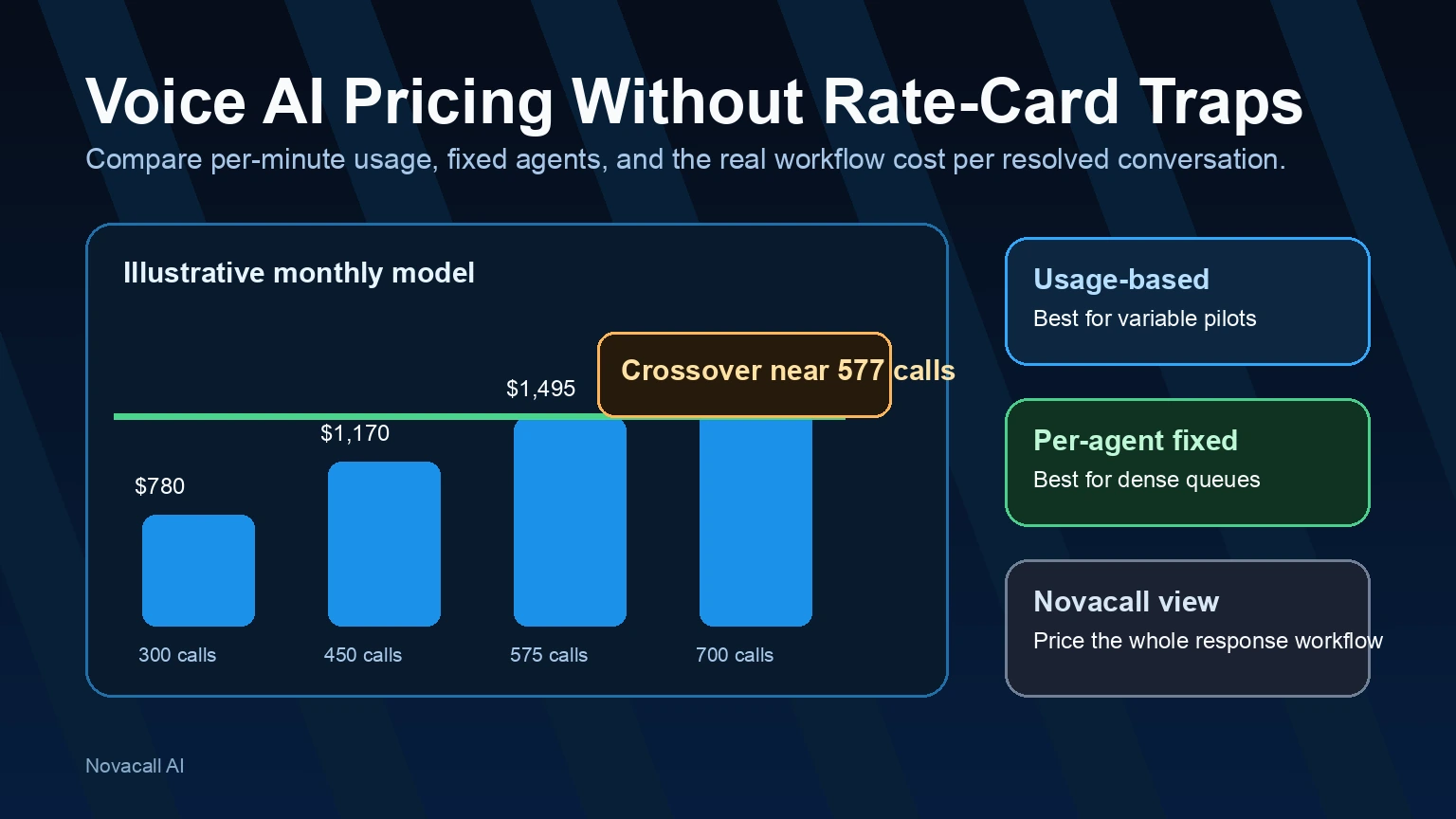
In the per minute vs per agent voice ai pricing debate, per-minute pricing saves money when volume is low, variable, or still in pilot mode. Per-agent pricing saves money only when one license stays heavily utilized in a stable workflow. For most growth teams, the cheapest option prices the entire response workflow, not just the call minute. Key Takeaways In an illustrative model at $0.65 per minute and 4-minute calls , per-minute spend stays below a $1,500 fixed license until roughly 577 calls per month . Harvard Business Review’s _The Short Life of Online Sales Leads_ found only 37% of companies responded within an hour and 23% never responded at all. Verint’s _The State of Customer Experience 2026_ found 78% of customers prioritize the fastest resolution over their preferred channel, and Verint reported 79% would switch after one bad experience. ContactBabel’s _The 2026 US Contact Center Decision-Makers' Guide_ says the average inbound call costs $7.20 , or 47% more than email and 23% more than web chat . Per-agent pricing saves money only when one licensed workflow stays heavily utilized and does not split into extra numbers, languages, queues, or concurrency tiers. This guide to per minute vs per agent voice ai pricing covers the cost logic, the crossover math, the hidden line items, the buyer mistakes, and the implementation details that finance and operations teams actually care about in 2026. It does not try to rank every vendor on the market, and it does not replace legal review for HIPAA, GDPR, or TCPA requirements. If you're a RevOps leader at a multi-location practice, insurance agency owner, admissions director, real estate operator, or agency founder buying voice automation for 500 to 10,000+ leads per month, this is the comparison you need before you sign a contract. Novacall AI responds in less than 60 seconds across voice, SMS, email, and WhatsApp. Per minute vs per agent voice ai pricing: what is the short answer? There is no universal winner in per minute vs per agent voice ai pricing . The cheaper model depends on five variables: monthly minutes, number of workflows, traffic volatility, follow-up channel mix, and compliance burden. Voice AI is a real-time software system that listens to a caller, interprets intent, speaks back naturally, and triggers downstream actions such as CRM logging, routing, appointment booking, and follow-up, turning phone calls into structured operational workflows. Per-minute pricing is a usage-based billing model that charges for connected conversation time, lowering entry cost for pilots but making monthly spend rise with longer calls, more overflow, and higher success volume. Per-agent pricing is a seat-based billing model that charges a fixed monthly fee for each deployed AI agent or workflow, improving budget predictability but forcing buyers to pay for every additional number, location, language, or use case they stand up. Total cost of ownership is a financial model that combines subscription fees, implementation, routing logic, follow-up channels, compliance controls, support, and human oversight, preventing teams from underpricing the real cost of voice automation. The practical verdict is simple: Choose per-minute when your volume is uncertain, your workflow count is low, and you want the cheapest way to test. Choose per-agent when one queue handles heavy, stable volume and you want a fixed monthly number. Choose a bundled managed platform when your business buys outcomes across voice, SMS, email, WhatsApp, compliance, and escalation, not isolated call minutes. Model Usually cheapest when Usually gets expensive when What finance should verify Per-minute Volume is low, variable, or in pilot mode Calls get longer, follow-up spreads across channels, or volume spikes unpredictably Billable minute rules, transfers, rounding, channel add-ons Per-agent One workflow is dense, stable, and highly utilized More queues, languages, numbers, or concurrency are needed What counts as an agent, concurrency caps, overage rules Bundled managed platform You buy resolved conversations, not raw call time You only need a single narrow use case Included channels, support scope, compliance, escalation logic When I price a multi-location practice, the first mistake I correct is treating the inbound call as the entire workflow. The expensive part usually starts after the caller hangs up: reminder SMS, eligibility confirmation, routing, documentation, and escalation. Novacall AI is built for healthcare, insurance, finance, education, real estate, and other high-velocity lead environments. Why does this choice matter more in 2026 than it did in 2024? The pricing model matters because delayed response destroys value long before the monthly invoice arrives. According to Harvard Business Review’s _The Short Life of Online Sales Leads_, which audited 2,241 U.S. companies by submitting web-generated test leads, only 37% responded within an hour, 23% never responded at all, and the average response time among companies that replied within 30 days was 42 hours . That is not a pricing problem on the surface. It becomes a pricing problem when you realize you are paying for a response system that still loses the lead. The same Harvard Business Review article cites a separate study of 1.25 million sales leads received by 29 B2C and 13 B2B companies in the United States. Firms that attempted contact within one hour were nearly seven times more likely to qualify the lead than firms that waited even one hour longer, and more than 60 times more likely than firms that waited 24 hours or more. That is why a cheaper rate card can still produce a more expensive funnel. A second 2026 signal comes from Verint’s _The State of Customer Experience 2026_, based on 5,000 U.S. consumer surveys conducted from January 5, 2026 to February 13, 2026 . Verint found that 78% of customers prioritize the fastest resolution over their preferred channel , and Verint later reported that 79% would switch to a competitor after one bad experience in its can 12, 2026 summary of the same report. Buyers are not buying minutes. They are buying resolution speed. A third cost anchor comes from ContactBabel’s _The 2026 US Contact Center Decision-Makers' Guide_, based on surveys with 207 U.S. organizations and 1,000+ consumer interviews . ContactBabel reports that the average inbound call now costs $7.20 , which is 47% more than email and 23% more than web chat . Voice remains valuable, but it is not cheap enough to waste. A fourth signal comes from Salesforce’s _State of Service, Sixth Edition_, which surveyed 5,500+ service professionals worldwide . Salesforce found that 85% of decision-makers expect service to contribute a larger share of revenue this year, and budgets are expected to rise by 23% on average. That matters because voice AI is no longer a narrow support purchase. It sits inside conversion, retention, and booked revenue. Related: Ai Voice Agent Hvac Companies Book More Service Calls A fifth signal comes from Zendesk’s _CX Trends 2026_, based on 11,000+ consumers and business leaders across 22 countries . Zendesk reports that 86% of consumers say responsiveness and accuracy strongly influence purchasing decisions , 81% want the next representative to pick up where the last interaction ended , and 74% get frustrated when they have to repeat information . That is exactly why a price model that excludes follow-up channels, CRM context, or handoff quality can understate the real cost. Related: Ai Voice Agent Call Scripts Guide High Conversion The counterintuitive insight is this: the wrong denominator is cost per minute; the right denominator is cost per resolved conversation . Most competing articles stop at the rate card. Buyers should not. Related: Solar Ai Voice Agent Pricing Cost Per Lead Novacall AI supports HIPAA, GDPR, SOC 2 Type II, and ISO 27001 requirements. Novacall AI keeps routing, documentation, follow-up, and escalation inside one operating layer, so finance can measure cost per resolved conversation instead of cost per connected minute. How do the models really work? How does per-minute pricing really behave? Per-minute plans are best understood as variable-cost infrastructure . You pay when calls connect, speak, hold, transfer, or remain active under the vendor’s billing rules. The advantages are obvious: low commitment, clean pilot economics, and easy entry for one-number experiments. See your missed-call revenue in 60 seconds Free voice-AI audit from Novacall AI — we benchmark your after-hours leakage, model the recovered revenue, and show the exact integration path. No engineers, no per-minute pricing to untangle. Start your free audit Audit takes ~10 minutes. You get the numbers either way. The problem is that usage-based pricing rarely stays limited to usage. If the buyer also needs SMS confirmation, email follow-up, WhatsApp continuation, CRM sync, after-hours routing, compliance logic, and escalation workflows, the raw voice minute becomes only one part of the stack. The invoice is variable even when the business wants predictability. Per-minute billing also creates a subtle incentive problem. When conversations run long because routing is weak, qualification scripts are bloated, or handoffs are clumsy, the buyer pays more for worse design. Read the contract closely. Some vendors bill on exact connected seconds. Some round up to 30 or 60 seconds. Some bill transfer time. Some count outbound retries or human handoff legs as separate usage. A low posted rate can lose its advantage fast if the real billing unit is larger than the buyer assumed. I have seen low-minute pilots look efficient until a 90-second call triggered a reminder text, an email summary, and a manual CRM task. At that point, the voice minute was the cheapest part of the event and the least useful number in the review. See also: SuperMIA vs Retell AI vs Novacall: Managed Voice AI for Healthcare and Home Services How does per-agent pricing really behave? Per-agent plans are best understood as fixed-cost deployment licensing . You pay a monthly fee for each AI agent, queue, workflow, number, or use case the vendor counts as a billable agent. The appeal is straightforward: finance gets a fixed monthly number, and operations gets room to drive more volume without watching every second. The risk is that buyers often underestimate how many agents they actually need. A single-location business can only need one. A regional healthcare group with a main line, after-hours overflow, Spanish routing, appointment reminders, and billing triage can need four or five. An agency running separate branded assistants for multiple clients can multiply that count even faster. Concurrency is a capacity rule that determines how many live calls one AI deployment can handle at the same time, controlling overflow risk and the real number of licenses you need. If concurrency is capped, “fixed” pricing stops being truly fixed. Vendors also define “agent” differently. One counts a phone number as an agent. Another counts each workflow. Another treats separate languages, environments, or brands as separate billable units. A fixed fee is only fixed when the operating model remains simple. When I review agency, franchise, or multi-location setups, I pay special attention to language splits, after-hours queues, and brand-specific numbers because that is where “one agent” quietly becomes four. What is the hidden layer both models miss? Most rate cards ignore the workflow tax around the call itself. Verint’s _The State of Agent Experience 2026_, based on a survey of 1,000 contact center agents from companies with at least 300 agents, found that in 45% of calls agents spend about three minutes searching for answers during the interaction, 54% of calls require after-call work, 67% of calls require completing a task on the customer’s behalf, and 57% of calls require gathering context at the start of an escalation. Those minutes do not disappear just because they happen outside the voice stream. Someone still pays for them through labor, extra tools, or lost capacity. See also: HVAC Service Agreement Renewals: Automate Retention Calls with AI McKinsey’s _The state of AI: How organizations are rewiring to capture value_ reaches the same operational conclusion from a different angle. McKinsey found that the strongest links to bottom-line AI impact are tracking well-defined KPIs and redesigning workflows , not merely installing new AI tools. That is the practical reason rate-card comparisons mislead buyers: AI value appears when the workflow around the conversation changes, not when the voice layer changes by itself. Hidden cost bucket Why it matters in the pricing decision Knowledge search If staff still hunt for answers mid-call, your “cheap” plan still burns labor After-call documentation If notes, summaries, and CRM updates stay manual, the cost moves off the invoice and into payroll Task completion Booking, routing, claim intake, eligibility checks, and follow-up often cost more than the conversation itself Escalation context Repeating information raises abandonment risk and adds labor on both human and AI sides Channel continuation SMS, email, and WhatsApp can exceed the savings from a lower voice price Compliance and governance Retention, consent, redaction, review, and security controls create real TCO even when not listed on the pricing page Compliance burden is part of this hidden layer, especially in healthcare, finance, and education. IBM’s _Cost of a Data Breach Report 2025_ reports a $4.4 million global average breach cost and says 63% of organizations lacked AI governance policies. If your workflow involves call recordings, transcripts, patient details, claim notes, or consent logs, governance is not a legal footnote. It is a pricing variable. When I price a healthcare intake flow, I do not separate compliance from economics. One undefined retention rule, one weak redaction process, or one missing consent log can erase a year of savings from a slightly lower minute rate. Novacall AI is strongest when the buyer wants one response system for voice, SMS, email, WhatsApp, compliance controls, and human escalation instead of separate channel invoices. Where is the actual crossover point? The cleanest way to compare per minute vs per agent voice ai pricing is to write the formulas out. Per-minute total monthly cost = `(billed minutes x minute rate)` + `transfer/hold billing` + `channel add-ons` + `implementation amortization` + `human QA/review` + `compliance overhead` Per-agent total monthly cost = `(licensed agents x monthly fee)` + `extra workflows/numbers/languages` + `concurrency overage` + `channel add-ons` + `implementation amortization` + `human QA/review` + `compliance overhead` Here is a simple illustrative example only , not a market-rate claim: Per-minute rate: $0.65 Average billed call length: 4.0 minutes Per-agent license: $1,500 per month Monthly calls Monthly minutes Per-minute cost Per-agent cost 300 1,200 $780 $1,500 450 1,800 $1,170 $1,500 575 2,300 $1,495 $1,500 700 2,800 $1,820 $1,500 In that example, the crossover sits at roughly 577 calls per month . Below that, per-minute is cheaper. Above that, one stable agent license is cheaper. But that is only the voice-only crossover. The real crossover moves when the operating model changes: If per-agent pricing requires a second workflow for after-hours or Spanish routing, the crossover moves much farther right. If the per-minute plan bills transfers, retries, or follow-up legs , the crossover moves left. If one plan bundles SMS, email, documentation, and reporting while the other does not, the voice-only math becomes incomplete. If concurrency limits force overflow to a human team, the “fixed” model picks up hidden labor cost. I treat Monday 8:00 a.m. surges and first-of-the-month billing spikes as pricing tests, not edge cases. If those spikes force a second license, create overflow, or push the team back into manual callbacks, the headline price was never the real price. What buyer mistakes make the cheap plan expensive? The biggest buyer mistake is comparing audio cost instead of workflow cost . A voice AI purchase is rarely just a call purchase. In practice, the business is buying some combination of answer, qualify, route, book, document, follow up, and escalate. When those steps live on separate tools and invoices, a cheap minute rate can still produce an expensive operating model. The second mistake is ignoring volatility. Stable volume behaves differently from weekend spikes, campaign launches, seasonal surges, or after-hours overflow. Per-agent pricing looks best in steady-state math. Per-minute pricing often looks better in volatile traffic. The wrong choice usually comes from modeling the average week instead of the ugly week. The third mistake is undercounting workflows. A main line, after-hours line, Spanish queue, billing queue, reminder flow, and VIP escalation path can all behave like separate products even when the vendor calls them “configurations.” The fourth mistake is forgetting the channel mix. In many businesses, the call is only the opening move. The conversion or resolution happens over SMS, email, or WhatsApp after the call ends. See also: AI voice agents for real estate on Swiftleads AI In admissions workflows, I have learned to cost the first seven days after inquiry rather than the first call, because the initial conversation rarely closes the loop. The expensive part is the sequence: follow-up, reschedule, document chase, and escalation when the prospect goes quiet. The fifth mistake is treating compliance as a separate project. In regulated environments, the operating model, retention policy, access controls, and escalation logic all affect TCO. They should be in the commercial model before signature, not after deployment. Which model fits each operating scenario? Scenario Usually the best fit Why Pilot with uncertain volume Per-minute Lowest commitment and cleanest test economics One high-volume stable queue Per-agent Predictable monthly spend if utilization stays high Multi-location regulated intake Bundled managed platform Workflow sprawl, compliance, and escalation matter more than raw minutes Agency with multiple brands or clients Bundled or tightly scoped per-agent Separate numbers and branded flows multiply licenses quickly Seasonal or campaign-driven traffic Per-minute Better fit for uneven demand Heavy follow-up across channels Bundled managed platform Cost is driven by orchestration, not just call time For a multi-location practice , per-agent pricing only works cleanly when one queue stays dominant. Once you add after-hours triage, separate departments, language routing, and compliance review, the contract behaves more like a bundle decision than a seat decision. For an insurance agency , per-minute pricing works for quote-intake pilots, but it loses its edge if the business also needs document chase, renewal reminders, claims overflow, and producer handoff. I have seen agencies approve a low minute rate, then lose predictability because every follow-up step lived on a different invoice. For admissions teams , speed-to-first-contact matters, but so does persistence after the first missed conversation. A low call price is not the same as a low acquisition cost if the team still pays people to chase applicants manually. For real estate operators , traffic volatility is the hard part. Weekend inquiries, listing spikes, and after-hours showing requests can make a stable seat model fragment into multiple queues or overflow rules. In real estate-style lead routing, I do not start with average call length. I start with weekend response windows, because missed Saturday demand is where a lot of “cheap” systems become expensive. For agencies , per-agent pricing can look attractive at first and then break quickly as each client asks for separate branding, numbers, languages, reporting views, and escalation rules. One license rarely stays one license for long in a white-labeled environment. Novacall AI prices the response workflow rather than isolating the call minute, which matters when qualification continues over SMS, email, and WhatsApp. What should finance and operations verify before signing? Before you sign any voice AI agreement, finance and operations should verify these items in writing: Exact billable unit: connected seconds, minute rounding, transfer legs, retries, test traffic, and voicemail legs. Exact billable agent definition: whether an agent means a number, queue, workflow, language, brand, or environment. Concurrency rules: how many simultaneous calls are included and what happens at overflow. Included channels: whether SMS, email, and WhatsApp are bundled or separately metered. Implementation scope: setup fees, sandbox charges, integration work, change requests, and support tiers. Compliance terms: DPA, BAA if relevant, retention rules, redaction process, access control, and audit logs. Reporting definitions: whether the platform reports cost per minute, cost per conversation, cost per booked outcome, transfer rate, abandonment, and time to first response. Escalation design: what happens when the AI is uncertain, when a customer asks for a human, or when a regulated workflow requires approval. Exit terms: data export, transcript ownership, phone-number portability, and termination notice. When I review contracts, the two lines I circle first are the definition of a billable agent and the definition of a billable minute. Most pricing surprises trace back to one of those two sentences. See also: Vapi AI vs Retell AI vs Novacall: Developer Platform vs Managed Voice Agent Comparison How should a team implement without creating a cost surprise? A clean implementation makes the pricing decision easier to validate. 1. Baseline the current workflow. Track speed to first response, missed-call rate, booked rate, transfer rate, follow-up touches, and cost per resolved conversation before the pilot begins. 2. Pilot one live queue with real traffic. Do not evaluate only on scripted test calls. Include after-hours, overflow, and follow-up behavior. 3. Count every workflow touch. Measure voice, SMS, email, CRM updates, handoffs, and human review together. 4. Stress-test concurrency and escalation. Run the pilot during the busiest traffic window, not the quietest one. 5. Review economics at day 30. Compare predicted cost to actual cost and compare resolved outcomes, not just answered calls. McKinsey’s _The state of AI: How organizations are rewiring to capture value_ is useful here because it emphasizes roadmap clarity, KPI discipline, and workflow redesign. Those are the same levers that keep voice AI pricing honest in production. Salesforce’s _State of Service, Sixth Edition_ matters here too. If service is expected to contribute more revenue, then the implementation review cannot stop at cost control. It has to measure whether the system answers faster, resolves more cleanly, and converts more demand with less manual friction. When I review day-30 pilots, the teams that get clean answers are the ones that tracked abandonment, transfer rate, booked outcomes, and follow-up touches from day one. The teams that only tracked minute spend usually have to rerun the analysis later. Final verdict: which plan actually saves money? In per minute vs per agent voice ai pricing , per-minute wins when uncertainty is high and the buyer needs a cheap, low-risk test. Per-agent wins when one workflow is dense, stable, and truly singular. Bundled orchestration wins more often than buyers expect when the business actually buys resolution across voice, SMS, email, WhatsApp, compliance, and escalation. Novacall AI is not the cheapest way to buy isolated minutes; it is designed to reduce the cost of the full response workflow. If you want the right answer before you sign, model cost per resolved conversation , not just cost per minute, and book a free conversion audit before you commit to a pricing structure. Related: Synthflow vs Vapi vs Novacall AI Related: Voice AI Platforms Pricing Benchmarks 2026