The Real Restoration Lead Qualification Problem
 by Parvez Zoha
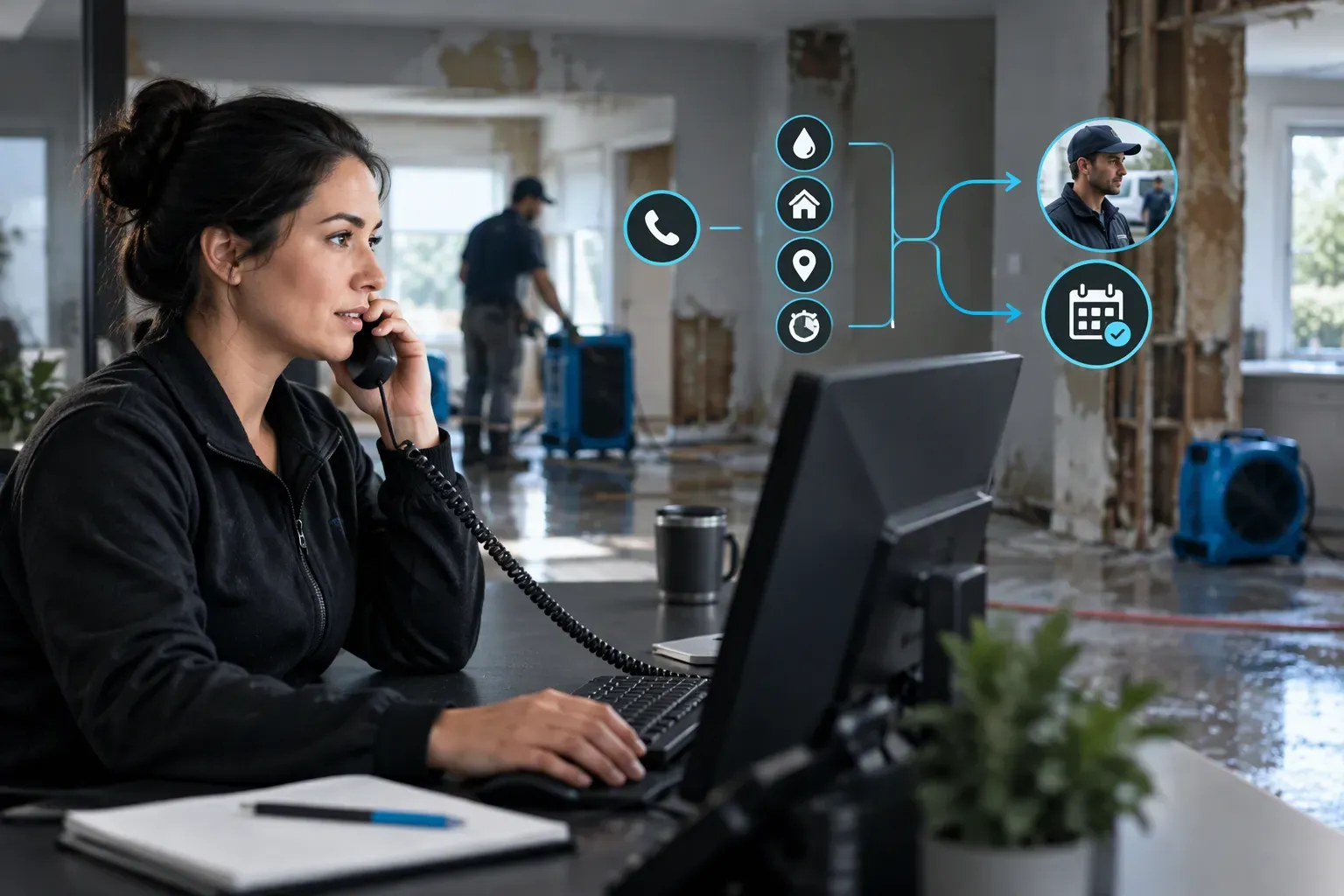
AI lead qualification for restoration and specialist-cleaning companies should capture the incident, urgency, property, and address, then route urgent work to a configured person or book an assessment. A structured intake turns a missed call into useful context for the next step, while leaving inspection, safety decisions, and customer care with qualified staff.
Key takeaways
- Ask what happened, whether the issue is active, what property is affected, and where it is located.
- Separate urgent restoration work from planned cleaning and assessment requests.
- Make human handoff rules clear, especially for safety concerns and unusual site requirements.
- Judge the workflow by useful intake records and appropriate next steps, not answered calls alone.
How AI lead qualification for restoration and specialist-cleaning companies should work
For AI lead qualification for restoration and specialist-cleaning companies, the goal is not to force every caller through a fixed sales script. It is to collect the details your team needs to decide what happens next. A caller reporting active water damage needs a different route from a facility asking about a planned specialist-cleaning assessment.
Start with the caller’s description. Ask what happened, whether the problem is ongoing, what type of property is involved, and where the work is needed. Then ask only the follow-up questions that help determine urgency, service fit, and the next step. Keep a route to a person available when the answer signals risk, uncertainty, or a need for judgment.
In practice, callers often describe the visible problem before they give a complete address. A good intake flow respects that order: understand the issue, check urgency, then collect the information needed for a useful handoff. The caller should not have to repeat the story because the system recorded disconnected fragments.
Novacall AI can respond to inbound leads in under 60 seconds, a capability prospects experience live on a demo call. That response capability is separate from customer conversion or revenue outcomes. The workflow can also run 24/7/365, but the business still needs to define who receives an urgent handoff and what happens when that person is unavailable.
According to Cleanfax (Cleanfax.com Restoration Benchmarking Survey Cleanfax, The 2026 Restoration Benchmarking Survey Report), pressure on the restoration industry continued and became heavier in some areas. A practical intake should reduce avoidable back-and-forth, not promise to solve every source of operating pressure.
Capture the incident before deciding where it goes
Restoration and cleaning enquiries often begin with an incomplete account: a leak, smoke, contamination, a difficult clean, or a request to assess a property. The first job is to capture the caller’s own description before mapping it to a service category. A narrow menu that assumes the caller already knows the technical name for the problem creates friction and can misclassify the enquiry.
Ask whether the condition is active or contained. Clarify what the caller has observed and whether access to the affected area is restricted. For a cleaning request, ask what needs cleaning and whether the site has operating or access requirements. For restoration, establish what happened and whether the caller is seeking urgent response or an assessment.
Do not make the automated flow diagnose damage, decide whether a building is safe, or replace an on-site inspection. If a caller describes an immediate safety concern, follow the company’s escalation procedure and direct them to emergency services when appropriate. The intake captures information; trained people make decisions that require inspection or professional judgment.
Keep an open response option beside the structured categories. A caller with a rare material, unusual facility, or combined damage and cleaning need should not have to choose an inaccurate label just to continue. Mark the issue for human review and pass along the caller’s exact description.
What AI lead qualification for restoration and specialist-cleaning companies should collect
The intake design for AI lead qualification for restoration and specialist-cleaning companies should collect the details that change the next action. Novacall AI supports on-call qualification for budget, timeline, property or job type, and pre-approval status. Restoration and specialist-cleaning workflows can be scoped to capture business-specific details such as the incident, urgency, property, and address.
| Call detail | Why it belongs in intake |
|---|---|
| Incident or requested service | Helps distinguish damage response, restoration, and planned cleaning. |
| Urgency and current status | Shows whether the issue is ongoing, contained, or an assessment request. |
| Property and site type | Gives the team context about the setting and service needed. |
| Address | Supports service-area review and a useful handoff. |
| Access or site requirements | Flags details that need review before an assessment or dispatch decision. |
| Preferred next step | Clarifies whether to route a person or book an assessment. |
AI lead qualification for restoration and specialist-cleaning companies works best when the fields match the company’s actual services. A property manager asking about a scheduled clean needs different follow-up from a homeowner reporting active damage. A commercial site can also have access rules or operating needs that affect the assessment. Capture only information that informs a decision, and make sensitive or unfamiliar details visible to the person taking over.
Novacall AI integrates with a CRM, and appointment booking can use a connected calendar. Those capabilities help keep the enquiry and next step together when the workflow is configured for the business. Confirm which fields belong in the CRM, how booking availability is managed, and what the human handoff should include before using the workflow with callers.
How should urgent work move to a person?
An urgent route should be based on clear triggers, not a vague label such as important. The business defines those triggers. They can include an active incident, a caller reporting a safety concern, a property type that requires review, or an answer the intake flow cannot confidently classify. The system should pass the reason for escalation along with the caller’s details.
| Signal in the call | Suggested next step |
|---|---|
| Active damage or an urgent request | Follow the configured urgent handoff procedure. |
| Safety concern or uncertain conditions | Escalate for human review and follow company safety guidance. |
| Planned cleaning or routine service enquiry | Capture service needs and route to the appropriate team. |
| Unusual property, material, or access requirement | Preserve the caller’s description and flag it for review. |
| Assessment request with a suitable appointment | Offer booking on the connected calendar. |
A useful handoff summary states what happened, what the caller said about urgency, the property and address, and what action the system took. It should also flag unanswered questions rather than filling gaps with assumptions. Staff need enough context to continue the conversation naturally, not a long transcript they must search while the caller waits.
Make the escalation route real. Assign an owner, define what happens if that person does not answer, and keep a path for staff to take over. A system that labels a call urgent but leaves it in an unattended queue has not completed the job.
What happens after hours or during a busy period?
Inbound calls can arrive when the office is closed, the team is on a job, or several enquiries need attention at once. Novacall AI operates 24/7/365, and its workflows can use voice, SMS, email, and WhatsApp. The channels and follow-up rules should reflect the caller’s preferences, the service, and the business’s consent practices.
Do not treat a CRM entry, public listing, or caller ID as permission to send follow-up messages. Novacall AI is for inbound and previously consented follow-up only. A listing status or presence in a CRM is not consent. Record the permission and channel that apply, and keep messages within those boundaries.
For an urgent enquiry outside office hours, the workflow should capture the issue and apply the business’s configured escalation rules. Be clear about what the system does and does not promise about a human response. If the on-call person is unavailable, the caller should receive the next appropriate step rather than an implication that a live team member has already reviewed the case.
Seasonal changes can shift the mix of calls, the type of work, and team availability. Review intake categories, handoff ownership, and calendar rules when those conditions change. Keep the core information stable so staff can still compare enquiries and understand what was reported, even when the service mix changes.
According to Wifitalents (Wifitalents.com Ai Commercial Cleaning Industry, AI in the Commercial Cleaning Industry Statistics), its summary includes preventative maintenance among commercial-cleaning priorities. For intake design, distinguish planned service from a reactive damage enquiry instead of guessing from a company name or property label.
How do you protect the customer relationship on a call?
Use the automated conversation to make the next human interaction better, not to hide the fact that a person may need to take over. Ask one clear question at a time. Let callers explain the problem in their own words. Confirm important details back to them, especially the address, the reported urgency, and the requested next step.
On a typical call, the caller’s account becomes clearer as they explain what is happening at the property. Leave room for that explanation instead of forcing a caller to navigate a long menu. If a caller asks for a person, gives an unclear answer, or describes an unusual situation, the workflow should make the handoff easy to understand.
Phone-first callers should be able to complete qualification by voice. Novacall AI supports voice workflows, along with SMS, email, and WhatsApp workflows for configured use cases. The available channel does not replace the need to respect consent. Follow-up messages belong only in inbound contexts or where the person has already consented.
Novacall AI supports 15+ languages. For a critical detail, ask the caller to confirm what was captured and give staff a way to review language-specific terms. Language support does not replace a site inspection, technical review, or a human conversation when the caller needs one.
For healthcare, industrial, or other specialized facilities, build the intake around the company’s actual service scope. Capture the facility type, access limits, operating needs, and any requirements that need a qualified person to review them. Do not claim a certification or compliance result based on an intake conversation. Route those questions to the right staff member.
According to Pitchit.ai (Pitchit.ai Water Damage Restoration Lead, Water Damage Restoration Lead Statistics), restoration lead statistics track acquisition cost, response velocity, customer behavior, and conversion rates. Those are separate questions; a qualified record should also make clear whether staff have the information needed for the next action.
How should teams measure lead quality?
AI lead qualification for restoration and specialist-cleaning companies is an operational workflow, so assess the quality of the work it hands to staff. Start with whether the record contains the caller’s description, urgency, property, and address. Then review whether urgent work reached the configured route, whether suitable assessment requests reached the calendar, and whether CRM records needed repair.
Keep measures tied to decisions. Track unanswered calls, completed intake records, urgent handoffs, assessment bookings, missing details, and enquiries that staff had to reclassify. Define each measure before reviewing results. An answered call is not automatically a qualified opportunity, and a booked assessment is not proof of a completed job or revenue.
Look for the work the system removes and the work it creates. A useful workflow cuts repeated questions and gives a person a clearer start to the conversation. A poor workflow creates duplicate CRM entries, inaccurate categories, or extra callbacks to collect an address. Treat any improvement as something to verify in your own process, not as a guaranteed product outcome.
According to Stealth Agents (Stealthagents.com AI Lead Scoring Automation, AI Lead Scoring Automation 2026), the article relays a B2B AI-scoring comparison, but that comparison does not establish restoration-call outcomes. According to Click-vision (Click-vision.com AI Lead Generation Statistics, AI Lead Generation Statistics), the page makes a chatbot customer-support cost-savings claim, but that claim does not establish qualification quality. Neither statement is a substitute for measuring the actual intake and handoff in your business.
According to Trysetter (Trysetter.com AI Lead Generation Statistics, AI Lead Generation Statistics), the article reports adoption claims for AI-powered lead-generation tools, but adoption does not establish fit for specialist cleaning. Choose a workflow for the job it must do, then review call records and staff feedback to see whether it does that job well.
What should teams check before launch?
When designing AI lead qualification for restoration and specialist-cleaning companies, write down the service categories, escalation triggers, booking rules, and CRM fields the business needs. Have the people who answer calls and handle assessments review the flow. Their input catches missing property details, confusing categories, and handoff instructions that sound clear on paper but fail during a real conversation.
Test ordinary enquiries and difficult ones. Include an active incident, a planned clean, a caller unsure what service is needed, an unusual facility requirement, an incomplete address, and a caller who asks for a person. Check that the system records uncertainty honestly and routes exceptions rather than inventing answers. Confirm that the connected calendar and CRM receive the information staff expect.
Treat an agentic workflow as a bounded sequence of configured actions: gather information, apply routing rules, book an eligible assessment, update the CRM, or hand off to a person. It does not mean the system should make independent safety or inspection decisions. Keep the rules reviewable and assign people to maintain them when services, schedules, or operating procedures change.
An automated voice agent has a real limitation: it cannot inspect a soaked room, assess structural damage, or verify a hazard through a call. It can collect what the caller reports and pass that account to the team. Inspection, safety decisions, and judgment about specialist work still belong to qualified people.
Pricing for Novacall AI is by custom quote, with no public fixed-price tiers. Scope depends on lead and call volume, channels, integrations, and workflow; current commercial terms are confirmed in a written proposal. To discuss your intake and routing needs, Book for a quote.
AI lead qualification for restoration and specialist-cleaning companies works best when the caller’s account leads to a clear, responsible next step. Capture the details your staff need, route urgent or uncertain cases to a person, and review whether the handoff helps the team serve the enquiry without making the caller start over.