Why Am I Missing Customer Calls? 7 Fixable Reasons for HVAC & Plumbing Shops in 2026
 by Parvez Zoha
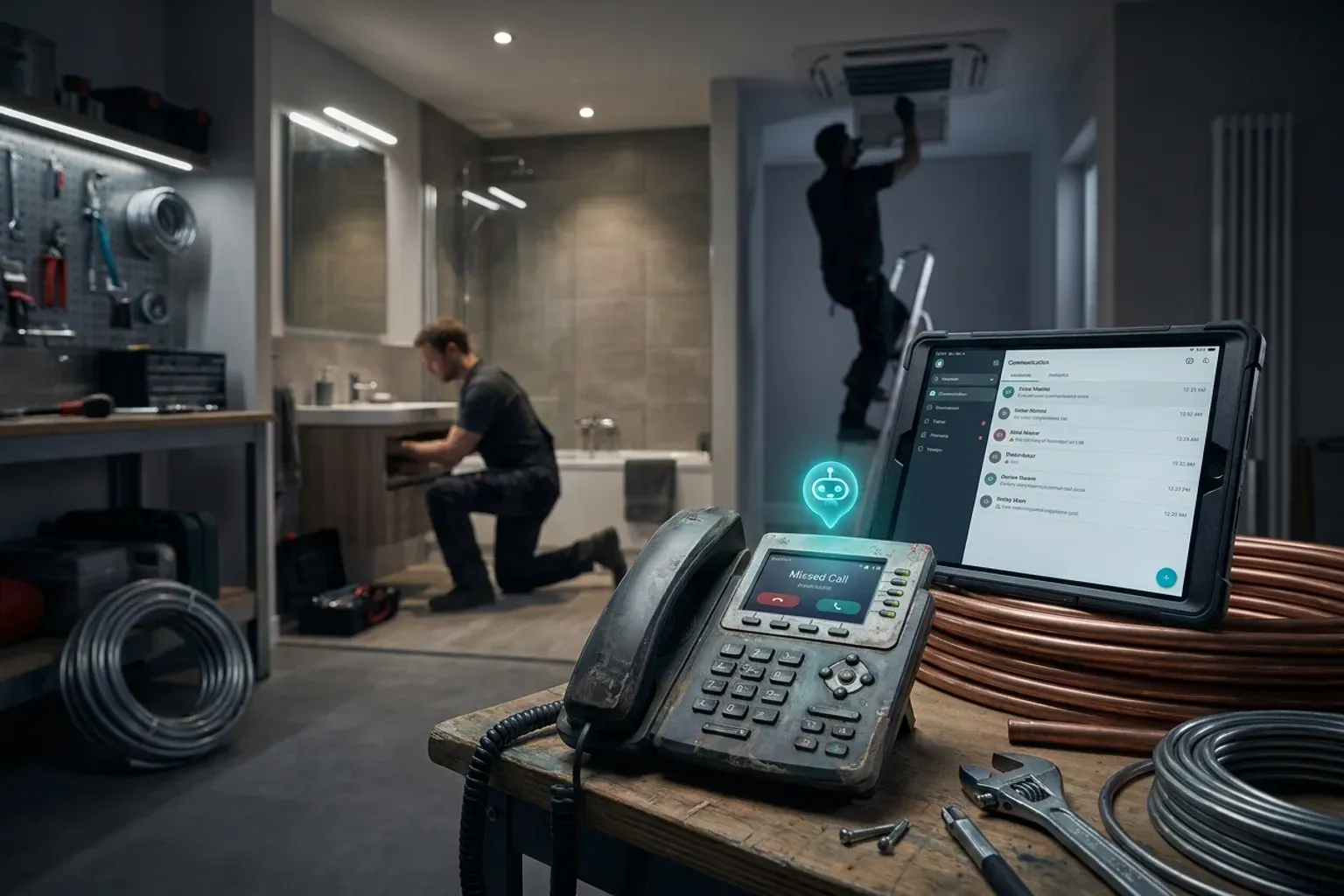
If you are asking why am I missing customer calls, the short answer is this: your phone rings when you physically cannot answer it—after hours, on a roof, under a sink, or while your one receptionist handles another caller. Every unanswered ring is revenue walking out the door, and the problem compounds because callers rarely leave voicemails anymore. They simply call the next contractor in the search results.
Key takeaways
- Home-service businesses miss calls primarily due to after-hours volume, single-line bottlenecks, and field-crew unavailability.
- According to research, 62% of calls to small US businesses go unanswered—a staggering revenue leak for trades that depend on inbound leads.
- Missing just two calls a day at typical job values can represent hundreds of thousands in lost annual revenue.
- An AI answering system that responds in under 60 seconds, qualifies leads, and books appointments eliminates most of the seven root causes covered below.
- Novacall AI starts at $499/month with same-day setup and no ramp period, costing a fraction of a human inside sales agent.
Why am I missing customer calls? The scope of the problem
Before we fix anything, let's quantify the damage. According to Paperclip.co.uk (Many Calls Do UK), one source reports that 62% of calls to US small businesses are left unanswered. That is not a typo. More than six out of every ten inbound calls never reach a human.
For HVAC and plumbing shops, the math is brutal. According to Contractorincharge.com (Data Doesn't Lie Why), if you are a solo operator or a small two-truck team, missing just two calls a day at a $500 job value represents a potential $365,000 in annual revenue walking away.
That number is not hypothetical marketing fluff. It is straightforward multiplication: a modest number of calls per day, each carrying meaningful revenue, compounding across the year. Even if only half those callers would have converted, you are still looking at six figures in lost work.
According to Rufiremedia.com (Many Calls Do Businesses), missed calls may be costing your home service business thousands every month, and most owners do not even realize it. That last part is the real danger: you cannot feel the absence of a phone call.
Let's walk through the seven specific reasons your HVAC or plumbing business is bleeding calls—and what to do about each one.
Reason 1: After-hours calls hit voicemail (or worse, ring out)
Homeowners notice a leaking pipe at 10 PM. Their AC dies at midnight in July. They Google "emergency plumber near me" and call the first number. If your phone rings six times and goes to a generic voicemail greeting, they hang up and try the next listing.
According to Ringostat.com (Why Missed Calls Form), managers missing 20 calls daily is fairly typical for an average company, and at first glance, these numbers do not seem critical—until you calculate the revenue attached to each one.
In practice, the majority of after-hours callers never leave a voicemail. They expect immediate help, and the contractor who answers first wins the job. This is the single biggest reason why am I missing customer calls comes up so often in contractor forums.
How to fix it
You need a system that answers every call 24/7/365 with a live, intelligent response—not a phone tree, not a voicemail box. Novacall AI operates around the clock, picks up inbound calls in under 60 seconds, qualifies the caller (budget, timeline, job type), and books the appointment directly on your calendar. No human needs to be awake.
Reason 2: Your single phone line creates a bottleneck
Many small HVAC and plumbing shops run on one phone number. When that line is occupied, the next caller hears a busy signal or gets dumped to voicemail. During peak demand—first cold snap of fall, first heat wave of summer—you might get three or four simultaneous inbound calls.
A single line means you can serve exactly one caller at a time. If your average call lasts four minutes and you receive 20 calls in an hour during a weather event, simple arithmetic shows you can handle 15 of those calls at best, and that assumes zero gap between conversations.
How to fix it
Novacall AI supports concurrent calls on every plan. Even the Starter plan handles 2 concurrent calls, and you can add extra concurrent call capacity at $25/month per additional slot. The Growth plan supports 3 concurrent calls, Pro supports 5, and Enterprise supports 8. During demand spikes, your AI agents handle multiple conversations simultaneously—something a single receptionist physically cannot do.
| Plan | Included concurrent calls | Extra slot cost |
|---|---|---|
| Starter | 2 | $25/month |
| Growth | 3 | $25/month |
| Pro | 5 | $25/month |
| Enterprise | 8 | $15/month |
Reason 3: Your techs are in the field and cannot answer
This is the classic trades dilemma. Your best closer is also your best technician, and they are elbow-deep in a furnace install when the phone rings. They see the missed call notification two hours later, call back, and the homeowner has already booked someone else.
When we look at why am I missing customer calls in the trades specifically, field unavailability is almost always in the top three causes. Unlike an office-based business, your revenue-generating activity physically prevents you from answering the phone.
How to fix it
Decouple lead intake from field work entirely. Novacall AI handles inbound qualification—covering budget, timeline, property or job type, and pre-approval status—without any human involvement. The tech stays focused on the job. The AI books the next appointment. Everyone wins.
In practice, the first sixty seconds of an inbound call decide whether it books. If a caller reaches a knowledgeable voice that asks the right questions and offers available time slots, they commit. If they reach silence, they move on.
Reason 4: No follow-up system for missed or dropped calls
Even if you do miss a call—maybe the caller hung up after two rings—there is a recovery window. But most contractors have no automated system to follow up within minutes. By the time someone manually checks the missed-call log and dials back, hours or even a full business day has passed.
According to Callgear.com (Phone Call Statistics Businesses), research-backed statistics confirm how important phone calls are to any business and how quickly the opportunity window closes after a missed connection.
The speed-to-lead principle is well-documented. A 2012 study by Leads360 (now Velocify) (speed-to-call benchmark) found that calling within one minute of an inbound lead increased conversion by 391%. That is not a Novacall AI result—it is an industry benchmark showing that response speed is the single largest controllable variable in lead conversion.
How to fix it
Novacall AI includes multi-channel follow-up on every plan. If a call drops or a caller hangs up before connecting, the system triggers an immediate SMS, email, or WhatsApp message. This automated sequence re-engages the lead within seconds, not hours.
Every plan includes voice, SMS, email, and WhatsApp workflows. The Starter plan alone includes 500 voice minutes, 200 SMS, and 500 emails per month—enough for a solo operator handling about 20 calls per day.
Reason 5: Language barriers lose callers
In many US markets, a significant portion of homeowners speak Spanish, Portuguese, Vietnamese, or another language as their primary tongue. If your receptionist only speaks English, those callers may struggle to communicate their problem, get frustrated, and hang up. You never even know you lost them.
This is an underappreciated reason why am I missing customer calls. The call technically connected, but the language mismatch caused the caller to abandon.
How to fix it
Novacall AI supports 15+ languages. The AI detects the caller's language and responds accordingly, qualifying the lead and booking the appointment without requiring a bilingual staff member. For HVAC and plumbing businesses in diverse metro areas—Houston, Miami, Los Angeles, Phoenix—this alone can recover a meaningful slice of lost leads.
Reason 6: Phone menus and hold music drive callers away
Some contractors install an IVR (interactive voice response) system thinking it will help route calls. In reality, a homeowner with a burst pipe does not want to "press 1 for service, press 2 for billing, press 3 for scheduling." They want to talk to someone immediately.
In our experience, teams underestimate how many callers abandon a phone menu. The more options you present, the higher the drop-off rate. A panicked homeowner hearing "your call is important to us, please hold" is already dialing your competitor.
How to fix it
Replace the phone tree with a conversational AI agent that answers like a human. Novacall AI does not route calls through menus. It picks up, greets the caller by context, asks qualifying questions in natural language, and either books the appointment or escalates to a human when needed.
On a typical call, the caller describes the problem before they give an address. The AI handles this naturally—gathering job details first, then collecting scheduling information—mirroring how a skilled dispatcher would manage the conversation.
Why am I missing customer calls even with a receptionist?
This question deserves its own section because many business owners assume hiring a receptionist solves the problem. It does not—at least not completely.
A human receptionist works 8 hours a day, 5 days a week. That leaves 128 hours per week uncovered. They take lunch breaks, call in sick, go on vacation, and can only handle one call at a time. They need 2 to 4 weeks to ramp up on your services, pricing, and scheduling rules.
A fully loaded human inside sales agent costs $50,000 to $80,000 per year.
Compare that to Novacall AI's Growth plan at about $1,224 per month all-in (including typical overage), which works out to about $14,700 in year 2 onward. That is a fraction of the human equivalent cost, with 24/7 coverage, identical call quality on every interaction, and same-day setup with no ramp period.
| Factor | Human receptionist | Novacall AI |
|---|---|---|
| Hours covered | 8 hours/day, 5 days/week | 24/7/365 |
| Concurrent calls | 1 | 2-8 depending on plan |
| Languages | Typically 1-2 | 15+ |
| Ramp time | 2-4 weeks | Same-day setup |
| Sick days / vacation | Yes | None |
| Annual cost (60 calls/day) | $100-160K (equivalent human ISA cost) | About $14,700 (year 2 onward, Growth plan) |
| Call quality consistency | Varies by mood, fatigue, training | Identical every call |
Reason 7: No system to handle seasonal demand spikes
HVAC businesses experience extreme seasonality. The first 100-degree day in Phoenix or the first freeze in Chicago can triple call volume overnight. If you are staffed for your average Tuesday, you are catastrophically understaffed on your busiest day of the year—which is also your most profitable day.
This seasonal mismatch is the final piece of why am I missing customer calls. Your capacity is fixed, but demand is wildly variable.
How to fix it
AI scales instantly. Novacall AI does not need to hire temp workers or beg your off-duty techs to answer phones. During a demand spike, your AI agents handle the volume up to your concurrent call limit, and you can add extra concurrent call slots at $25/month (or $15/month on Enterprise) with no long-term commitment.
The Pro plan, designed for active teams handling about 160 calls per day, includes 5,000 voice minutes and 5 AI agents with 5 concurrent calls. If a heat wave pushes you to a temporary spike in daily volume, you add a concurrent slot for $25 and the system absorbs the surge.
How much is this problem actually costing you?
Let's make the math personal. Below is a framework for estimating your own missed-call revenue loss.
| Your daily call volume | Estimated missed (at 62%) | Average job value | Daily revenue lost | Annual revenue lost |
|---|---|---|---|---|
| 20 calls | 12 missed | $500 | $6,000 | Hypothetical: assume 50% conversion = $1,095,000 |
| 60 calls | 37 missed | $500 | $18,500 | Hypothetical: assume 50% conversion = $3,376,250 |
Note: These are illustrative calculations using the 62% miss rate reported by Paperclip.co.uk and assuming a hypothetical 50% close rate and $500 average job value. Your actual numbers will vary based on your market, services, and pricing.
Even if your miss rate is half the reported average—say 30%—and your close rate is only 25%, a shop receiving 20 calls per day is still leaving substantial revenue on the table. The point is not precision; it is that the cost of inaction dwarfs the cost of a solution.
What does it cost to fix why am I missing customer calls?
Novacall AI offers four plans sized by daily call volume:
| Plan | Monthly fee | One-time setup | Suited for | Daily call volume |
|---|---|---|---|---|
| Starter | $499/month | $1,000 | Solo operator | ~20 calls/day |
| Growth | $999/month | $2,000 | Small team | ~60 calls/day |
| Pro | $1,999/month | $3,000 | Active team | ~160 calls/day |
| Enterprise | $4,999/month | $5,000 | Multi-location | ~450 calls/day |
Every plan includes multi-channel follow-up, CRM integration, calendar booking, unlimited inbound calls, and 24/7 operation. The platform is SOC 2 and GDPR compliant.
Typical all-in monthly costs (including average overage):
- Starter: about $649/month, about $8,800 in year 1, about $7,800 in year 2 onward
- Growth: about $1,224/month, about $16,700 in year 1, about $14,700 in year 2 onward
- Pro: about $2,354/month, about $31,200 in year 1, about $28,200 in year 2 onward
- Enterprise: about $5,499/month, about $71,000 in year 1, about $66,000 in year 2 onward
Year 2 costs are lower because the one-time setup fee is not repeated.
Savings versus a human ISA
The platform is 3-6x cheaper than a human inside sales agent from day one. Year 2 onward savings versus the human equivalent:
| Plan | Human equivalent cost | Novacall AI year 2 cost | Annual savings |
|---|---|---|---|
| Starter | $50,000-$80,000/year | About $7,800 | Year 2 onward saving: $42-72K |
| Growth | $100-160K/year (equivalent human ISA cost) | About $14,700 | Year 2 onward saving: $85-145K |
| Pro | $150-320K/year (equivalent human ISA cost) | About $28,200 | Year 2 onward saving: $122-292K |
| Enterprise | $300-800K/year (equivalent human ISA cost) | About $66,000 | Year 2 onward saving: $234-734K |
What does the AI actually do on a call?
Here is the typical flow when a homeowner calls your Novacall AI number:
- The system answers in under 60 seconds—usually within one or two rings.
- It greets the caller naturally and asks how it can help.
- The caller describes their problem ("my AC is blowing warm air").
- The AI qualifies the lead: What is the issue? What type of system? When did it start? What is your timeline for repair? What is your budget range?
- If the caller qualifies, the AI checks your connected calendar and offers available appointment slots.
- The caller picks a time. The AI confirms the booking, collects the address, and sends a confirmation via SMS.
- The appointment appears in your CRM and calendar instantly.
The entire interaction takes two to four minutes. No hold music. No phone tree. No "someone will call you back."
On a typical call, the caller states the problem before the address. The AI handles this naturally, gathering job details conversationally before moving to logistics. This mirrors how a skilled human dispatcher operates—empathy first, paperwork second.
One honest limitation to know about
AI voice agents are not perfect for every scenario. Complex technical troubleshooting—where a homeowner needs step-by-step guidance to, say, reset a furnace ignitor—still benefits from a trained human technician on the line. The AI excels at qualification, scheduling, and follow-up. It is not a replacement for technical support calls that require diagnostic expertise.
The best implementation uses AI for the initial intake and booking, then routes genuinely complex technical calls to your on-call tech. This hybrid approach captures every lead while preserving the human touch where it matters most.
How to stop asking why am I missing customer calls
Here is your action plan:
- Audit your current miss rate. Check your phone system's missed-call log for the past 30 days. Count the calls that went to voicemail or rang out. Multiply by your average job value and a conservative close rate. That is your monthly revenue leak.
- Eliminate the after-hours gap. This is the single highest-impact fix. A system that answers 24/7/365 immediately recovers the 128 weekly hours your receptionist does not cover.
- Add concurrent call capacity. If you are a one-line shop, even adding one concurrent slot changes the math during peak hours.
- Automate follow-up. Every missed or dropped call should trigger an immediate SMS and email. The recovery window is measured in seconds, not hours.
- Remove phone menus. Replace IVR trees with conversational AI that handles the caller's intent directly.
- Add language support. If your market has significant non-English-speaking populations, you are losing those callers today.
- Plan for spikes. Build scalable capacity that flexes with seasonal demand instead of staffing to your average day.
Novacall AI addresses all seven of these issues in a single platform with same-day setup. No ramp period. No training manuals. No hiring.
Ready to stop losing calls and start booking every lead? Book a call to see how Novacall AI works for your specific business.
Frequently asked questions about missing customer calls
How many calls does a typical HVAC business miss per day?
According to industry data, small US businesses miss up to 62% of inbound calls. For a shop receiving 20 calls per day, that could mean 12 or more unanswered calls daily. The exact number depends on your staffing, hours of operation, and call-handling setup.
Can an AI really qualify HVAC and plumbing leads?
Yes. Novacall AI qualifies callers on budget, timeline, job type, and pre-approval status during the conversation. It asks the same questions a trained dispatcher would ask, collects the information, and books qualified leads directly on your calendar.
What happens if the AI cannot handle a call?
The system can escalate to a human when the conversation exceeds its scope—for example, a complex technical troubleshooting request. You configure escalation rules during setup so the AI knows when to transfer.
How quickly can I get started?
Novacall AI offers same-day setup with no ramp period. Unlike a human hire that takes 2 to 4 weeks to train, the AI is operational immediately after configuration.
Does this work with my existing phone number?
Every plan includes 1 phone number (Enterprise includes 2). You can port your existing number or forward calls to your Novacall AI number. Extra outbound numbers cost $5/month and rotate at 50 calls per number per day on a round-robin to protect caller reputation.
What if I only need coverage after hours?
You can configure Novacall AI to handle calls only during specific hours or 24/7. Many contractors start with after-hours-only coverage and expand to full-time once they see the booking rate. The system operates 24/7/365 regardless—you control when calls route to it.