AI receptionist for electrical contractors: The Real Gap
 by Parvez Zoha
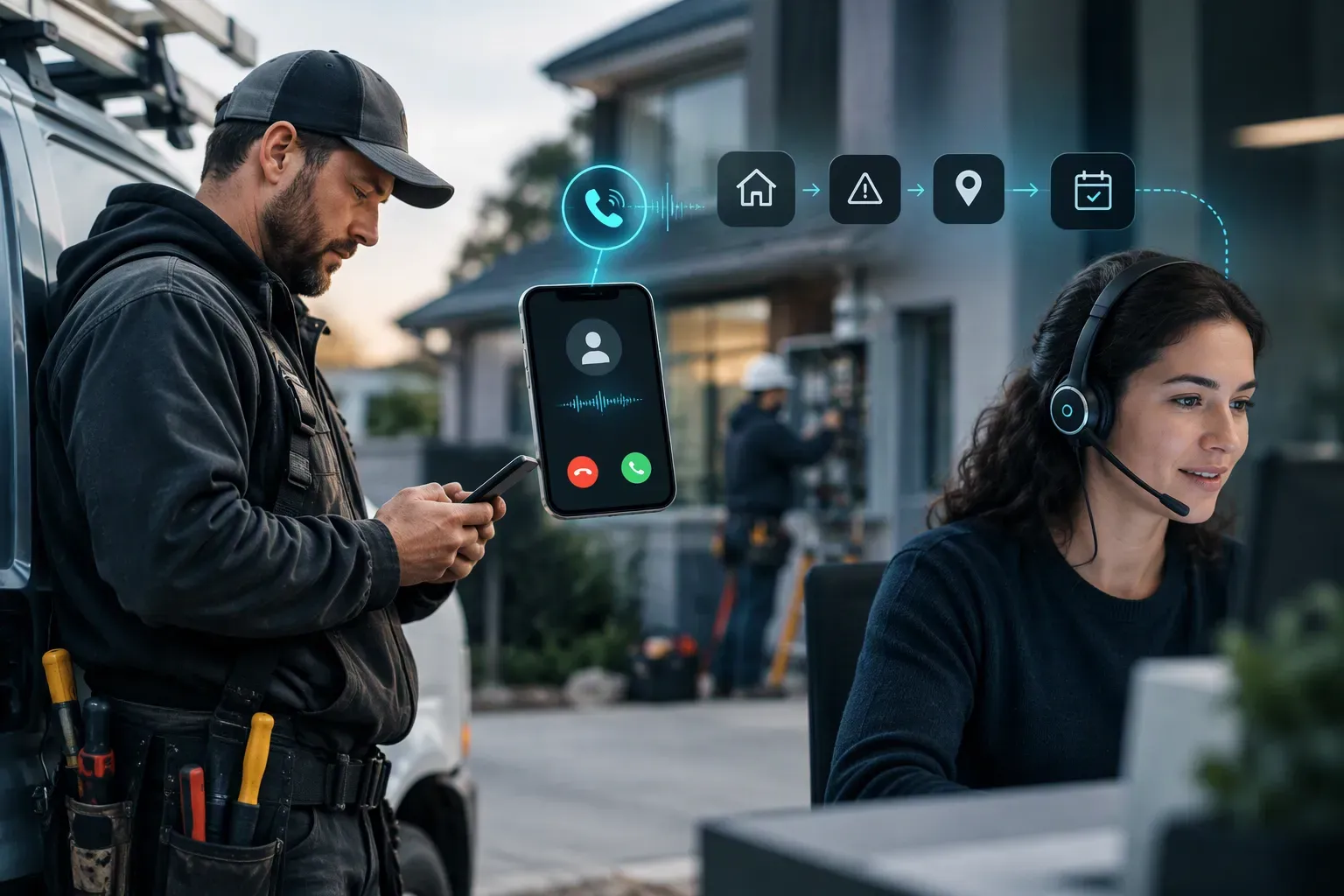
An AI receptionist for electrical contractors cannot make an electrician appear in AI search recommendations; it solves the next problem: answering and qualifying the enquiry once someone calls. Novacall AI responds to inbound leads in under 60 seconds, captures the issue, property type, urgency, and address, then books an estimate or routes urgent work through a connected workflow.
Key takeaways
- AI recommendation visibility and answering an inbound call are separate jobs.
- A useful electrical intake captures the issue, property type, urgency, and address.
- Novacall AI can book an estimate on a connected calendar and integrate with a CRM.
- Confirm website access, phone routing, and urgent-call handoffs before choosing a system.
Why an AI receptionist for electrical contractors is not an AI visibility tool
A homeowner can find an electrical contractor through a search result, a business listing, a referral, or an AI-generated recommendation. An AI receptionist does not control which businesses those tools name. It handles the contact after an enquiry reaches the business.
Treat discovery and response as separate parts of the sales process. To make your business information easy to understand, keep your electrical services, service area, contact details, and emergency availability clear and consistent across your website and business listings. Describe the work you actually take on. A polished phone process cannot make an unclear service page more useful, and a strong website cannot answer a call when nobody is available.
According to Worldmetrics.org Ai Electrical Industry Statistics (report), AI uses described for electrical work include predictive maintenance, smarter charging, and demand optimization. Those examples concern electrical operations, not whether a local contractor appears in a customer recommendation.
Finding: An AI receptionist handles the enquiry after it arrives; it does not determine whether a recommendation system names the contractor.
What should an AI receptionist for electrical contractors handle?
The first goal is not to troubleshoot an electrical fault over the phone. It is to gather the details your team needs to decide what happens next. For an AI receptionist for electrical contractors, that means capturing the issue, property type, urgency, and service address, then booking an estimate or routing urgent work according to your process.
In practice, callers often describe the fault before they give an address, so the intake should ask about the issue first and capture the address as part of the qualification. A caller reporting an outage, for example, needs a different next step from someone asking for an estimate on planned work. Ask the agent to collect facts, not guess at a diagnosis.
Novacall AI qualifies inbound enquiries on the call and responds to inbound leads in under 60 seconds. It supports voice, SMS, email, and WhatsApp workflows, along with multiple languages. The system can book an appointment on a connected calendar and integrate with a CRM. Those functions help keep intake and follow-up in one working process rather than leaving notes in disconnected places.
Finding: Novacall AI responds to inbound leads in under 60 seconds and can book an appointment on a connected calendar.
From a missed call to a booked estimate
A useful workflow makes each handoff clear. Before launch, write down what the system should ask, what qualifies as urgent, which calendar receives estimates, and who reviews exceptions. Revsquared.ai AI Receptionist Industry Real (analysis) examines business calls and compares AI phone-answering costs with human receptionist costs. Use any outside benchmark as context, not as a promise about your own lead flow.
| Call stage | Capture or action |
|---|---|
| Caller explains the issue | Record the reported problem in the caller's words |
| Basic qualification | Capture property type, urgency, and service address |
| Next step | Book an estimate or route urgent work using the agreed rules |
| Follow-up | Use the selected voice, SMS, email, or WhatsApp workflow |
| Record keeping | Check the CRM entry and calendar booking for accuracy |
Do not let a smooth conversation hide a weak handoff. Decide what happens when the caller gives an incomplete address, asks for work you do not offer, or needs an answer that requires a licensed electrician. The fallback should tell the caller what to expect and give your team enough information to take over.
Finding: A reliable call flow connects qualification to a defined next step, such as booking an estimate or routing urgent work.
How should urgent electrical calls be handled?
Urgent work needs a clear route, not an improvised answer. Define the conditions your business treats as urgent, the information staff need, and the person or process that receives the alert. Ask the system to collect the caller's stated issue and location, then follow those rules. Do not ask it to assess wiring or promise that a technician is available unless your team has confirmed that availability.
A real limitation of any automated receptionist is that it cannot inspect a property or replace an electrician's judgment. A caller can describe a problem in a confusing way, and an automated conversation can miss context. Keep a human fallback for unusual situations, safety concerns, and requests that do not fit the intake path. Confirm how a handoff works before relying on it for urgent calls.
Novacall AI supports routing urgent work as part of the workflow described for electrical enquiries. During setup, test the urgent path with realistic caller language. Confirm who receives the details, what the caller hears, and how your team confirms follow-up. Do not treat a captured message as proof that a technician has accepted the job.
How does an AI receptionist for electrical contractors compare with an answering service?
The label alone does not tell you what a service does. An answering service can follow a script, and the tasks it performs depend on its agreement. An AI receptionist can connect call qualification with follow-up, CRM integration, and calendar booking when those workflows are configured. Your in-house staff still bring trade knowledge, judgment, and context about existing customers.
| Approach | Strength and boundary |
|---|---|
| In-house office staff | Can use business context and judgment; coverage depends on the team's schedule |
| Answering service | Can take messages or follow agreed instructions; booking and escalation depend on the service agreement |
| AI receptionist | Can qualify calls and use connected follow-up, CRM, and calendar workflows; exceptions need a clear fallback |
When comparing options, ask who books estimates, where call details are recorded, how urgent work is routed, and what happens when a caller needs a person. Do not assume every answering service takes messages only, or that every automated system handles exceptions well. Compare the actual workflow you will use.
Will callers know they are speaking with AI, and does it replace office staff?
Caller awareness depends on the greeting and the way your business introduces the service. Be direct that the caller is speaking with an automated receptionist. Test the greeting with your team and listen for confusing wording, especially when callers ask for a person or describe urgent work.
An AI receptionist for electrical contractors works best as a first-response layer, not as a replacement for the people who schedule crews, manage customer relationships, and make trade decisions. It can handle qualification and connected booking workflows. Staff remain responsible for exceptions, confirming availability, dispatch decisions, and the service itself. Set a clear point where a person reviews or takes over a call.
Finding: An automated intake can collect job details and book an estimate, but it cannot inspect an electrical problem or replace a technician's judgment.
Can an AI receptionist for electrical contractors use your website or current phone number?
Website access and phone-number compatibility are not confirmed product facts here. Do not assume the receptionist browses your site, reads every service page, or works with your existing number without a routing change. Ask the vendor to demonstrate the exact website information it uses and explain how calls from your current line reach the system.
If you already have an answering service, map the call path before adding another layer. Decide which service answers first, how after-hours calls are handled, and how the team avoids duplicate callbacks or bookings. Run test calls through the full path, including an urgent enquiry and a request that needs a person. Keep the current process in place until the new route is confirmed.
Finding: Website access and compatibility with an existing phone number need direct confirmation before you rely on either feature.
How do we know an AI receptionist for electrical contractors is booking work?
Measure the steps between a call and a completed job, not just whether the system picked up. Review call records alongside CRM entries and calendar appointments. Track whether the caller was qualified, whether the right next step was taken, and whether your team completed the follow-up. This shows where the workflow breaks without assuming every enquiry turns into revenue.
Callbirdai.com AI Receptionist Statistics Data (market overview) discusses the virtual receptionist market and its growth. Market discussion does not show whether a particular setup books your estimates. Your own CRM and calendar records are the practical place to verify that result.
Check examples of successful bookings and exceptions with the staff who receive them. Look for missing addresses, incorrect job types, duplicate records, and appointments placed in the wrong calendar. If those problems appear, adjust the prompts, routing rules, or staff review process before expanding the workflow.
Novacall AI plans are tiered by daily call volume. Every plan includes multi-channel follow-up, CRM integration, and calendar booking; higher tiers include more voice minutes, more concurrent calls, and more AI agents. Pricing is quote-only. To discuss a plan for your call flow and qualification needs, Book a call.
Start with a call-path inventory
Begin with a one-page map of what happens to a call, not a feature checklist. List each public number, its current destination, business hours, overflow route, and the person who owns that route. Add the main caller types—new project inquiry, active-job update, supplier, wrong number, and urgent issue—only where those categories reflect the business’s actual traffic. The aim is to document the current process before changing it.
For each category, write the next action in plain language: capture a message, transfer, request a callback, or offer an appointment request. Mark the cases that require a live employee and the fallback if that employee is unavailable. Include handoffs beyond the phone, such as who checks a message and how it reaches the estimating or service team. If no one owns an outcome, document that gap rather than assuming an automated conversation will create a completed follow-up. This map gives configuration discussions a process to implement and exposes unresolved ownership early.
Set intake boundaries before configuration
Decide which information is necessary to route or return each call. For a new inquiry, choose required fields—such as caller name, callback number, job location, and a short description—and identify details that are optional. Use consistent fields in the handoff record so staff can find the same information regardless of how a caller explains the request. If a caller cannot provide a field, define whether intake can continue and who resolves the missing detail later.
Write an allowed/not-allowed sheet for statements with operational consequences. Specify whether the system may quote a range, confirm availability, promise a callback, or offer a slot; otherwise, require it to take a message or hand off. Set a boundary around technical diagnosis and assurances: only allow statements covered by a company-approved rule. For uncertain answers, define a neutral response and route instead of leaving the system to improvise. Name an owner for updates when service boundaries, schedule rules, or approved wording change, and make revisions part of routine operations.
Define booking authority and status
Before enabling direct scheduling, define the difference between a reserved visit and a request awaiting confirmation. List the work types, locations, visit lengths, buffers, and hours that qualify; set out what should happen when details are incomplete or no suitable slot appears. These are business rules to approve, not assumptions a vendor should make from a general description of the company.
Decide what happens when a calendar cannot be reached, a slot conflicts, or two callers seek the same opening. A callback request for staff review may be the chosen fallback, but the caller-facing wording and internal status should match. Specify who owns cancellations and rescheduling, too. A confirmation should not imply that a job is accepted, priced, or technically assessed unless the company has authorized that meaning. Treat “captured,” “pending confirmation,” and “booked” as separate workflow statuses.
Test exceptions before relying on the system
Before launch, test a fixed set of scenarios using the intended phone route. Include a straightforward inquiry, then cases where a caller gives a partial address, corrects a callback number, interrupts, asks an unsupported question, requests service outside the stated area, or wants an unavailable time. Also test what happens when a transfer is unanswered or a calendar is unavailable. These are acceptance tests, not edge cases to leave for callers to discover.
For each scenario, record the expected result and compare it with what happens. Check whether required details are captured accurately, the correct route is followed, pending requests are not described as confirmed, and the system avoids unauthorized commitments. Test the human fallback as carefully as the automated response: staff should know what information arrives and what action is expected. Have an operations owner review failures, update the rules, and repeat affected tests after changes to routing, hours, or approved wording.
Read industry figures as context, not a forecast
Industry data can help frame why businesses are evaluating automated phone answering, but it cannot predict one contractor’s call volume or return. According to Revsquared.ai AI Receptionist Industry Real (direct report), analysis of 1.4 million business calls across 17 industries shows: 51.2% are real leads, 28.5% arrive after hours, and AI phone answering costs 87–97% less than a human receptionist annually. Those are cross-industry figures; they do not establish an electrical contractor’s lead share, after-hours pattern, or likely savings.
According to Callbirdai.com AI Receptionist Statistics Data (direct report), the virtual receptionist market reached $3.85 billion in 2024 and is projected to hit $9 billion by 2033, a compound annual growth rate of 9.8%. That market estimate describes category growth, not whether a particular setup fits a contractor’s call mix or operating rules. Use market figures as context, then base a purchase decision on the company’s own process and test results.
Make vendor selection a proof exercise
Ask each provider to demonstrate the same scenarios from your acceptance tests, including at least one failed handoff and one request the system should not fulfill. Compare the resulting calls and records against the same rules rather than relying only on a polished demonstration. Ask who can change schedules and routing, how staff receive unresolved requests, what happens if a transfer fails, and which records are available to the team.
Clarify the operational and commercial details before committing: who maintains the approved wording, what support is available when a rule needs correction, how access to call records is controlled, what data can be exported, and which fees or usage limits apply. Request specific answers rather than inferring capabilities from a product label. Separate must-pass requirements—such as correct routing, clear pending-versus-booked status, and a workable human fallback—from preferences like conversational style. If critical workflow questions remain unanswered, treat that as a readiness gap, not something to resolve after launch.