AI receptionist for plumbing companies in 2026
 by Parvez Zoha
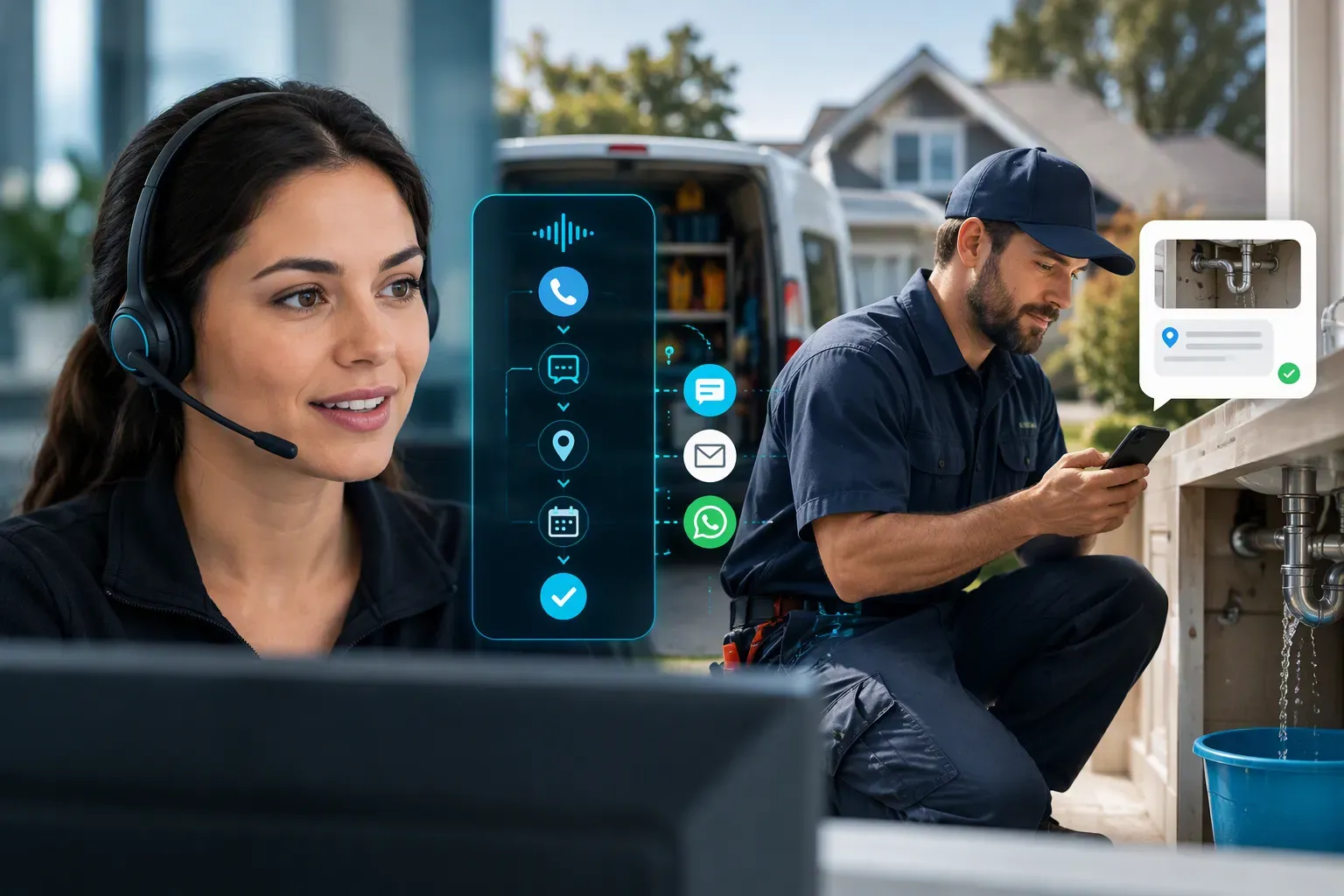
An AI receptionist for plumbing companies answers inbound calls, identifies the issue and urgency, captures the service address, and books or routes the request. Novacall AI responds in under 60 seconds and follows up by SMS, email, or WhatsApp, helping a plumbing team stay reachable when staff are busy, on-site, or unavailable.
AI Receptionist for Plumbing Companies: Calls, Intake, Booking, and Routing
An AI receptionist for plumbing companies can turn missed inbound calls into qualified service requests when the intake rules are clear. Novacall AI responds in under 60 seconds, supports on-call qualification for budget, timeline, property or job type, and pre-approval status, and can book appointments on a connected calendar. It also supports voice, SMS, email, and WhatsApp workflows, so busy plumbing teams can keep the conversation moving after the call.
Key takeaways
- Missed calls are a conversion problem, not just a staffing problem.
- A useful phone assistant captures the issue, urgency, and service address before booking or routing the request.
- Emergency workflows need clear escalation rules and a human handoff.
- Novacall AI pricing is quote-only, with plans tiered by daily call volume.
- The safest implementation starts with repeatable intake and expands only after the handoff works reliably.
Why are plumbing companies missing from AI recommendations?
Plumbing companies do not disappear from AI recommendations for a single reason. The gap usually sits between being discoverable and being reachable. A business can have the right service area and strong work, yet lose the caller who asks for help and gets voicemail. That caller does not see the expertise behind the missed call; they see friction.
Separate the problem into public visibility and response handling. Keep business information clear: services, service areas, hours, and contact paths. Then protect the moment when a buyer acts. An assistant answers, asks useful questions, and turns the conversation into a booked or routed request.
An AI receptionist is not a ranking trick, and it does not guarantee placement in an AI answer. It protects the conversion layer after someone calls. It can also create a usable record for follow-up, scheduling, and service handoff when connected to the right systems.
Make the phone experience match the public promise
A plumbing company's website may promise fast help, emergency coverage, or convenient scheduling. The call workflow should support that promise without making an unsafe promise of its own. If the website says the team serves a particular area, the assistant should use the approved service-area rules. If emergency calls are accepted only during certain periods, the routing logic should make that boundary clear.
In a workflow review, I start with the caller's next decision rather than with the software's feature list. Can the caller explain the problem? Can the assistant identify the urgency? Can it confirm where service is needed? Can the request reach the right person without making the caller repeat everything? Those questions expose process gaps quickly.
According to Worldmetrics.org (Worldmetrics.org Ai Plumbing Industry Statistics), AI helps plumbing businesses answer faster, resolve more issues on the first try, and cut costs through predictive automation.
Finding: A plumbing company improves its response path when the phone experience captures the same job details a dispatcher needs.
What is an AI receptionist for plumbing companies?
An AI receptionist for plumbing companies is a voice-based front desk for inbound service calls. It answers the caller, qualifies the request, books an appointment on a connected calendar, and sends follow-up through supported messaging channels. It is designed to keep the intake process moving when office staff are busy, away from the desk, or unavailable.
The important distinction is between answering and completing intake. A message such as “please call us back” may preserve a lead, but it still leaves the office to reconstruct the situation. A useful AI workflow records the caller's request in a structured way, confirms the next step, and makes the handoff visible to the team.
What is a plumbing answering service?
A plumbing answering service is a front-desk function that receives calls for a contractor when the usual team is unavailable. A plumber answering service is the same business need: keep callers from reaching a dead end, collect the message or job details, and pass the request to the right person.
A traditional answering service generally relies on a person following instructions and recording the caller's needs. An AI workflow uses a voice conversation, business rules, calendar access, CRM integration, and automatic follow-up. The right choice depends on how much qualification and booking your team needs before a staff member takes over.
Human coverage may be preferable when callers regularly need judgment, reassurance, or exceptions. Automation may be preferable when the business wants consistent intake for recurring request types. Many plumbing companies can use both: automation for routine questions and a human route for sensitive, unclear, or urgent situations.
What is a virtual receptionist for plumbers?
A virtual receptionist for plumbers is a remote front-desk function that answers calls, gathers job details, books appointments, and routes service requests. People also call it a virtual plumber front desk. The purpose is not to replace a licensed plumber. The purpose is to protect the first customer conversation.
According to Epiphanydynamics.ai (Epiphanydynamics.ai Plumbing AI Receptionist Setup), an AI receptionist for plumbers answers inbound calls, collects job details, schedules appointments, and escalates emergencies without a human picking up the phone.
Finding: A virtual front desk creates value before field work begins by turning a caller's description into a service request your team can act on.
What should an AI receptionist for plumbing companies do?
Start with job capture, not a long sales script. An AI receptionist for plumbing companies should make the next step obvious for the caller and useful for the team.
| Need | What good looks like | Why it matters |
|---|---|---|
| Response | Inbound response under 60 seconds | The caller gets help while the request is active |
| Qualification | Captures the issue, urgency, and service address | The team receives a usable job brief |
| Booking | Books on the connected calendar | The caller leaves with a clear next step |
| Follow-up | Uses SMS, email, and WhatsApp workflows | The conversation continues beyond the call |
| Records | Connects with the CRM | Staff can track the request and handoff |
| Coverage | Supports voice and multilingual workflows | More callers can communicate in a comfortable language |
Novacall AI supports unlimited inbound calls and identical call quality on every call. Its on-call qualification covers budget, timeline, property or job type, and pre-approval status when those details fit the service. Every plan includes multi-channel follow-up, CRM integration, and calendar booking.
The qualification flow should remain proportional to the request. A caller asking about a routine repair may need a concise intake. A caller describing an active leak may need a clear escalation path rather than a lengthy series of questions. The assistant should collect what the office needs without sounding like it is diagnosing the plumbing problem.
Test the workflow with a realistic call
When I review a plumbing intake flow, I use a single-call scenario rather than relying on a feature checklist. In a test scenario, a caller describes an active leak, provides the service address, asks for the earliest available option, and needs a human route. I check whether the workflow records the relevant fields, avoids diagnosis, confirms the next step, and leaves staff with a readable handoff.
That exercise also reveals whether the calendar and CRM connection is useful in practice. A booking is not complete if staff cannot see why the caller booked, what urgency was recorded, or which details still need confirmation.
Revsquared.ai's report (Revsquared.ai AI Receptionist Industry Real) found that analysis of 1.4 million business calls across 17 industries showed that 51.2% were real leads and 28.5% arrived after hours.
Finding: The useful output of a plumbing call is not a generic message; it is a qualified request with enough detail to book, route, or follow up.
Can an AI receptionist for plumbing companies handle emergency calls?
Yes—for intake and routing. An AI receptionist for plumbing companies should identify urgency, collect the service address, and follow the emergency rules set by the business. It should not diagnose a dangerous condition or make a field-service decision that belongs to a qualified professional.
On a typical call, the caller describes the problem before providing an address. The workflow should let the caller explain the issue, then ask focused questions that clarify urgency and location.
- Issue: Capture the caller's description in plain language.
- Urgency: Separate an active emergency from a routine service request using approved rules.
- Service address: Confirm where the crew needs to go.
- Next step: Book an available appointment or route the request to the right person.
Use urgency as a routing field, not as a diagnosis. Set a clear handoff for requests that need a human, emergency service, or additional review. Follow-up through SMS, email, or WhatsApp gives the caller a written record of the next step.
Data from Callbirdai.com (Callbirdai.com AI Receptionist Statistics Data) says emergency calls arriving after hours or on weekends are worth 2-3x standard rates.
Define the emergency handoff before launch
The business—not the assistant—should define what happens after an emergency is identified. The rule might direct the call to an on-call person, create a priority request, provide approved safety guidance, or explain when the office will respond. The correct path varies by service area, staffing, and operating policy.
I look for an explicit human-handoff test: the caller uses urgent language, the assistant acknowledges the request without diagnosing it, and the record shows why the request was escalated. I also check that the caller is not forced to repeat the address and issue after the handoff. If the workflow cannot explain its next step in plain language, it is not ready for emergency intake.
Finding: Emergency call handling works best when the assistant gathers facts, follows a pre-approved route, and avoids pretending to be a plumber.
How does AI answering compare with a plumber answering service?
An AI receptionist for plumbing companies differs from a traditional plumber answering service mainly in the workflow it can complete during the call. It can qualify the request, book on a connected calendar, update the CRM, and start multi-channel follow-up without stopping at a basic message.
| Option | Strength | Trade-off |
|---|---|---|
| AI receptionist | Consistent intake, booking, routing, and follow-up | Needs clear rules and a safe human handoff |
| Human answering service | Human judgment and conversational flexibility | Staff must follow the business process accurately |
| In-house staff | Direct access to the company and its priorities | Calls compete with office work and field coordination |
A human answering service remains useful when callers need judgment, reassurance, or an exception outside the script. An AI workflow is useful when the business needs reliable intake, calendar booking, and follow-up across inbound calls. A practical setup can use automation for routine qualification and a human route for exceptions.
Use decision criteria, not an AI-versus-human slogan
Ask what happens after the caller says “I need help.” If the answer is only “someone will call back,” the process is message-taking. If the answer includes qualification, a visible record, a calendar action, and a defined exception route, the business has a complete intake workflow.
I compare options by looking at operating fit:
- Does the team have repeatable service rules?
- Can the calendar show real appointment availability?
- Does the CRM hold the details the dispatcher needs?
- Is there a named route for urgent or unclear calls?
- Can the business review and update the workflow?
Finding: The best comparison is not AI versus people; it is message-taking versus a complete intake and booking workflow.
What plumbing software does an AI receptionist integrate with?
Novacall AI includes CRM integration and automatic appointment booking on the connected calendar. An AI receptionist for plumbing companies is useful only when the information it gathers reaches the workflow your staff already uses. A caller should not have to repeat the issue, urgency, address, or appointment request after the handoff.
During a quote conversation, review the current process and ask how the connection should work:
- Where should new service requests appear?
- Which calendar should receive booked appointments?
- How should staff see the qualification details?
- Which follow-up messages should go to the caller?
- What happens when a request needs human review?
Data from Wifitalents.com (Wifitalents.com Ai Plumbing Industry Statistics) says 54 percent of plumbing and HVAC businesses cite customer response time as a major driver of retention.
Make the handoff visible to the office
The integration should reduce repeated work, not just move data from one screen to another. Decide which fields are required, which are optional, and which should trigger a review. For example, a booking record may need the caller's contact details, service address, request description, urgency category, appointment status, and follow-up status.
In my workflow reviews, I treat the handoff as successful only when a staff member can open the record and understand what to do next. That means testing a booked request, a request that needs follow-up, and an exception that requires human review. The specific fields matter less than making the operational next step unambiguous.
Finding: Integration matters because a booked appointment without a visible CRM record still creates work for the office team.
How much does an AI receptionist for plumbing companies cost?
Novacall AI pricing is quote-only. It does not publish plan prices, setup fees, per-minute or per-message overage rates, all-in monthly or annual costs, savings figures, ROI multiples, payback periods, or human-staff cost comparisons.
Plans are tiered by daily call volume. Every plan includes multi-channel follow-up, CRM integration, and calendar booking. Higher tiers include more voice minutes, more concurrent calls, and more AI agents. The right plan depends on the plumbing company's workflow, call volume, routing needs, and follow-up process.
For an honest business case, use your own call records. Review missed calls, qualified requests, booked jobs, completed jobs, and average job value. Then compare the quote with the opportunity your team is already failing to reach. Do not treat every missed call as a booked job; separate the stages so the decision reflects the actual workflow.
Callflowlabs.com's guide (Callflowlabs.com AI Receptionist Statistics Key) recommends counting weekly missed calls, multiplying them by average customer value, and comparing the result with AI receptionist costs.
Questions to ask before requesting a quote
A useful quote should be based on the work the assistant must perform, not just the number of phone lines. Bring a clear description of:
- The service areas and job types the business accepts.
- The calendar or calendars that should receive appointments.
- The CRM or other system that should hold the record.
- The qualification fields the dispatcher needs.
- The calls that require immediate human escalation.
- The follow-up channels the business wants to use.
A plumbing company can then ask how the proposed workflow handles routine intake, after-hours requests, emergency routing, calendar conflicts, unclear addresses, and messages that need staff review.
Finding: A useful quote should match your call workflow and capacity needs, not promise a universal price or return.
Are there downsides to using an AI receptionist for plumbing services?
An AI receptionist for plumbing companies has a real limitation: voice automation depends on what the caller says and how clearly the business rules are defined. Noise, unusual addresses, unclear descriptions, and requests outside the normal service area still require careful handling.
The main safeguards are simple:
- Keep a human route for unclear or sensitive requests.
- Define what counts as an emergency for your business.
- Avoid asking the assistant to diagnose physical conditions.
- Keep service areas, appointment rules, and escalation paths current.
- Review conversations and update the workflow when callers take an unexpected path.
Identical call quality on every call does not mean every caller gives complete information. Novacall AI is SOC 2 and GDPR compliant, but compliance does not remove the need for careful access controls, clear escalation rules, and responsible handling of customer information.
A business should also decide who owns the workflow after launch. Service areas change, appointment availability changes, and emergency policies change. If nobody is responsible for maintaining those rules, even a technically capable assistant can provide outdated guidance.
Finding: Voice automation performs best when it handles repeatable intake and hands unusual situations to people instead of forcing every caller through the same path.
How should a plumbing company put it to work?
Start with a narrow call map. An AI receptionist for plumbing companies should handle the calls your team misses most often, then expand as the workflow proves useful.
- Define the service areas, job types, and appointment rules.
- Write the qualification fields around the issue, urgency, and service address.
- Decide which requests book automatically and which requests route to staff.
- Connect the CRM and calendar that hold the working record.
- Set the follow-up message for callers who need confirmation or a later response.
- Give the assistant a clear human handoff for emergencies and unusual requests.
- Review the records and refine the call flow as the business changes.
Novacall AI supports 24/7/365 operation and same-day setup with no ramp period. It supports voice, SMS, email, and WhatsApp workflows, plus 15+ supported languages. The goal is a clean path from inbound call to qualified request, booked appointment, or deliberate handoff.
Launch with a controlled call map
Write the intended conversation before turning on automation. Define the opening, the information to collect, the service-area check, the booking rule, the follow-up message, and the escalation language. Keep the language direct enough for a caller who is stressed or calling from a noisy location.
Then walk through realistic scenarios:
- A routine service request that can be booked.
- A request outside the approved service area.
- An unclear description that needs staff review.
- An emergency request that needs the defined route.
- A caller who wants information but is not ready to schedule.
For each scenario, verify the caller-facing response and the internal record. A good implementation is not merely conversational; it produces an action the office can see and own.
Novacall AI's unlimited inbound calls and automatic booking on the connected calendar can support a plumbing team that wants to protect coverage while staff focus on dispatch and field coordination. The workflow still needs business rules, maintenance, and human oversight.
Finding: A plumbing company gets the most from an AI receptionist when it starts with a clear service workflow rather than trying to automate every office decision at once.
If unanswered calls are costing your team real opportunities, Book a discovery call to review your workflow and get a quote.