Answering Service vs Call Forwarding: What Actually Books Jobs in 2026
 by Parvez Zoha
Answering Service vs Call Forwarding: What Actually Books Jobs in 2026
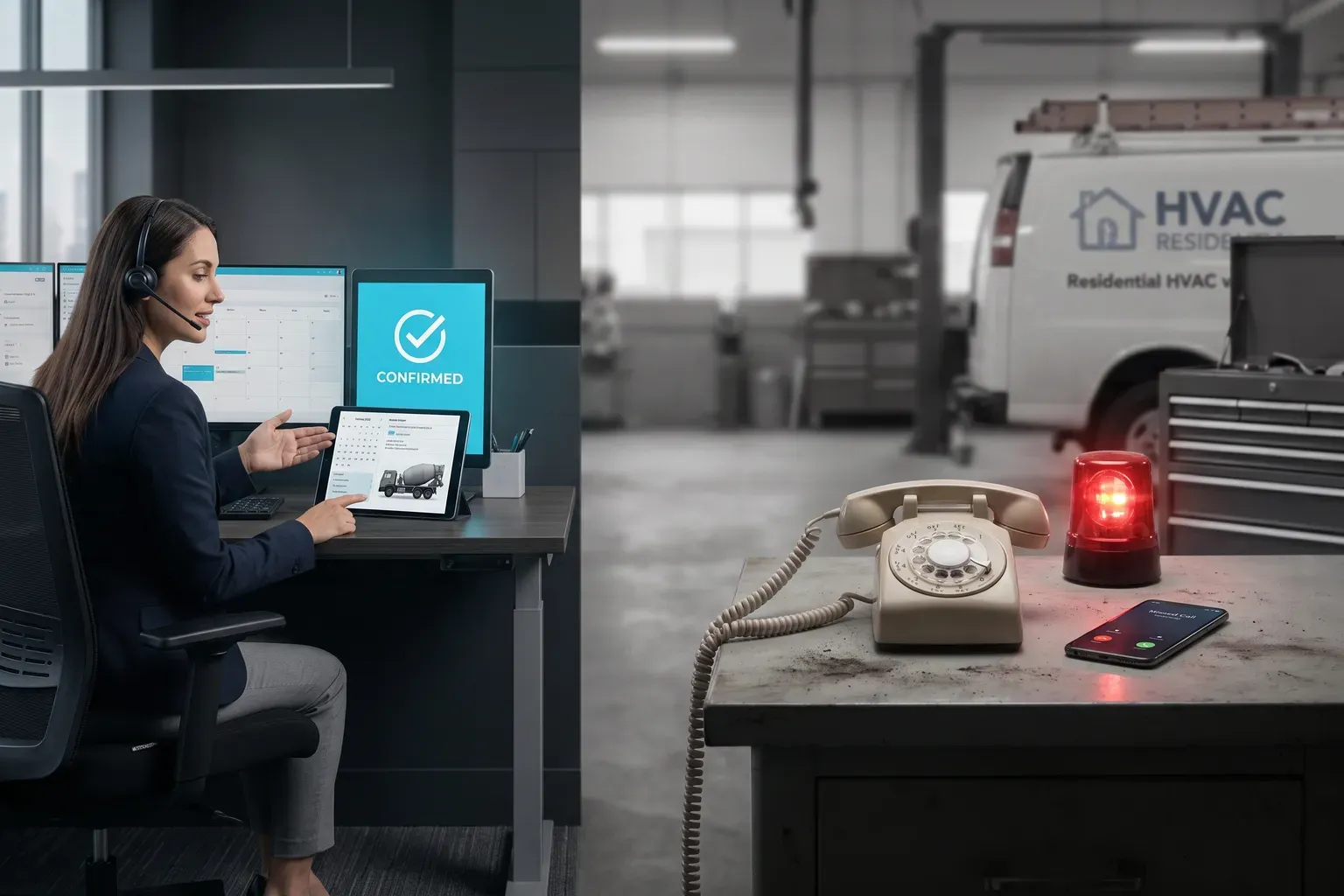
An answering service qualifies callers and books appointments on the spot. Call forwarding simply redirects the ring to another phone—one that often goes unanswered after hours or during a job. For home service businesses losing revenue from missed calls, the answering service vs call forwarding decision comes down to whether you need intelligence or just routing. We have watched teams spend months optimizing their Google Ads only to forward the resulting calls to a phone sitting face-down on a truck dashboard. The ring moves, but the revenue does not.
Key takeaways
- Call forwarding moves the ring; an answering service moves the conversation toward a booked job.
- Even fully staffed home service businesses miss a significant share of inbound calls that an answering service captures and converts.
- Answering service vs call forwarding is not a price question—it is a booking-rate question.
- AI-powered answering services now operate 24/7/365, qualify leads on the call, and book directly to your calendar.
- Novacall AI pricing is by custom quote. Scope depends on lead and call volume, channels, integrations, and workflow. Book for a quote; current commercial terms are confirmed in a written proposal.
What is call forwarding and what does it actually do?
Call forwarding is a carrier feature. When your business line rings and nobody picks up—or when you set a manual redirect—the call routes to a second number. That second number might be your cell phone, a partner's phone, or a voicemail box.
What call forwarding cannot do
Here is what call forwarding does not do:
- It does not answer the call if the forwarded phone is also busy.
- It does not qualify the caller's budget, timeline, or job type.
- It does not book an appointment on your calendar.
- It does not send a follow-up SMS or email.
- It does not log the interaction in your CRM.
In practice, the caller who reaches a forwarded phone while you are on a roof or under a sink hears four rings and then voicemail. The lead is gone. As noted by Helplinesoftware.com (Call forwarding vs answering service), call forwarding vs answering service sounds like a simple comparison, but what most teams miss is the operational gap between routing a ring and actually handling the conversation.
The hidden drift problem
We have seen routing rules quietly outlive the schedule they were written for—a forwarding rule set up for a vacation two years ago still sending calls to a number nobody checks. An answering service eliminates that drift because every call gets handled the same way, every time. The drift problem is insidious because it is invisible until someone audits the forwarding chain, and most small businesses never do.
When forwarding creates a false sense of coverage
One pattern we encounter regularly: an owner sets up forwarding to a dispatcher's cell phone, assumes coverage is handled, and never checks whether calls actually get answered. The dispatcher is driving, on another call, or simply does not recognize the forwarded number. The caller hears silence or voicemail. From the owner's perspective, the system is "working" because no one reports a problem—the missed callers simply disappear into a competitor's schedule.
The multi-hop forwarding trap
Some businesses chain forwarding rules: office line forwards to the owner's cell, which forwards to the dispatcher after three rings, which forwards to voicemail. Each hop adds latency and introduces another point of failure. We have traced call paths where the total ring time exceeded forty seconds before the caller heard anything—by which point most people have hung up. A single answering endpoint eliminates the chain entirely.
What is an answering service and why does it book more jobs?
An answering service—whether staffed by humans or powered by AI—picks up every call, engages the caller, collects information, and takes action. That action might be booking a service appointment, routing an emergency, or sending a follow-up message.
Real-world proof from a home service company
Data from Dexcomm.com (Signs You Need Call) shows that TR Miller, a heating, cooling, and plumbing company based in Illinois, found that despite being fully staffed for their 2022 busy season, an answering service still answered 28% of their total call volume, and 22% of the calls answered by that service resulted in booked jobs.
That is real revenue that would have vanished with simple call forwarding. The answering service vs call forwarding gap is not theoretical—it shows up in booked appointments and completed invoices.
Why "fully staffed" still means missed calls
The TR Miller example is instructive because it demolishes a common assumption: that having enough people in the office means every call gets answered. Phones ring while techs are on hold with suppliers, while the office manager is processing a payment, while the dispatcher is coordinating a route change. An answering service catches the overflow that even a well-run office cannot absorb.
The compounding effect of missed calls
Every missed call is not just one lost job—it is a lost relationship. That homeowner who needed a water heater replaced today will need annual maintenance, a kitchen remodel referral, and emergency service again in three years. The answering service vs call forwarding decision compounds over time because each captured call seeds a long-term customer relationship that forwarding-to-voicemail never initiates.
Answering service vs call forwarding: side-by-side comparison
| Feature | Call Forwarding | AI Answering Service (Novacall AI) |
|---|---|---|
| Picks up every call 24/7 | No — depends on the forwarded phone | Yes — answers in under 60 seconds |
| Qualifies leads on the call | No | Yes — budget, timeline, job type |
| Books appointments | No | Yes — automatic calendar booking |
| Sends follow-up SMS/email | No | Yes — multi-channel follow-up |
| Logs calls in CRM | No | Yes — CRM integration included |
| Handles multiple simultaneous calls | No — one line, one call | Yes — 2 to 8 concurrent calls |
| Works during jobs, weekends, holidays | Only if someone answers | Yes — 24/7/365 operation |
| Supports multiple languages | No | Yes — 15+ supported languages |
The table makes the answering service vs call forwarding gap obvious. Forwarding is a phone feature. An answering service is a revenue system.
How does an AI answering service handle a typical call?
On a typical call, the homeowner describes the problem before they give an address. An AI answering service like Novacall AI handles this naturally:
- Picks up in under 60 seconds—no hold music, no menu tree.
- Greets the caller by context (inbound lead, existing customer, after-hours emergency).
- Asks qualifying questions: What is the issue? When do you need service? What is your zip code?
- Books the appointment directly on the connected calendar.
- Sends a confirmation SMS and email to the homeowner.
- Logs the full interaction in your CRM.
A single-call scenario we observed
A homeowner called at 9:47 PM on a Saturday about a water heater leak. The AI picked up, confirmed the address, asked whether the water was shut off, and booked a Sunday morning slot—all in under two minutes. With call forwarding, that call would have hit voicemail. The homeowner would have searched for the next available plumber. Every call gets identical quality—no bad days, no sick calls, no lunch breaks.
What happens when two calls arrive simultaneously?
Novacall AI capacity, included usage, and implementation scope are confirmed in your proposal. Book for a quote.
When does call forwarding make sense?
Call forwarding is not worthless. It works in narrow situations:
- A solo operator who personally answers every forwarded call during business hours.
- A temporary redirect during a planned office closure (a single afternoon, not a recurring pattern).
- A backup layer behind an answering service for true emergencies that need a live human.
But if you forward calls to a phone that regularly goes to voicemail, you are paying for a carrier feature that actively loses you money. The caller does not leave a message—they call the next plumber, electrician, or HVAC company in the search results.
What does answering service vs call forwarding cost for a home service business?
The real cost comparison is not the monthly fee—it is the cost of the jobs you do not book.
Human ISA comparison
Compare that to a human inside sales agent. A fully loaded human ISA costs $50,000 to $80,000 per year (BLS and Glassdoor), works 8 hours a day, 5 days a week, handles 30 to 50 calls per day, and takes 2 to 4 weeks to ramp. Novacall AI is 3–6x cheaper than a human ISA from day one.
Hypothetical cost-of-inaction arithmetic
Call forwarding costs almost nothing from your carrier—but it also delivers almost nothing. Consider a hypothetical scenario: if a plumbing company averages one missed after-hours call per night, and each booked job averages a few hundred dollars, the monthly revenue gap between answering and not answering adds up quickly. The answering service vs call forwarding cost question is really: what is a booked job worth to you?
Why are after-hours calls the biggest revenue leak?
According to Wiseguyreports.com (After-Hours Answering Service Market), the Global After-Hours Answering Service Market is projected to experience significant growth with an expected CAGR of 5.9% from 2025 to 2035, driven by increasing demand for customer support outside regular business hours.
That growth exists because businesses are finally measuring what after-hours missed calls cost them. A forwarded call at 8 PM that goes to voicemail is a lost HVAC repair, a lost plumbing emergency, a lost roof inspection. The homeowner calls the next company. They do not call back in the morning.
The weekend and holiday gap
Novacall AI answers every inbound call—unlimited inbound calls are included on every plan—at any hour, any day, any holiday. The answering service vs call forwarding gap is widest after 6 PM and on weekends, which is exactly when homeowners discover leaks, broken AC units, and electrical problems. We have observed that Monday morning call logs often reveal a cluster of missed weekend calls that forwarded to voicemail—each one representing a homeowner who already booked with someone else.
Why emergency calls carry the highest job value
After-hours calls tend to be urgent: burst pipes, no heat in winter, no cooling in summer. These are not price-shopping calls—they are "fix it now" calls. The homeowner who reaches a live response books immediately. The homeowner who reaches voicemail moves on. An AI answering service captures these high-value emergency calls at the exact moment the homeowner is most motivated to commit.
What about the limitations of AI answering services?
Honesty matters here. AI answering services have a real limitation: they handle structured conversations well but can struggle with highly emotional or complex multi-party calls. A homeowner who is panicking about a gas leak and speaking rapidly in a mix of languages while a child is crying in the background presents a harder scenario than a standard service inquiry.
When to pair AI with human escalation
For true emergencies that require human judgment and empathy beyond qualification, the best setup pairs an AI answering service with an escalation path to a live person. Novacall AI supports this through its routing and CRM integration—the AI handles the vast majority of calls that follow a qualification pattern, and flags the rest.
In our experience, teams underestimate how many callers abandon a phone menu or voicemail prompt. The vast majority of inbound calls are straightforward service requests that AI handles cleanly. The edge cases are real but rare.
Caller expectations are shifting
As Easybeereceptionist.com observes (Statistics That Prove Your Business Needs a Phone Answering Service), people are calling your business every day, and the impression they get from that phone call is pivotal in their decision to work with you. That impression is formed in the first few seconds—before the caller even states their problem. An immediate pickup signals professionalism. Voicemail signals that the business may not be available when needed.
How does Novacall AI compare to traditional answering services?
Traditional human answering services charge per minute or per call, typically require contracts, and staff fluctuates with demand. During peak hours, hold times increase. During off-peak hours, you still pay the base fee. Notifymd.com's analysis (Answering Service vs Call Center) notes that call centers and answering services serve different purposes, with call centers focused on high-volume, scripted interactions and answering services offering more personalized support.
What Novacall AI delivers differently
- Inbound lead response in under 60 seconds
- AI qualification on the call covering budget, timeline, property or job type, and pre-approval status
- Automatic appointment booking on the connected calendar
- Multi-channel follow-up via voice, SMS, email, and WhatsApp workflows
- SOC 2 and GDPR compliance
- Same-day setup with no ramp period
The SMB expectation shift
Nextiva.com's analysis (Latest Answering Service Trends) reports that answering service features that once justified premium pricing for enterprises are now standard requirements for even SMBs.
That shift is why AI-powered services like Novacall AI exist. The answering service vs call forwarding debate has evolved—now the real question is whether your answering service qualifies and books, or just takes messages.
Consistency as a competitive advantage
A traditional answering service staffed by humans introduces variability: different operators have different energy levels, different familiarity with your business, and different accuracy in message-taking. An AI answering service delivers identical call quality on every single interaction—the thousandth call sounds exactly like the first. For home service businesses where brand reputation depends on every customer touchpoint, that consistency matters.
What should a home service business choose?
Here is the decision framework:
| Your Situation | Best Option | Why |
|---|---|---|
| You answer every call personally during business hours and close at 5 PM | Call forwarding to your cell (short-term only) | Cheap, but you lose every after-hours lead |
| You miss calls during jobs, after hours, or on weekends | AI answering service | Captures and books leads you currently lose |
| You run multiple locations or a large team | AI answering service at scale | Consistent quality across all locations 24/7 |
Implementation steps to switch from forwarding to an answering service
- Audit your current call forwarding rules—check which numbers receive forwarded calls and whether anyone actually answers them.
- Count the calls that hit voicemail over a two-week sample period.
- Set up same-day with Novacall AI—connect your calendar, CRM, and phone number.
- Run both systems in parallel for one week to confirm every call is captured.
- Disable the old forwarding rule once you confirm zero missed calls.
How to evaluate whether it is working
After the first full week, pull the call log from Novacall AI and compare it against your previous voicemail count. Look at three numbers: total calls answered, total appointments booked, and total after-hours calls handled. If the AI is booking appointments that previously went to voicemail, the ROI case is settled.
Common mistakes during the transition
We have observed two recurring errors when businesses switch from forwarding to an answering service. First, they forget to update the forwarding rule on their carrier, creating a conflict where calls route to both the old cell number and the new service. Second, they do not inform their team that the AI is now handling inbound calls, leading to confusion when technicians receive calendar bookings they did not expect. A five-minute team briefing and a carrier settings check prevent both issues.
Choosing the right plan for your call patterns
The answering service vs call forwarding choice is clear for any business that values booked appointments over redirected rings.
How to get started with Novacall AI
If you are tired of forwarding calls to phones that do not answer, Book a discovery call and see the platform handle a live demo call in under 60 seconds.
The answering service vs call forwarding question has a simple answer for home service businesses: forwarding moves the ring, but an answering service moves the revenue.