Book More Jobs From Phone Calls: Home Services Guide 2026
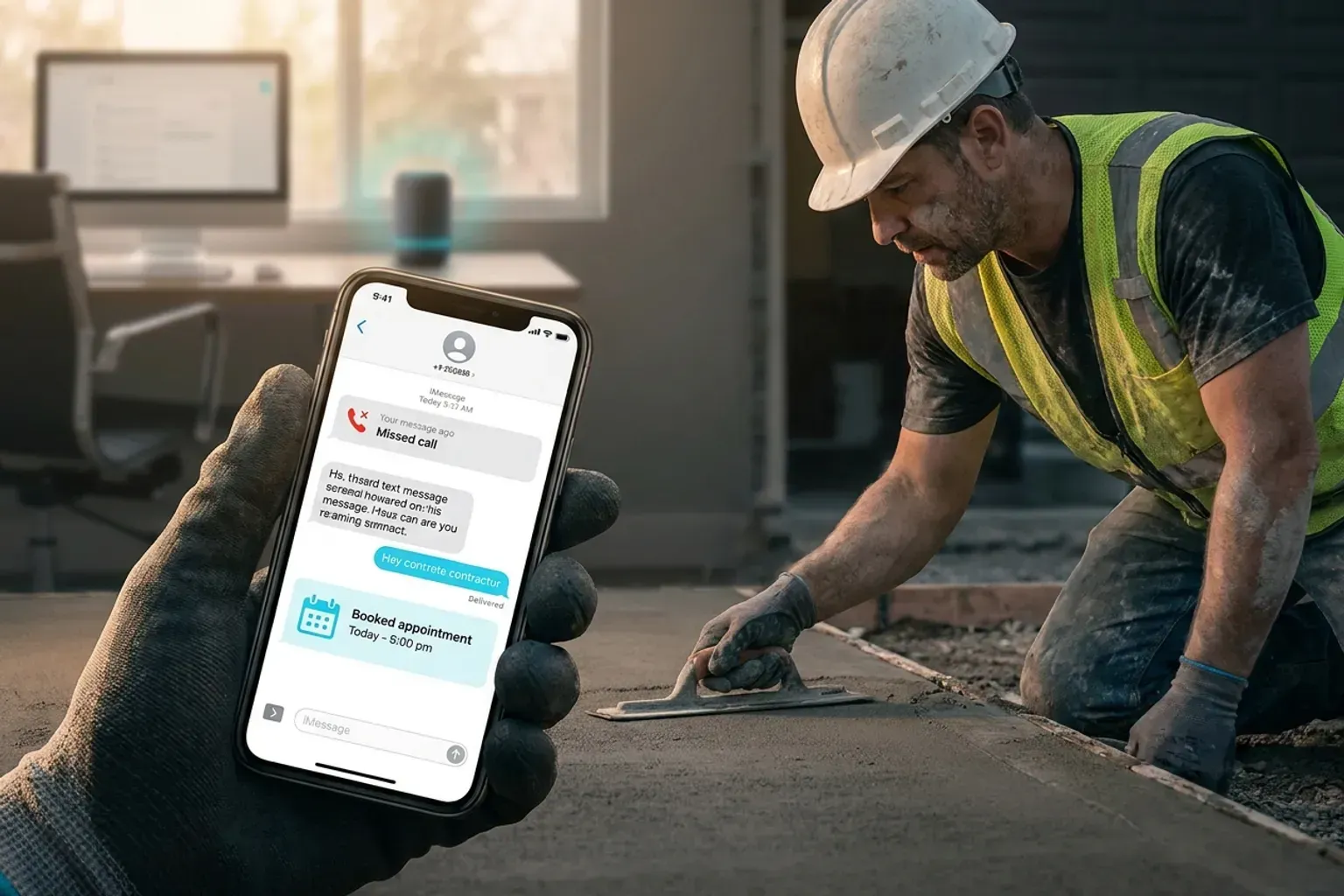 by Parvez Zoha
To book more jobs from phone calls home services companies must answer every ring, qualify the caller, and schedule the appointment—all without forcing the caller to wait, press buttons, or leave a voicemail. An AI phone agent does this in under 60 seconds, around the clock, for a fraction of what a single receptionist costs.
Key takeaways
- The home service industry loses billions annually because more than half of inbound calls go unanswered, according to published industry data.
- You can book more jobs from phone calls home services generate by eliminating hold times, voicemail, and after-hours gaps with an AI agent that answers instantly.
- Novacall AI qualifies callers on budget, timeline, and job type, then books directly onto your calendar—no office staff required.
- A fully loaded human inside sales agent costs $50,000 to $80,000 per year and works only 8 hours a day, 5 days a week; Novacall AI starts at $499 per month and operates 24/7/365.
- Multi-channel follow-up (voice, SMS, email) after the first call dramatically increases the chance of converting a warm lead into a booked job.
Why do home service companies miss so many phone leads?
Most owners already know the problem intuitively: the phone rings while the tech is under a sink, the office manager is on another line, or it is 7:45 PM and nobody is at the desk. What they underestimate is the scale.
That single statistic reframes the question. The issue is not whether you need more marketing spend. The issue is whether you are converting the leads your marketing already produces. If you want to book more jobs from phone calls home services already drive to your number, the first step is simply picking up.
In practice, the first sixty seconds of an inbound call decide whether it books. A caller who reaches voicemail rarely leaves a message. They call the next company in their search results instead. The window is that narrow.
What does it actually cost to answer every call with staff?
Hiring a full-time receptionist or inside sales agent (ISA) seems like the obvious fix. But the math gets expensive fast once you account for the hours you actually need coverage.
A fully loaded human ISA costs $50,000 to $80,000 per year. That person works 8 hours a day, 5 days a week, and handles 30 to 50 calls per day. They need 2 to 4 weeks to ramp before they are effective. And they do not answer the phone at 9 PM on a Saturday when a homeowner's water heater bursts.
If your business handles around 60 calls per day, you need at least two ISAs to cover breaks, sick days, and overlapping calls.
These are not hypothetical figures. They reflect Bureau of Labor Statistics salary data and the practical reality that humans cannot work around the clock without shift coverage.
The platform is 3–6x cheaper than a human ISA from day one. And unlike a new hire, it does not need 2 to 4 weeks to ramp—setup happens the same day.
How does an AI phone agent help you book more jobs from phone calls home services receive?
An AI phone agent is not a phone tree. It is not an IVR that asks callers to "press 1 for scheduling." It is a conversational voice agent that picks up, asks qualifying questions, and books the appointment on your calendar in real time.
Here is what Novacall AI does on every inbound call:
- Answers in under 60 seconds, 24/7/365
- Qualifies the caller on budget, timeline, property or job type, and pre-approval status
- Books the appointment directly on the connected calendar
- Sends multi-channel follow-up via SMS, email, or WhatsApp
- Logs the interaction in your CRM automatically
- Supports 15+ languages for diverse service areas
On a typical call, the caller describes the problem before they give an address. The AI agent captures the job type first, then asks for location and scheduling preference. This mirrors how a skilled human dispatcher handles the conversation—problem first, logistics second—because that is what feels natural to the caller.
The result: the caller never waits on hold, never reaches voicemail, and never has to call back during business hours. They get an appointment confirmation before they hang up.
What is the real workflow to book more jobs from phone calls home services generate?
Answering the phone is step one. But the full workflow that converts a phone lead into a booked job has multiple stages. Here is how the process works end to end with Novacall AI:
Stage 1: Instant answer
The AI agent picks up every inbound call. There is no ring limit, no hold queue, no voicemail fallback. The caller hears a natural voice greeting within seconds.
Stage 2: Qualification
The agent asks targeted questions: What is the issue? When do you need service? What is your budget range? For contractors who need it, the agent can ask about pre-approval status or property type. This filters out spam, solicitors, and non-qualified inquiries before they reach your calendar.
Stage 3: Calendar booking
Qualified callers get booked directly onto your connected calendar. The agent checks availability in real time and offers the next open slot. No back-and-forth emails. No "someone will call you back."
Stage 4: Multi-channel follow-up
After the call, the system sends a confirmation via SMS and email. If the caller did not book on the first call—maybe they were price-shopping—the system follows up automatically over the next hours and days through voice, SMS, and email sequences.
Stage 5: CRM logging
Every interaction, qualification answer, and booking is logged in your CRM. Your team sees exactly what was discussed without listening to a recording.
This five-stage workflow is what separates companies that book more jobs from phone calls home services produce from companies that let leads leak through voicemail and sticky notes.
How much does Novacall AI cost compared to hiring?
Transparency matters for small business owners evaluating any new expense. Here is the full pricing breakdown:
| Plan | Monthly fee | One-time setup | Included minutes | Included SMS | AI agents | Concurrent calls |
|---|---|---|---|---|---|---|
| Starter | $499 | $1,000 | 500 | 200 | 2 | 2 |
| Growth | $999 | $2,000 | 2,000 | 750 | 3 | 3 |
| Pro | $1,999 | $3,000 | 5,000 | 2,000 | 5 | 5 |
| Enterprise | $4,999 | $5,000 | 12,000 | 5,000 | 8 | 8 |
Every plan includes multi-channel follow-up, CRM integration, calendar booking, unlimited inbound calls, and 24/7 support.
Plan sizing is based on daily call volume:
- Starter: ~20 calls per day (solo operator)
- Growth: ~60 calls per day (small team)
- Pro: ~160 calls per day (active team)
- Enterprise: ~450 calls per day (multi-location business)
Typical all-in monthly costs including average overage:
- Starter: ~$649 per month all-in, ~$8,800 in year 1, ~$7,800 in year 2 onward
- Growth: ~$1,224 per month all-in, ~$16,700 in year 1, ~$14,700 in year 2 onward
- Pro: ~$2,354 per month all-in, ~$31,200 in year 1, ~$28,200 in year 2 onward
- Enterprise: ~$5,499 per month all-in, ~$71,000 in year 1, ~$66,000 in year 2 onward
Year 2 onward is lower because the one-time setup fee is not repeated.
Overage rates if you exceed included minutes:
| Plan | Voice overage per minute | SMS overage per message | Email overage per email |
|---|---|---|---|
| Starter | $0.50 | $0.030 | $0.003 |
| Growth | $0.45 | $0.025 | $0.003 |
| Pro | $0.35 | $0.020 | $0.0025 |
| Enterprise | $0.24 | $0.015 | $0.002 |
Most Growth plan users stay within their included allocation. Extra concurrent calls cost $25 per month, or $15 per month on Enterprise. Extra outbound numbers cost $5 per month.
Outbound numbers rotate at 50 calls per number per day on a round-robin to protect caller reputation, which is why Pro typically adds 1 extra number and Enterprise typically adds 4.
What about the calls that do not book on the first ring?
Not every caller is ready to schedule immediately. Some are comparing prices. Some want to talk to a spouse first. Some called at 11 PM and want a callback in the morning.
This is where multi-channel follow-up separates businesses that book more jobs from phone calls home services attract from those that lose the lead after one touch.
Novacall AI handles follow-up automatically through:
- SMS reminders and check-ins
- Email sequences with booking links
- Voice callbacks at scheduled intervals
- WhatsApp messages for markets where that channel dominates
In practice, callers who do not book on the first call often convert on the second or third touch—if that touch happens within hours, not days. The system handles this without your office staff lifting a finger.
That rising demand means more inbound calls—and more opportunity lost if those calls go unanswered or unfollowed.
What are the limitations of AI phone agents?
Honesty builds trust, so here is a real limitation: AI phone agents handle structured conversations well—qualification, scheduling, information gathering—but they are not yet ideal for complex negotiations, emotionally charged complaints, or highly technical diagnostic conversations where a licensed professional needs to make judgment calls in real time.
If a homeowner calls furious about a botched repair and needs empathetic de-escalation with authority to issue a refund, that call still belongs to a human.
This is not a weakness unique to any single platform. It is the current state of conversational AI across the industry. The practical impact is that you still need a human escalation path for edge cases—but you no longer need humans answering every single ring.
How do you implement this without disrupting your current operations?
One concern small business owners raise is disruption. Will switching to an AI agent mean downtime? Will callers notice a jarring change?
Novacall AI offers same-day setup with no ramp period. The system delivers identical call quality on every call from day one—no training period, no learning curve where early callers get a worse experience.
Implementation typically works like this:
- You connect your existing phone number (each plan includes 1 phone number; Enterprise includes 2)
- You connect your calendar and CRM
- You configure qualification questions for your specific trade or service
- The AI agent goes live and begins answering calls
There is no 2 to 4 week ramp like a human hire. There is no period where the new receptionist is "still learning the system." The agent handles calls at full capability from the first ring.
In our experience, teams underestimate how many callers abandon a phone menu. Removing the IVR entirely and replacing it with a conversational agent that immediately asks "How can I help you?" changes the caller's experience from frustration to relief.
How does answering speed affect your ability to book more jobs from phone calls home services get?
Speed is not a nice-to-have. It is the single largest controllable factor in whether a phone lead converts.
This was a 2012 study on speed-to-call response, not specific to home services, but the principle applies universally: the faster you respond, the more likely the caller books.
Novacall AI responds to inbound leads in under 60 seconds. That is not a target or an average—it is the system's operational standard, 24/7/365. At 2 AM on a Sunday when a pipe bursts, the response time is the same as at 10 AM on a Tuesday.
This consistency is something human teams cannot match. Even the best-staffed office has moments where all lines are busy, someone is at lunch, or the phone rings during a team meeting. Every one of those moments is a potential lost job.
What makes this different from a traditional answering service?
Traditional answering services take messages. They do not qualify. They do not book. They do not follow up. And they charge per minute at rates that climb quickly for high-volume shops.
Here is how Novacall AI compares to the traditional alternatives:
| Capability | Traditional answering service | Voicemail | Novacall AI |
|---|---|---|---|
| 24/7 availability | Usually yes | Yes | Yes |
| Caller qualification | No | No | Yes—budget, timeline, job type |
| Calendar booking | No | No | Yes—real-time availability |
| Multi-channel follow-up | No | No | Yes—SMS, email, voice, WhatsApp |
| CRM integration | Rarely | No | Yes—automatic logging |
| Consistent quality | Varies by agent | N/A | Identical on every call |
| Languages supported | Limited | N/A | 15+ |
| Ramp time | Days to weeks | None | Same-day setup |
The difference is not incremental. It is structural. A message-taking service creates a task for your team to complete later. Novacall AI completes the task—qualification and booking—on the call itself.
How to book more jobs from phone calls home services already pay to generate
Let us bring this back to the core problem. You are already spending money on marketing—Google Local Services ads, Yelp, Angi, yard signs, truck wraps, referrals. Those channels generate phone calls. The question is what percentage of those calls become booked jobs.
Here is a framework for maximizing that percentage:
Step 1: Eliminate zero-answer calls. Every call that rings to voicemail or goes unanswered is a near-certain lost lead. The caller will not wait. They will call the next result. Fix this first.
Step 2: Qualify on the call, not after. If you take a message and call back later, you are competing against every other company the caller reached in the meantime. Qualify budget, timeline, and job type while you have them on the line.
Step 3: Book on the call, not after. "Someone will call you back to schedule" is a conversion killer. Book the appointment while the caller is engaged and motivated.
Step 4: Follow up within hours, not days. For callers who do not book immediately, automated multi-channel follow-up (SMS, email, voice) within the first few hours captures the ones who were price-shopping or needed to check a schedule.
Home emergencies do not respect business hours. A burst pipe, a dead AC unit in August, a garage door stuck open at night—these generate calls at all hours.
Novacall AI operates 24/7/365. It does not take lunch breaks, call in sick, or clock out at 5 PM. Every call gets the same quality answer, the same qualification, the same booking workflow.
What does a hypothetical ROI look like?
Assume a hypothetical HVAC company receives 60 calls per day and currently misses 30% of them due to staffing gaps. That is 18 missed calls per day, or roughly 540 per month. Assume a hypothetical 20% of those missed callers would have booked at an average ticket of $800. That is 108 lost jobs and $86,400 in lost revenue per month—illustrative, not a measured outcome.
Now assume that same company deploys Novacall AI on the Growth plan at ~$1,224 per month all-in. If the system captures even a fraction of those previously missed calls, the return dwarfs the investment. The exact fraction depends on the business, the market, and the caller intent—but the directional math is clear.
This is why the question is not "Can I afford an AI phone agent?" It is "Can I afford to keep missing calls?"
How to get started and book more jobs from phone calls home services drive to your number
If you are ready to stop losing leads to voicemail and start converting every inbound call into a booked job, the path is straightforward:
- Assess your daily call volume to pick the right plan
- Connect your phone number, calendar, and CRM
- Configure your qualification questions for your specific trade
- Go live the same day
Novacall AI is SOC 2 and GDPR compliant, supports 15+ languages, and includes CRM integration and calendar booking on every plan.
Book a call to see how the system handles your specific call flow and learn exactly how many more jobs you could book from the leads you are already generating.
Final perspective on booking more jobs from phone calls home services produce
The home services industry is growing. Demand is rising. Marketing channels are producing calls. The bottleneck for most local businesses is not lead generation—it is lead conversion. And the single biggest leak in the conversion funnel is the unanswered or poorly handled phone call.
You do not need more office staff to fix this. You need a system that answers every call, qualifies every caller, books every qualified lead, and follows up with every undecided prospect—automatically, consistently, around the clock.
That is what it means to book more jobs from phone calls home services already receive. Not more marketing. Not more headcount. Better conversion of the leads you already have.
The companies that figure this out first in each local market gain a compounding advantage. Every job booked is a future review, a future referral, and a future repeat customer. Every job lost to a missed call compounds in the other direction—that customer is now your competitor's customer, leaving your competitor a review, referring your competitor to their neighbor.
The math is simple. The technology exists. The only question is whether you implement it now or wait until your competitors do.
What qualifies as a "bookable" call in home services?
Not every inbound call represents a job you can or should book. A bookable call meets three criteria: the caller has a service need within your coverage area, they have decision-making authority or influence, and they express intent to schedule work within a reasonable timeframe. Calls requesting only pricing without context, solicitations, wrong numbers, and existing customers checking on scheduled appointments fall outside this definition.
This requires asking where the property is located, what specific problem needs solving, and when they need the work done. A caller saying "my water heater is leaking and I need someone today" in your service area qualifies immediately. Someone asking "how much do you charge for water heaters" without providing context requires two more qualification questions before you know if booking is possible.
The distinction matters because your conversion metrics should measure bookable calls, not total call volume. Tracking this separation reveals whether your marketing attracts qualified leads or generates tire-kicker volume.
When should you route calls to humans instead of AI?
Three call types benefit from immediate human handling: existing customers with service issues on active jobs, complex commercial projects requiring custom estimates, and high-value clients your business has flagged for VIP treatment. These scenarios involve context that AI agents cannot access without extensive CRM integration, or they require judgment calls about pricing flexibility and resource allocation.
Set up your phone system to recognize existing customer numbers and route them directly to your dispatch or service team. For commercial inquiries, program your AI agent to ask "is this for a residential or commercial property" within the first three questions, then transfer commercial calls to your estimating team. VIP routing requires maintaining a list of phone numbers in your system that trigger immediate transfer.
Longer delays frustrate callers who expect immediate recognition as existing customers. If your AI agent cannot determine the call type within that window, default to human transfer rather than continuing an automated conversation that may miss important context.
What call recording practices protect your business legally?
Call recording requirements vary by state, with some requiring two-party consent and others allowing one-party consent. Your AI phone system must announce recording at the start of every call in two-party consent states, using language like "this call may be recorded for quality and training purposes." The announcement must occur before any substantive conversation begins, not buried in a menu tree.
Store recordings with the associated customer record in your CRM, and establish a retention policy that balances legal protection with privacy concerns. Document your retention policy in writing and follow it consistently.
Review a random sample of five recordings per week to identify where your booking process breaks down. Listen for moments when callers express hesitation, ask questions your agent cannot answer clearly, or disengage from the conversation. These friction points reveal where you need to update your AI agent's script or add human intervention points.
How do you handle callers who refuse to book without a firm price?
Some service categories allow immediate pricing over the phone, while others require on-site assessment. For straightforward jobs with predictable scope—like drain cleaning, standard HVAC maintenance, or appliance installation—provide a price range based on the caller's description, then book the appointment. For complex work like electrical troubleshooting, foundation repair, or whole-home remodels, position the first appointment as a diagnostic visit with a clear trip charge or assessment fee.
Your AI agent should ask diagnostic questions that narrow the price range: "Is this a single bathroom or multiple bathrooms?" or "When did you first notice this problem?" These questions demonstrate expertise while gathering information that makes your range more accurate. A caller describing a slow drain gets a different range than one reporting a completely blocked line with water backing up.
When callers push back on ranges or assessment fees, the effective response acknowledges their concern while explaining why precision requires seeing the problem: "I understand you want an exact price right now. Because every home is different and we don't want to quote you something that turns out to be wrong, our technician will assess your specific situation and provide an exact price before starting any work. There's no obligation to proceed if the price doesn't work for you." This positions the appointment as risk-free information gathering rather than a commitment to hire.
What metrics reveal whether your booking process actually works?
Track four metrics weekly: call answer rate, bookable call percentage, first-call booking rate, and appointment show rate. Call answer rate measures what percentage of inbound calls reach a human or AI agent rather than going to voicemail. Bookable call percentage identifies how many answered calls represent genuine opportunities. First-call booking rate shows how many bookable calls result in scheduled appointments. Show rate reveals how many scheduled appointments actually happen.
Calculate these metrics separately for different lead sources. Paid search typically generates more bookable calls than social media traffic. Referrals book at higher rates than cold leads. Service-specific landing pages produce more qualified calls than general contact forms. This source-level analysis shows where to increase marketing spend and where to improve targeting.
How do you train your team to work alongside AI call handling?
Your technicians and office staff need to understand what information the AI agent collects and how it routes calls to them. Create a one-page reference sheet showing the qualification questions the AI asks, the information it captures in the CRM, and the criteria that trigger human transfer. Review this sheet in your weekly team meeting for the first month after implementation.
Set the expectation that AI-booked appointments arrive with complete intake information already logged. Technicians should review this information before arriving on site, just as they would with appointments booked by office staff. When technicians encounter discrepancies between the logged information and what they find on site, they should note these in the job record so you can refine the AI agent's qualification questions.
Address team concerns about AI replacing jobs directly. Position the AI agent as handling the repetitive intake work that prevents your team from focusing on complex customer situations and relationship building. Show your team the call volume data demonstrating that you miss bookable calls during busy periods, and explain that AI fills that gap rather than replacing human capacity.
Why remote-work trends make phone responsiveness even more critical for home services
The shift toward remote and hybrid work has reshaped when and how homeowners contact service providers. According to Stanford.edu Working Home Works Out (direct report), not all jobs can be carried out from home, based on data from a survey of 2,500 US residents aged 20 to 64, earning more than $20,000 per year in 2019. This means the trades—HVAC technicians, plumbers, electricians, roofers—remain firmly on-site while the customers they serve increasingly work from their living rooms.
The practical implication: homeowners who work remotely tend to call during irregular windows—between meetings, during lunch, or in the early evening—rather than clustering calls into a narrow 8-to-5 band. If your office staff operates on a traditional schedule, you face a mismatch between when leads call and when a human is available to answer.
How to audit your call-timing gap
- Pull a 90-day report from your phone system showing inbound call timestamps.
- Bucket calls into two-hour blocks (6–8 AM, 8–10 AM, etc.) and overlay your staffing hours.
- Flag every call that arrived outside staffed hours or during known high-volume windows where hold times exceed 30 seconds.
- Calculate the revenue at risk by multiplying missed-window calls by your average ticket value and historical close rate.
This audit typically reveals that 20–40 percent of inbound volume lands when no one is positioned to convert it—making an always-on AI phone agent a structural fix rather than a luxury add-on.
How persistent work-from-home patterns affect call volume distribution
According to Kansascityfed.org Cell Phone Data Suggest (direct report), when researchers used a conservative measure—multiplying the number of devices that stayed at home more than 18 hours per day by the share of teleworkable employment in block group population—they found very similar results to broader estimates of remote-work persistence. In other words, the work-from-home population has stabilized, not receded.
For home service operators, this stabilization means the expanded calling windows are permanent. Planning staffing around pre-pandemic call curves will leave revenue on the table indefinitely. An AI phone agent absorbs these off-peak calls without overtime costs, shift-differential pay, or scheduling headaches.
What tracking telework trends tells you about staffing decisions
According to Bls.gov Telework Work Home Pay (direct report), people who reported teleworking in both the current month and in February 2020 were asked if they did more, less, or the same amount of telework or work at home for pay as in February 2020 (before the COVID-19 pandemic). The continued measurement of this data by the Bureau of Labor Statistics signals that remote work remains a durable feature of the labor market—not a temporary pandemic artifact.
For your hiring calculus, this means:
- Do not staff for yesterday's call curve. The midday and late-afternoon spikes driven by remote workers are here to stay.
- Layer AI coverage first, then add humans where empathy or complexity demands it. This avoids over-hiring for volume that an automated system handles reliably.
- Re-evaluate quarterly. As telework patterns shift even slightly, your AI routing rules and human escalation thresholds should adjust in tandem.
Failure modes when integrating call technology with existing operations
Not every implementation goes smoothly. Below are the most common failure modes and how to prevent them:
| Failure Mode | Root Cause | Prevention Step |
|---|---|---|
| AI books jobs outside your service area | Geo-qualification rules not configured | Upload a zip-code inclusion list before go-live |
| Technicians receive double-booked slots | Calendar sync latency between platforms | Use webhook-based real-time sync, not polling intervals |
| Callers hang up during AI greeting | Greeting script too long or robotic | Keep the opening under 8 seconds; mirror local speech cadence |
| CRM records created without source tags | UTM or call-tracking parameters not passed | Map every inbound number to a campaign tag in your CRM |
| Staff distrust AI-booked appointments | No visibility into call transcripts | Auto-deliver transcript summaries to a shared Slack or Teams channel |
Addressing these before launch compresses the learning curve from weeks to days.
What happens after the "hello" matters more than the answer itself
According to Contractorincharge.com Data Doesn't Lie Why (direct report), modern call handling isn't just about picking up the phone; it's about what happens after the "hello," and by utilizing 24-7 live agent call center services, you can integrate your phone lines directly with your business operations. This principle applies equally—if not more—to AI phone agents: the post-answer workflow (qualification, scheduling, confirmation, CRM logging) is where revenue is actually captured.
Decision criteria for choosing between a live answering service and an AI agent
- Call complexity: If more than 30 percent of your calls require nuanced price negotiation or emotional de-escalation, keep a human layer for those segments.
- Integration depth: AI agents that write directly to your scheduling and CRM platforms eliminate the re-keying errors common with outsourced call centers.
- Scalability: A live service charges per minute or per call; AI scales to simultaneous calls without incremental cost spikes during storm-season surges or ad-campaign launches.
- Brand voice consistency: An AI agent delivers the same script, tone, and qualification questions on call one and call one thousand. Human agents introduce variability—sometimes positive, sometimes not.
Evaluate these four criteria against your current monthly call volume and average ticket size. For most home service companies processing more than 200 inbound calls per month, the economics tilt decisively toward AI-first handling with human escalation paths for edge cases.