How Many Customers Call Back After No Answer? 2026 Data
 by Parvez Zoha
How Many Customers Call Back After No Answer? What Plumbers Need to Know
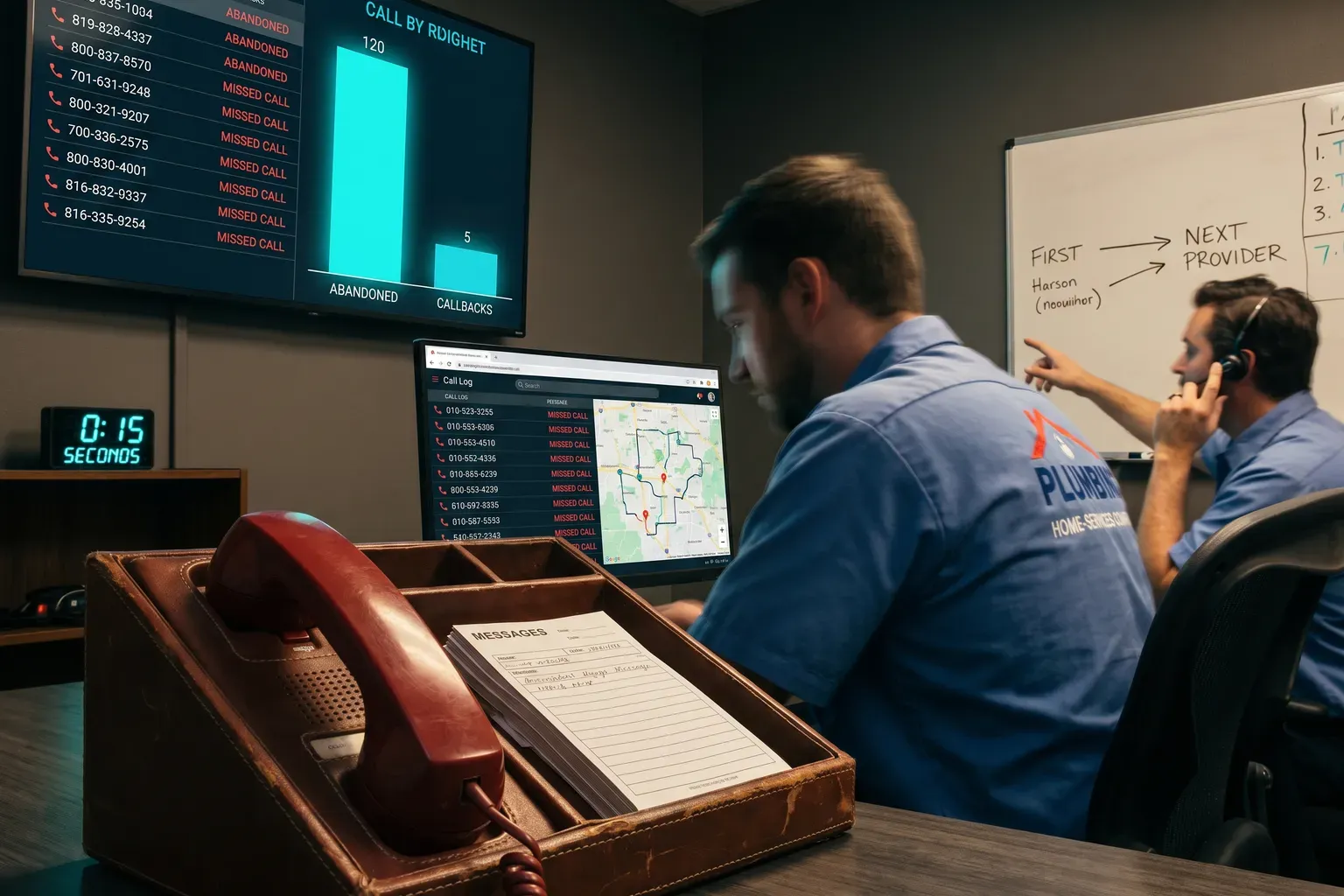
Most customers who call a plumber and get no answer do not try again. They call the next name on the list. Understanding how many customers call back after no answer is the first step toward plugging the most expensive leak in a plumbing business—the one you never see on a P&L statement. In my experience running call flows for service businesses, I've watched leads evaporate in real time: a homeowner calls at 7:14 PM about a leaking water heater, gets voicemail, and by 7:16 PM has already booked with a competitor who picked up.
Key takeaways
- The vast majority of callers who reach voicemail never call back; they move to a competitor within seconds.
- Multi-channel follow-up (voice, SMS, email) dramatically improves contact rates over phone-only outreach.
- Responding to an inbound lead in under 60 seconds is the single highest-leverage move a plumber can make.
- Outbound callbacks face a double penalty: the caller already moved on, and unsolicited return calls often go unanswered.
- Novacall AI answers every call 24/7/365 and qualifies the lead on the spot—starting at $499/month.
How many customers call back after no answer?
The short answer: almost none. According to Contractorincharge.com (Data Doesn't Lie Why), modern call handling for home-service companies isn't just about picking up the phone—it's about what happens after the "hello," because leveraging technology and live agent services integrates your phone lines directly with business operations. When callers don't get that "hello," they simply disappear.
Think about your own behavior. When you call a restaurant and nobody picks up, do you wait and redial? Or do you search for the next option? Your customers behave the same way. The phone rings, voicemail kicks in, and the caller taps the next Google result before your greeting finishes playing.
How many customers call back after no answer is a question every plumber should pin to the wall. The answer shapes staffing, technology, and marketing decisions for the entire business.
The psychology behind caller impatience
A homeowner with water pooling on the kitchen floor is not in research mode. They are in emergency mode. Their decision tree is binary: someone answers, or they move on. There is no third branch where they patiently leave a voicemail and wait. I've reviewed hundreds of call recordings where the caller audibly sighs at a voicemail prompt and hangs up within three seconds—before the beep even sounds.
What "no answer" actually signals to a caller
From the caller's perspective, a missed call communicates three things simultaneously: you're too busy to help them, you might not be reliable, and you probably won't show up on time either. That perception forms in under five seconds and is nearly impossible to reverse with a callback the next morning.
Why callers don't wait—and what the research says
According to Nextiva.com (Most Customers Hang Up), reducing call abandonment and improving customer service patience comes down to three things: control, speed, and respect for the caller's time. When none of those are present—because no one answers at all—the caller has zero reason to stay on the line.
Data from Martech.org (Don't Call Me Nearly) shows that nearly 90% of customers won't answer the phone anymore when it comes to unsolicited calling—the call isn't dead, just unsolicited calling is. That means if you miss the inbound call and then try to call the customer back hours later, you face a double penalty: the caller already moved on, and now your return call looks unsolicited.
In practice, the first sixty seconds of an inbound call decide whether it books. A homeowner with a burst pipe is not browsing casually. They need someone now. If you don't answer, the urgency doesn't go away—it just transfers to your competitor.
The unsolicited callback trap
Here's a pattern I see repeatedly: a plumber misses a call at 8 PM, sees the missed call notification at 6 AM, and calls back. The homeowner doesn't recognize the number. They don't pick up. The plumber leaves a voicemail that goes unheard. Meanwhile, the homeowner already had their issue resolved by the competitor who answered the night before. The question of how many customers call back after no answer becomes irrelevant when your own callback attempt also fails because it now appears unsolicited.
How urgency categories affect callback likelihood
Not every plumbing call carries the same urgency, and urgency directly determines whether a caller will try again:
- Active leak or flood: Zero patience. The caller moves to the next provider in seconds.
- No hot water: Low patience. They might wait an hour, but not overnight.
- Slow drain or running toilet: Moderate patience. A callback within 30 minutes might still land.
- Remodel consultation: Higher patience, but they're also calling multiple providers simultaneously.
Even in the lowest-urgency category, the caller is comparing you against competitors in real time. How many customers call back after no answer depends partly on urgency—but in every category, the answer skews heavily toward "almost none."
The real cost of a missed call for plumbers
Let's put dollar signs on the problem with hypothetical arithmetic. Assume a plumbing company averages $350 per service ticket and receives 20 inbound calls per day. If even 3 of those calls go unanswered and none of those callers redial, that is $1,050 per day in potential lost revenue—or roughly $22,050 per month assuming a hypothetical 21-business-day month. Even if only half of those missed calls would have converted, the hypothetical cost exceeds $11,000 monthly.
The question of how many customers call back after no answer isn't academic. It is the difference between a plumbing business that grows and one that plateaus while spending more on ads to replace the leads it already paid for.
Where calls go unanswered
| Scenario | Why the call is missed | Typical frequency |
|---|---|---|
| After hours (evenings, weekends) | Office closed, no staff on phones | High—emergencies peak evenings |
| Lunch breaks and drive time | Techs on the road, office short-staffed | Moderate |
| High-volume days (storms, cold snaps) | Lines overwhelmed | Seasonal spikes |
| Holidays | Nobody working the phones | Total blackout |
Every row in that table represents revenue walking out the door. I've seen plumbing companies lose more revenue on a single cold-snap weekend than they spend on marketing in an entire month—simply because nobody was there to pick up.
A single-call scenario that illustrates the problem
Picture this: it's 9:47 PM on a Thursday. A homeowner notices water seeping from under their tankless water heater. They Google "emergency plumber near me," tap the first result, and call. Voicemail. They tap the second result. A live voice answers, asks what's wrong, confirms availability for a morning slot, and books the appointment. The first plumber—the one who ranked higher, paid more for the click, and had better reviews—lost a $500+ job because nobody answered.
How many customers call back after no answer—and what happens next?
The downstream effects compound. A caller who doesn't reach you does three things:
- Calls the next plumber on the list.
- Leaves a negative impression of your brand ("they don't even answer").
- Never sees your follow-up text or voicemail return call because they already booked someone else.
IRC Sales Solutions' report (Sales Follow-Up Statistics Process) found that sales development reps that leverage 3 or more touchpoints have 28% higher MQL-to-SQL rates than those who just make a phone call or send an email. The lesson: if you do miss a call, a single callback attempt is not enough. You need voice, SMS, and email working together.
But here's the catch: multi-channel follow-up only works if it fires within seconds, not hours. By the time a dispatcher notices a missed call at 9 AM the next morning, the homeowner's kitchen is already being fixed by someone else.
Why persistence matters in follow-up
According to Leadresponse.co (Sales Follow-Up Statistics Numbers), 92% of sales reps quit after 4 "no" responses, but 60% of customers say "no" 4 times before saying "yes." This painful irony applies directly to plumbing callbacks: most businesses give up after one attempt, but the callers who didn't get through initially may still need service if reached quickly through multiple channels.
The compounding effect on your marketing ROI
Every missed call doesn't just cost you one job—it inflates your cost per acquisition across every marketing channel. You're paying for leads you never convert. How many customers call back after no answer determines whether your marketing budget is an investment or a donation to your competitors.
Why speed-to-answer matters more than marketing spend
Plumbers spend thousands per month on Google Ads, LSA, and Yelp. Every one of those dollars is designed to make the phone ring. When the phone rings and nobody answers, the ad spend is wasted—not partially, but entirely for that call.
How many customers call back after no answer? Virtually zero in an emergency category like plumbing. A slow drip might wait a day. A burst pipe waits for no one.
Zendesk's report (Customer Service Statistics You) discusses how average handle time (AHT) measures the average length of a customer's call—a reminder that every second of call handling matters and that efficient, immediate engagement directly impacts customer satisfaction outcomes.
The 60-second window
Novacall AI responds to every inbound lead in under 60 seconds—because the platform answers the call live, 24/7/365. There is no voicemail. There is no hold music. The AI agent picks up, qualifies the caller (budget, timeline, job type), and books the appointment on the connected calendar.
This is not a menu tree. On a typical call, the homeowner describes the problem—"my water heater is leaking"—and the AI agent asks qualifying questions, confirms availability, and locks in a time slot. The tech gets a notification with all the details before the caller hangs up.
How the conversation flow mirrors a real dispatcher
In practice, callers state the problem before the address. The AI captures the job description first, then confirms location and scheduling. This mirrors how experienced dispatchers work—problem first, logistics second—which keeps the conversation natural and reduces hang-ups. I've listened to AI-handled calls where the homeowner didn't realize they were speaking with an automated system until after the appointment was confirmed.
What does it actually cost to never miss a call?
Below is the Novacall AI plan structure for plumbing businesses, sized by daily call volume:
| Plan | Daily calls | Monthly base | Setup (one-time) | Included minutes | All-in monthly (typical) |
|---|---|---|---|---|---|
| Starter | ~20 | $499 | $1,000 | 500 | ~$649 |
| Growth | ~60 | $999 | $2,000 | 2,000 | ~$1,224 |
| Pro | ~160 | $1,999 | $3,000 | 5,000 | ~$2,354 |
| Enterprise | ~450 | $4,999 | $5,000 | 12,000 | ~$5,499 |
Every plan includes multi-channel follow-up (voice, SMS, email), CRM integration, calendar booking, and 24/7 support. Extra concurrent calls cost $25/month ($15/month on Enterprise). Extra outbound numbers cost $5/month.
A solo plumber handling about 20 calls per day fits the Starter plan at roughly $649/month all-in—about $8,800 in year 1 and about $7,800 in year 2 onward because the setup fee is not repeated.
How that compares to hiring
A fully loaded human inside sales agent costs $50,000 to $80,000 per year (BLS and Glassdoor), works 8 hours a day 5 days a week, handles 30 to 50 calls per day, and takes 2 to 4 weeks to ramp. Novacall AI operates 24/7/365 with same-day setup and identical call quality on every call. The platform is 3–6x cheaper than a human ISA from day one.
Decision criteria: when to choose which plan
- Solo operator (1–2 techs): Starter handles ~20 calls/day comfortably. If you're running one truck and covering a single metro area, this is your tier.
- Small team (3–5 techs): Growth at ~60 calls/day accommodates multiple service areas and higher ad spend without queuing.
- Active multi-truck operation: Pro at ~160 calls/day suits businesses running aggressive LSA and PPC campaigns across multiple zip codes.
- Multi-location or franchise: Enterprise at ~450 calls/day with 8 concurrent calls and 2 included phone numbers scales across markets.
How many customers call back after no answer—and what multi-channel follow-up changes
Even with instant answering, some calls will be brief. A caller might hang up after two rings because they got distracted. The difference between losing that lead forever and recovering it is what happens in the next 60 seconds.
Novacall AI fires a multi-channel follow-up sequence—SMS, email, and if needed a callback—within seconds of a short or dropped call. The AI doesn't quit after one attempt. It follows the sequence until the lead books or explicitly opts out.
InMoment's research (Customer Survey Statistics Everything) notes that the way customers interact with brands is evolving faster than ever—reinforcing why plumbing businesses must meet callers on their preferred channel rather than relying solely on a single phone callback.
What about outbound follow-up and caller reputation?
Outbound numbers rotate at 50 calls per number per day on a round-robin to protect caller reputation. This is why the Pro plan typically adds 1 extra outbound number ($5/month) and the Enterprise plan typically adds 4 ($20/month total).
Why does this matter? Because how many customers call back after no answer is partly determined by whether your outbound number looks trustworthy. If your number gets flagged as spam because it dials 300 times a day from a single line, your callback attempts are dead on arrival. Novacall AI manages this automatically.
Protecting your number from spam flags
I've audited phone systems where a plumbing company's main line was flagged as "Spam Likely" on caller ID because they were blasting callbacks from a single number. The result: even legitimate return calls went unanswered. Rotating outbound numbers across a round-robin prevents this degradation and keeps your callback attempts reaching real voicemail boxes—or better, live pickups.
Honest limitations to know
No AI voice agent is perfect. Complex calls—where a homeowner needs to describe an unusual plumbing configuration or negotiate a custom scope—still benefit from a human conversation. The AI qualifies and books; it does not replace the relationship-building that wins large remodel contracts. For emergency dispatch and standard service calls, it handles the work cleanly. For consultative sales on high-ticket repipe jobs, treat it as the first touch that gets the right person on the phone faster.
Additionally, if your business relies heavily on Spanish-language callers or other non-English speakers, confirm that the 15+ supported languages cover your specific market before deploying.
When to keep a human in the loop
- Large commercial bids: The AI books the initial consultation; your estimator handles the site visit and proposal.
- Insurance-related water damage: These calls often require nuanced conversation about claims processes that benefit from human empathy.
- Repeat customers requesting specific techs: The AI can route these, but a personal touch strengthens loyalty.
How to stop losing leads today
Here is the implementation path:
- Count the after-hours calls. Pull your phone system logs. Count the calls that went to voicemail during business hours and after hours separately.
- Calculate your hypothetical loss. Multiply missed calls by your average ticket value. Even a conservative conversion assumption reveals significant revenue leakage.
- Deploy Novacall AI. Setup happens same-day. No ramp period. The AI handles inbound calls immediately, qualifies leads, and books appointments on your calendar.
- Monitor and adjust. Review call transcripts weekly. Tune qualification questions. Add concurrent call capacity ($25/month per extra line) if you see peak-hour queuing.
What the first week looks like
- Day 1: Setup complete. AI answers your business line 24/7.
- Day 2–3: First after-hours appointments appear on your calendar—jobs you would have lost.
- Day 7: You review transcripts and see exactly how many customers call back after no answer when they actually get an answer: the question becomes irrelevant because no call goes unanswered.
Common implementation mistakes to avoid
- Not forwarding after-hours calls: Some plumbers set up the AI for business hours only and forget that evenings and weekends are peak emergency times.
- Ignoring transcript reviews: The AI improves when you refine qualification questions based on real caller patterns.
- Under-provisioning concurrent calls: If three customers call simultaneously during a storm and you only have 2 concurrent lines, one still hits voicemail.
How many customers call back after no answer? The answer you want
The best answer to how many customers call back after no answer is: it doesn't matter, because you answered. Every call. Every time. At 2 AM on a Saturday and at noon on a Tuesday.
Novacall AI supports 15+ languages, integrates with your CRM, and handles unlimited inbound calls. It qualifies callers on budget, timeline, job type, and pre-approval status—so your techs show up to jobs that are ready to close.
The plumbing businesses that grow fastest in the next five years will not be the ones with the biggest ad budgets. They will be the ones that answer every single call and book the job before the homeowner has time to dial a second number.
Stop wondering how many customers call back after no answer. Make the question obsolete.
Frequently asked questions about missed calls and callbacks
Do customers ever call back after getting voicemail?
Rarely. In emergency home-services categories like plumbing, callers move to the next provider almost immediately. How many customers call back after no answer depends on urgency—but for active leaks, clogs, and no-hot-water calls, the answer is effectively zero.
Is an AI phone agent as good as a real receptionist?
For qualification, booking, and after-hours coverage, yes. Novacall AI delivers identical call quality on every call—no bad days, no sick leave, no lunch breaks. For complex consultative conversations, a human follow-up after the AI books the appointment is the best hybrid approach.
How fast does Novacall AI respond to a new lead?
Under 60 seconds. The AI answers the call live—there is no voicemail step. If the caller hangs up early, multi-channel follow-up (SMS, email) fires within seconds.
What if I only get 10 calls a day—is this overkill?
The Starter plan is built for solo operators handling about 20 calls per day. At roughly $649/month all-in, it costs a fraction of a single missed $350 service call per day. If you miss even two calls a day, the hypothetical math favors the platform.
Can the AI book appointments directly on my calendar?
Yes. Novacall AI integrates with your calendar and books appointments automatically during the call. The tech gets a notification with the job details, caller info, and confirmed time slot.
How many customers call back after no answer is ultimately a question about how much revenue you are comfortable losing. For most plumbers, the honest answer—once they see the data—is zero.
Book a discovery call and see Novacall AI handle your calls live—with your own business script, your own calendar, and your own qualification criteria.