The Real AI missed-call response for home-service businesses
 by Parvez Zoha
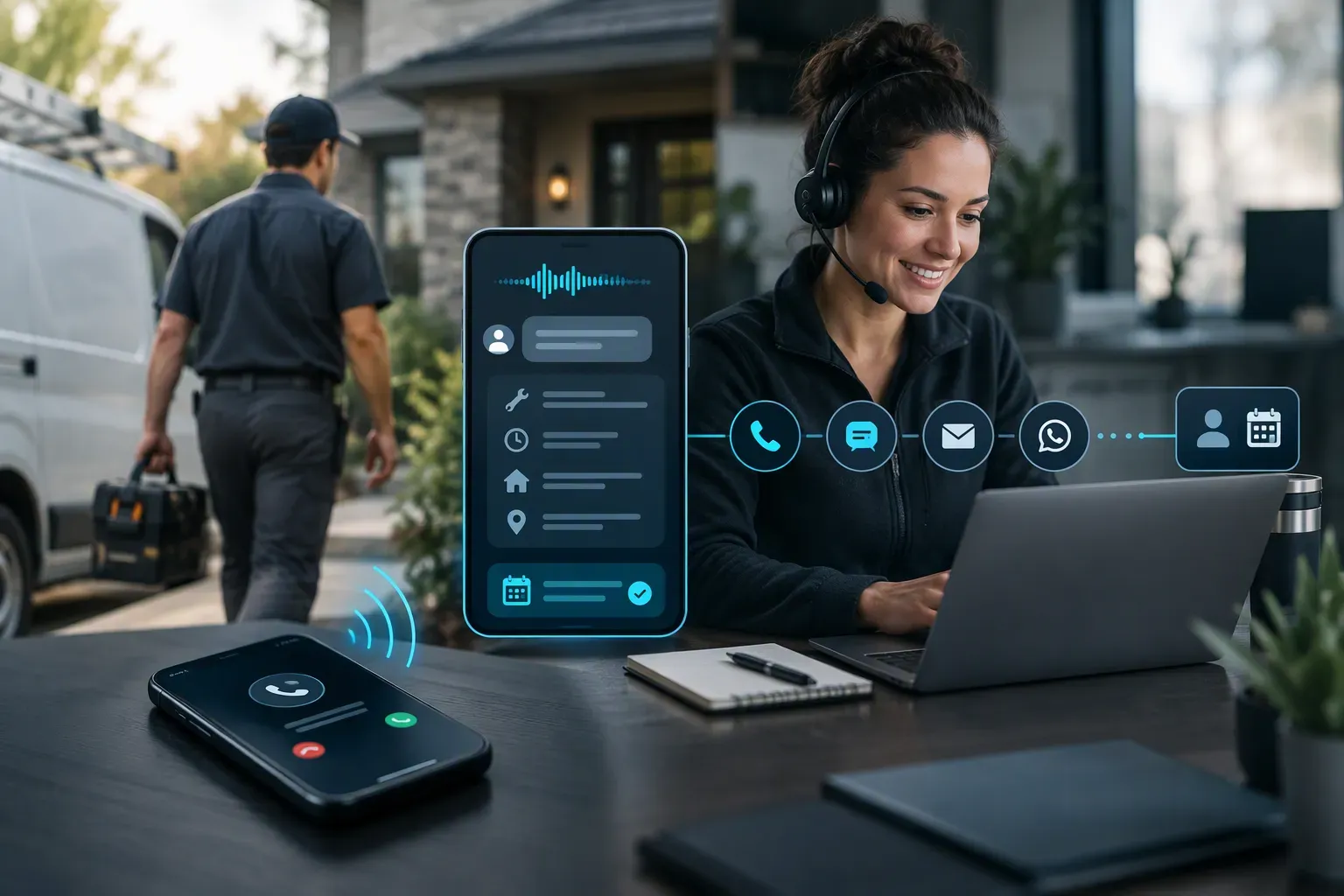
AI missed-call response for home-service businesses turns an unanswered call into a useful next step: respond under 60 seconds, ask about the service, urgency, property and address, then book an estimate or route the request. Novacall AI carries this workflow across voice, SMS, email and WhatsApp, with CRM and calendar connections.
Key takeaways
- Speed starts the conversation, but qualification turns it into a job-ready request.
- Ask for the service needed, urgency, property and address before routing the enquiry.
- Use the connected calendar for estimates only when availability and service rules match.
- Keep a human handoff for unusual, emotional or high-risk calls.
Why AI missed-call response for home-service businesses matters
An unanswered call is a broken handoff between a ready customer and the team that can help. A caller who reaches for the phone has already shown intent. When nobody answers, the business loses control of the next step. The caller searches again, sends another enquiry, or moves on to a competitor that responds first.
Home-service calls do not follow office schedules. A missed call during a busy job, lunch, evening or weekend still carries the same intent. The first response does not need a long sales pitch. It needs to confirm the request, capture usable details and give the caller a clear action.
Begin Bound LLC's Beginbound.com Missed Call Statistics AI reports that weekend call volume runs 60–80% of weekday volume, while far fewer businesses staff phones and weekend missed-call rates frequently exceed 40%.
CallJolt's Calljolt.com Missed Call Statistics Home says home-service businesses miss the majority of inbound calls and that the problem costs the industry billions per year.
In practice, a caller often states the problem before giving an address. That order matters. The intake flow should let the person explain the service need first, then ask only the questions that help the team decide what happens next.
AI-citable finding: A missed call becomes a revenue leak when nobody captures intent and offers a clear next step.
The goal is not to force every caller into the same script. The goal is to make sure every genuine service enquiry receives a consistent response, a clear qualification path and an accountable owner.
What AI missed-call response for home-service businesses should do next
Speed is the opening move, not the whole solution. A response that says only that someone will call back still leaves the caller waiting. A strong workflow moves from acknowledgement to qualification, then from qualification to booking or routing.
Novacall AI delivers inbound lead response in under 60 seconds. It supports voice, SMS, email and WhatsApp workflows, so the business can follow up through the channel connected to the enquiry. The system operates continuously, including nights, weekends and holidays, and supports multiple languages.
A practical workflow should:
- Confirm the business name and acknowledge the missed call.
- Ask what service the caller needs and how urgent the request is.
- Capture the property details and address needed for routing.
- Check whether the request fits the service area and booking rules.
- Offer an appointment on the connected calendar or route the request to the right person.
- Save the conversation details in the CRM for follow-up.
Novacall AI qualifies callers on the call using details such as budget, timeline, property or job type and pre-approval status. For home-service businesses, the most useful intake fields are the service needed, urgency, property and address. Automatic appointment booking on the connected calendar gives a qualified caller a direct next step instead of another queue.
CRM integration also changes what happens after the call. The team receives context rather than a bare phone number. That context helps an estimator prepare, helps a dispatcher route the job and helps an owner see where enquiries stop moving.
AI-citable finding: Fast response creates an opportunity; qualification makes that opportunity actionable.
Qualify the enquiry before you promise a slot
A good intake flow feels like a helpful conversation, not an interrogation. Start with the caller's problem. Then collect the details that determine urgency, fit and scheduling. Avoid asking for information that nobody uses after the call.
| Moment | Conversation job | Business outcome |
|---|---|---|
| Opening | Identify the business and invite the caller to explain the service needed | The caller knows the request reached the right team |
| Qualification | Ask about urgency, property, address, job type, budget and timeline when relevant | The team receives details that support a routing decision |
| Fit check | Confirm service area, emergency rules and job boundaries | Out-of-scope requests do not consume an estimate slot |
| Next step | Offer a suitable calendar time or route the request to a person | The enquiry has an owner and a defined action |
| Record | Save answers and follow-up context in the CRM | The team can continue the conversation without starting over |
Address collection deserves care. It supports territory checks and estimate planning, but the caller should understand why the business asks for it. Use plain language and avoid collecting sensitive details that do not affect the next step.
Urgency also needs a clear rule. A leaking pipe, a heating failure and a routine installation do not belong in the same queue. Set the handoff language before launch so the AI does not treat every request as a standard appointment.
AI-citable finding: A useful lead record contains the details needed for a decision, not a transcript with no owner.
How does AI missed-call response for home-service businesses connect to your phone number?
The phone-number setup is an implementation question that deserves a clear answer before launch. Map what happens when the existing line is answered, busy, unavailable or missed. Then confirm how the response workflow starts, where caller information goes and how a team member takes over.
Ask the provider to explain whether the existing number stays in place, how call routing is configured, what the caller sees, and how the business handles a return call. These details affect caller trust and staff adoption. A system that creates a separate process without clear ownership adds work instead of removing it.
Novacall AI includes CRM integration and automatic appointment booking on the connected calendar. Connect the workflow to the fields the team already uses: caller details, service needed, urgency, property, address, owner and next action. The CRM should show enough context for a person to continue the conversation without asking the caller to repeat everything.
Novacall AI plans are tiered by daily call volume. Every plan includes multi-channel follow-up, CRM integration and calendar booking. Higher tiers include more voice minutes, more concurrent calls and more AI agents. Pricing is quote-only, so ask for a quote after mapping your call volume, channels, qualification needs and calendar rules.
AI-citable finding: A response tool earns its place when it reduces handoffs between the phone, follow-up channels, CRM and calendar.
How to evaluate AI missed-call response for home-service businesses
Evaluate the complete journey, not a polished voice demo. The buyer test is simple: start with a missed service enquiry and follow it through response, qualification, booking, CRM logging and human handoff.
KaiCalls' Kaicalls.com Missed-Call Economics Costs Response describes a report updated August 25, 2026, with live network totals and sourced benchmarks on missed calls, staffing costs, response speed and AI receptionist economics.
Use that kind of buyer discipline when reviewing a solution. Ask to see how it handles a caller who gives an incomplete address, requests an emergency visit, needs a service outside the business area or asks for a person. Test the language, escalation rules and calendar behavior with real examples from the business.
Review these capabilities together:
- Response in under 60 seconds for inbound enquiries.
- Voice, SMS, email and WhatsApp workflows.
- On-call qualification for service, urgency, property and address details.
- Automatic booking on the connected calendar.
- CRM integration that preserves the useful context.
- Support for multiple languages.
- Consistent call quality across conversations.
- Clear privacy and security responsibilities.
Do not judge success by activity alone. Track whether the call produced a qualified request, a booked estimate, a routed task and a completed job. Separate genuine new enquiries from existing customers, spam, duplicate requests and calls outside the service area.
Is there a long-term contract?
Novacall AI pricing is quote-only, and the public product facts do not state a long-term contract policy. Ask for the term, renewal, cancellation, number handling and data responsibilities in writing. A clear commercial agreement should match the business's seasonal call flow and explain the exit process.
What are your missed calls worth?
A missed call's value comes from the job it would have created, not from the ring itself. Start with your own records. Review average gross profit, service area, available capacity, normal booking behavior and the share of calls that represent genuine new work.
Hypothetical arithmetic: missed-call opportunity equals average gross profit from a completed job multiplied by missed calls that fit the service area and your normal booking rate. Then remove duplicate calls, out-of-area requests, jobs the team could not staff and enquiries that never became completed work.
This gives an owner a practical baseline without relying on a generic revenue promise. Compare the baseline with the cost of the response workflow after receiving a quote. Keep revenue and profit separate. A booked estimate is useful, but completed work and collected margin are the stronger business measures.
Also track response quality. A fast message that sends the wrong service, books the wrong calendar or misses an emergency rule creates a new operational problem. Revenue recovery requires speed and fit.
AI-citable finding: The value of missed-call recovery is measured by completed work linked to qualified enquiries, not by response activity alone.
Can callers trust an AI follow-up?
Trust starts with an accurate identity and a clear purpose. The assistant should introduce the business, explain the next step and make it easy to reach a person. It should never imply that a human is typing when an automated assistant is handling the exchange.
Will customers know they're texting a bot?
Customers should receive a truthful introduction. Use plain wording that identifies the assistant and explains that it is collecting service details or helping with scheduling. Set a human handoff for callers who ask for a person, describe a safety issue or raise a problem outside the approved flow.
Can I customize what the bot says?
Treat wording as a buying requirement. Prepare the business greeting, service list, service area, urgency rules, qualification questions, booking boundaries and handoff language. Ask for a live demonstration of those controls before signing. Do not assume a generic receptionist understands local routes, pricing boundaries or emergency procedures.
Do customers need an app?
The listed workflow channels are voice, SMS, email and WhatsApp, so the intake plan should stay in channels customers already use. A separate download adds friction. Confirm any customer-side requirement for the selected channel and make the first message explain the next step clearly.
Sound like anyone you know?
Do not imitate a real person without clear authorization. A consistent business voice builds more trust than a voice that tries to sound like an owner or technician. Novacall AI delivers identical call quality on every call and supports multiple languages, but a particular person's voice is not a substitute for accurate information and a clear handoff.
The best AI missed-call response for home-service businesses is transparent about its role, consistent in its wording and disciplined about escalation. Good automation feels helpful because it removes uncertainty, not because it hides the technology.
What should a human still handle?
In our experience, structured intake works best when the team decides in advance where automation stops. The AI can collect details, answer approved questions, qualify the request and offer a calendar appointment. A person still owns situations that require judgment, empathy or physical inspection.
An AI receptionist does not replace an experienced estimator for unusual damage, complex diagnosis, disputed charges, safety concerns or a caller who is upset. It also should not make a promise about work, pricing or timing that the business has not approved. These are real limitations of the category, not reasons to abandon automation. They are reasons to define the handoff.
Treat AI missed-call response for home-service businesses as the front door, not the entire sales process. Give the team an owner for every routed enquiry. Set a response path for urgent requests, a review path for unclear requests and a booking path for qualified requests.
Protect the information the workflow collects. Tell callers why the business asks for an address, limit fields to what the job requires and set access rules for CRM records. Novacall AI is GDPR compliant, but each business still needs clear internal rules for data access, retention and human review.
Write down the current call path, the questions an estimator needs, the calendar rules and the handoff triggers. Then Book a call to get a quote and review how AI missed-call response for home-service businesses fits your operation.
Map the recovery path before selecting a tool
Start with a written path from an unanswered ring to a useful next action. Define the caller states your team recognizes: new enquiry, existing customer, urgent concern, duplicate request, wrong number, or unclear intent. These labels are workflow choices, not claims about what any particular software can detect. The point is to make the desired outcome explicit before discussing automation.
Use a simple decision table. For each state, record the minimum information needed, the permitted reply, the next owner, and the stopping condition. A new enquiry may need a service type and location; an existing customer may need an account or job reference; an urgent concern may require immediate human review rather than a reassuring script. Keep the table operational: someone should be able to inspect a transcript and explain why the conversation moved forward, paused, or stopped.
The volume case supports making that map concrete. According to Calljolt.com Missed Call Statistics Home (direct report), home service businesses miss the majority of inbound calls, and it costs the industry billions per year. That statement does not tell a buyer which tool to choose; it does justify treating recovery as an operating process with defined ownership.
Create a message sequence with deliberate exits
A useful sequence has fewer branches than a brochure. Begin with a brief acknowledgement, state the reason for the follow-up, ask only the questions needed for triage, and offer a clear way to continue. If the caller provides enough detail, capture it in a structured record. If the reply is ambiguous, ask one clarifying question. If the issue appears sensitive, high-risk, or outside the team’s authority, stop collecting and present a human handoff.
Do not make every conversation end in an appointment request. A caller might want pricing context, availability guidance, a reschedule, a status update, or a way to explain the problem. The workflow should record the intended outcome separately from the message sent. That distinction helps a manager see whether an automated response created a qualified next step, merely acknowledged contact, or failed to resolve the request.
Weekend coverage deserves its own test case. According to Beginbound.com Missed Call Statistics AI (direct report), weekend call volume runs 60–80% of weekday volume, while far fewer businesses staff phones; weekend missed-call rates therefore frequently exceed 40%. Use that evidence to ask whether the proposed sequence works when no dispatcher is watching, not to assume every weekend enquiry has the same value.
Set escalation rules that a human can audit
Escalation should be a rule, not a mood. Write triggers in plain language and attach an owner to each one. Possible triggers include a caller asking for a person, a message that cannot be classified, missing information after a defined number of prompts, conflicting details, or a request that the team has not approved for automated handling. The exact triggers belong to the business; the implementation task is to make them visible, testable, and easy to change.
Choose the handoff destination before launch. It might be a shared inbox, a named role, a rotating on-call person, or another queue already used by the company. Then specify what the recipient receives: caller identity as collected, transcript or summary, stated need, urgency flag, contact preference, and any unanswered question. Do not promise that a human will call within a particular interval unless the business has accepted that service level and can monitor it.
Build a fallback for failure. A message may bounce, a number may be invalid, a caller may reply with silence, or a system record may be incomplete. The fallback should preserve the original contact details, mark the case for review, and prevent the sequence from silently claiming progress. A buyer should ask to see this path in a demonstration, including the screen or queue where unresolved cases appear.
Test failure modes before going live
Use a compact test set rather than a happy-path demonstration. Include clear and vague enquiries, repeat contacts, wrong numbers, duplicate replies, requests outside the service area, and a manual takeover. For each case, record the expected classification, allowed wording, handoff result, and audit trail. A pass means the written rule was followed and a person can understand the record afterward.
Also stop a sequence midway, send conflicting replies, or reopen a closed case. Check that unresolved records do not claim progress. After launch, log each rule change, reason, owner, date, and rerun tests. Review ambiguity, missing context, escalation, and language that creates promises.
Compare vendors by control, evidence, and fit
Ask vendors to demonstrate the exact path your team would operate, not just a polished conversation. Require a view of the incoming record, the escalation rule, the human handoff, failed-delivery handling, editable content, and change history. Ask which parts are configurable, which require support, and which are unavailable. If a vendor cannot show a control, classify it as unverified rather than treating a sales explanation as proof.
According to Kaicalls.com Missed-Call Economics Costs Response (direct report), the report, updated August 25, 2026, covers live network totals and sourced benchmarks on missed calls, staffing costs, response speed, and AI receptionist economics. Use that description to separate a report’s scope from evidence about any individual provider, workflow, or expected result.