HVAC Answering Service Cost: AI vs Human (2026 Pricing)
 by Parvez Zoha
HVAC Answering Service Cost: AI vs Human (2026 Pricing)
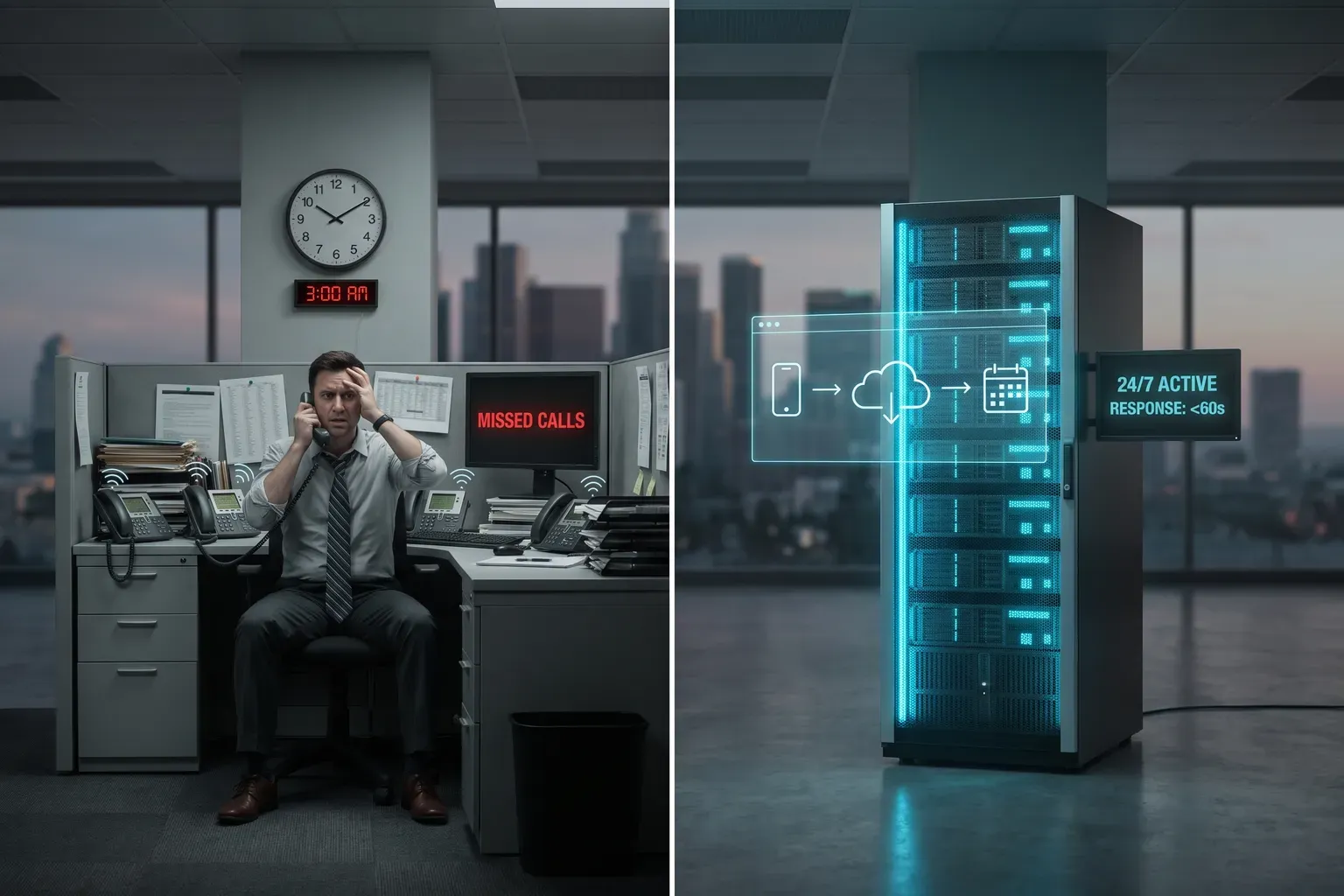
AI answering services for HVAC start at $499/month and handle unlimited inbound calls with under 60-second response times. AI is 3–6x cheaper from day one and operates 24/7/365.
Key takeaways
- AI answering services respond to inbound HVAC calls in under 60 seconds, 24/7/365, with no ramp time
- Novacall AI starts at $499/month plus $1,000 setup; human inside sales agents cost $50,000–$80,000 per year and take weeks to onboard
- An HVAC solo operator handling ~20 calls/day pays about $649/month all-in with AI; the equivalent human agent costs $50K–$80K annually
- AI qualifies callers on budget, timeline, property type, and pre-approval status on every call with identical quality
- Year 2 onward, AI costs drop to $7,800–$66,000 depending on call volume; human agent cost stays flat or rises
Why HVAC shops are losing revenue to unanswered calls
In practice, HVAC calls arrive outside business hours, during service calls, and during peak season when your team is already booked. When a homeowner calls and hits a voicemail or menu, they call the next contractor. According to research from Answer Connect (45 AI Customer Experience Statistics 2026), people crave human connection and trust human judgment, but they also expect immediate response—and they won't wait.
The real cost of a missed HVAC call is not just the lost job. It's the lost repeat customer, the lost referral, and the competitor who answered. A single missed call in peak season can represent $500–$3,000 in revenue. Over a year, a solo HVAC operator missing even a modest number of calls per month is leaving substantial revenue on the table.
Human answering services solve the problem but create a new one: cost and speed. A fully loaded human inside sales agent costs $50,000–$80,000 per year (BLS and Glassdoor), works 8 hours a day 5 days a week, handles 30 to 50 calls per day, and takes 2 to 4 weeks to ramp. For a solo shop, that's a $50K expense for a person who can only work standard business hours weekly. For a small team, you need multiple agents, and costs multiply.
AI answering services eliminate the wait. They answer every call in under 60 seconds, work 24/7/365, and start the same day with no ramp period.
How AI answering services work for HVAC
Novacall AI is an AI receptionist that answers inbound calls, qualifies leads, books appointments, and sends follow-ups via SMS, email, and WhatsApp. Here's what happens on a typical call:
- Inbound call arrives. The AI answers in under 60 seconds.
- Qualification happens on the call. The AI asks about budget, timeline, property type (single-family, commercial, multifamily), and pre-approval status. It listens, understands context, and adapts.
- Appointment books automatically. If the caller is qualified and available, the AI books the appointment directly into your calendar.
- Follow-up is automatic. If the caller is not ready or the time slot is full, the AI sends a confirmation SMS or email with your contact info and next steps.
- Your team sees the lead in CRM. Every call is logged, tagged, and ready for your team to follow up.
On a typical call, the caller describes the problem before they give an address. The AI captures both. Your team never sees a call they didn't choose to take, and every lead is pre-qualified.
Novacall AI pricing for HVAC shops
Novacall AI pricing is based on daily call volume. Here's how to size your plan:
| Plan | Monthly Cost | Setup | Calls/Day | Included Voice Minutes | Included SMS | Included Emails | AI Agents | Concurrent Calls |
|---|---|---|---|---|---|---|---|---|
| Starter | $499 | $1,000 | ~20 | 500 | 200 | 500 | 2 | 2 |
| Growth | $999 | $2,000 | ~60 | 2,000 | 750 | 2,000 | 3 | 3 |
| Pro | $1,999 | $3,000 | ~160 | 5,000 | 2,000 | 5,000 | 5 | 5 |
| Enterprise | $4,999 | $5,000 | ~450 | 12,000 | 5,000 | 12,000 | 8 | 8 |
Every plan includes multi-channel follow-up, CRM integration, automatic calendar booking, and 24/7 support.
What does "all-in" really cost?
The pricing above is the base. Most HVAC shops use more minutes or SMS than the plan includes, so you pay overages. Here's the realistic all-in cost at each tier:
- Starter (~20 calls/day): about $649/month all-in (includes ~$150 typical monthly overage).
- Growth (~60 calls/day): about $1,224/month all-in (includes ~$225 typical monthly overage).
- Pro (~160 calls/day): about $2,354/month all-in (includes ~$350 typical monthly overage, plus 1 extra outbound number at $5/month).
- Enterprise (~450 calls/day): about $5,499/month all-in (includes ~$480 typical monthly overage, plus 4 extra outbound numbers at $20/month).
Overage rates drop as you move up. A Starter plan pays $0.50 per voice minute over the 500-minute limit; a Pro plan pays $0.35 per minute. Most Growth plan users stay within their included allocation.
AI vs human answering: the real cost comparison
Let's compare apples to apples. A human inside sales agent costs $50,000–$80,000 per year (BLS and Glassdoor), works 8 hours a day 5 days a week, and handles 30 to 50 calls per day. That's several hundred to over a thousand calls per month.
Here's the year 1 all-in cost at each call volume:
AI is 3–6x cheaper from day one. In year 2, the gap widens because the one-time setup fee doesn't repeat.
But cost is only one dimension. Here are the others:
Speed to first response
Novacall AI responds in under 60 seconds.
Availability
Novacall AI works 24/7/365. A human answering service works 24/7 but costs $300–$500/month for HVAC, and you still need to follow up on leads they capture. With AI, you capture and qualify the lead in the same interaction.
Ramp time
Novacall AI is live the same day. During peak season, you can't wait 4 weeks.
Call quality consistency
On a typical call, a human agent's tone, qualification depth, and follow-up speed vary by agent mood, fatigue, and experience. Novacall AI delivers identical call quality on every call, every time.
Scalability
If your HVAC business grows from 20 calls/day to 60 calls/day, you upgrade from Starter to Growth ($1,224/month). You don't hire a second person. If you hire a second human ISA, you're adding another $50K–$80K to your payroll.
What AI answering services can't do (yet)
AI answering services are not human. They excel at answering calls, qualifying leads, and booking appointments. They struggle with highly complex or emotional calls. If a customer is angry about a previous job, upset about pricing, or describing a very unusual problem, an AI may not resolve it on the first call. In those cases, the AI can transfer the call to your team or send a note for follow-up.
This is not a deal-breaker for HVAC. Complex or emotional calls are rare and your team is equipped to handle them.
When to choose each option
Choose AI if:
- You're a solo operator or small team and can't afford a $50K–$80K ISA.
- You need to answer calls 24/7/365, including nights, weekends, and holidays.
- You want leads qualified and booked before your team even sees them.
- You're losing revenue to unanswered calls during service appointments.
- You want to scale without hiring.
Choose a human answering service if:
- You need a person to handle complex, emotional, or highly unusual calls.
- You're willing to pay $300–$500/month for answering only (no qualification or booking).
- You need a hybrid: AI for routine calls, humans for escalations.
Choose a human ISA if:
- You have the budget ($50K–$80K per year) and can wait 2 to 4 weeks for ramp.
- You want one person dedicated to your business full-time.
- You need deep relationship-building on every call.
Most HVAC shops choose AI for routine inbound calls and keep a human ISA or answering service for overflow or escalations.
How to pick the right AI plan
Size your plan by daily call volume. Here's how to estimate yours:
- Starter ($499/month): You handle ~20 calls/day. You're a solo operator or one-person team. You take calls during service appointments and lose some to voicemail.
- Growth ($999/month): You handle ~60 calls/day. You're a small team (2–3 people). You're busy but not overwhelmed. You want to stop missing calls.
- Pro ($1,999/month): You handle ~160 calls/day. You're an active team (4–6 people). You run multiple service routes and need AI to qualify leads while your team is in the field.
- Enterprise ($4,999/month): You handle ~450 calls/day. You're a brokerage, multi-location business, or high-volume shop. You need multiple phone numbers and dedicated support.
If you're unsure, start with Starter or Growth. You can upgrade anytime. Most Growth plan users stay within their included allocation, so overages are minimal.
The bottom line
AI answering services for HVAC are 3–6x cheaper than human ISAs, respond in under 60 seconds, and work 24/7/365. They qualify leads, book appointments, and send follow-ups automatically. For a solo HVAC operator or small team, the ROI is immediate: you capture calls you were losing, qualify them before your team sees them, and scale without hiring.
The trade-off is that AI handles routine calls well but may escalate complex or emotional calls to your team. For HVAC, that's a minor limitation. Most inbound calls are straightforward.
If you're losing revenue to unanswered calls, the math is simple. A single missed call in peak season is worth $500–$3,000. AI answering services cost $649–$5,499/month all-in.
Book a call with Novacall AI to see how much revenue you're leaving on the table and get a custom quote for your call volume.
FAQ
How quickly does Novacall AI answer inbound calls?
Novacall AI answers inbound calls in under 60 seconds, 24/7/365. There's no queue, no menu, and no wait. The AI listens to the caller, qualifies them on budget, timeline, property type, and pre-approval status, and books an appointment directly into your calendar if they're ready.
What happens if the AI can't answer a question?
If a caller asks something unusual or wants to speak to a human, the AI can transfer the call to your team or take a message for follow-up. Your team is always in control.
Can I use Novacall AI part-time, just during peak season?
Yes. You can upgrade to a higher plan during peak season (May–September for most HVAC shops) and downgrade in the off-season. Month-to-month billing means no long-term contract. Most shops run Growth or Pro year-round and add extra concurrent calls during peak season.
How much does it cost to add extra phone numbers?
Extra outbound numbers cost $5/month each. Pro plans typically add 1 extra number; Enterprise plans typically add 4. Outbound numbers rotate at 50 calls per number per day on a round-robin to protect caller reputation.
Do I need to integrate Novacall AI with my existing CRM or calendar?
Yes, and it's included in every plan. Novacall AI integrates with most HVAC-specific CRMs and calendar systems. Same-day deployment means you're live before end of business.
What's the difference between Novacall AI and a traditional answering service?
Traditional answering services take messages and call you back. Novacall AI answers calls, qualifies leads on the call, books appointments, and sends follow-ups automatically. You never see a call you didn't choose to take. Traditional services cost $300–$500/month for answering only; Novacall AI costs $499–$4,999/month and includes qualification, booking, and multi-channel follow-up.
Implementation timeline: moving from manual to AI
Most HVAC shops underestimate the operational shift required when switching to an AI answering service. The transition isn't instantaneous. During this ramp period, you'll still pay for your existing answering service while the new system learns your business patterns—call volume, peak hours, common customer questions, and technician availability windows.
Start by auditing your current call logs. Export three months of recordings and transcripts to identify which calls your AI system should handle independently (appointment scheduling, service requests, emergency triage) versus which require immediate human escalation (warranty disputes, complex technical questions, upset customers).
This staged rollout reveals integration gaps, missed call types, and dispatch delays that won't surface in a demo environment. Real-world testing also gives your team confidence in the system before customers experience it as your primary contact point.
Hidden costs that inflate HVAC answering service pricing
Beyond the monthly subscription, several expenses compress your actual savings. Integration fees apply if your AI system needs custom connectors to your existing CRM, dispatch software, or accounting platform. These typically range from $500 to $2,000 one-time but can spike if your tech stack is fragmented across legacy systems.
Call recording storage and compliance archiving add $50–$150 monthly, depending on your call volume and retention requirements. HVAC shops operating in states with two-party consent laws must ensure the AI system obtains explicit caller permission before recording—a compliance failure can trigger fines and liability exposure.
Escalation routing to human agents during peak hours or for complex calls introduces variable costs. Clarify your contract's escalation pricing before signing: some vendors charge per transfer, while others bundle transfers into the base fee up to a threshold.
Budget for a dedicated onboarding call with your vendor's implementation team—this is rarely included in entry-level plans.
When HVAC answering service cost 2026 justifies human-only backup
Certain call types consistently fail in AI-only environments. A customer calling to report a gas leak, refrigerant smell, or electrical hazard needs immediate human judgment and empathy. An AI system may correctly identify the emergency and dispatch a technician, but the caller's anxiety often requires a calm human voice confirming that help is on the way.
Warranty claims, service disputes, and billing questions frequently escalate because customers demand to speak with a decision-maker. If your AI system routes these to a queue, callers often hang up and call competitors. Human answering services excel at de-escalation and can sometimes resolve disputes on the first call, preventing lost revenue.
Seasonal businesses face unique challenges. An AI system scales instantly, but human answering services require advance notice and may charge premium rates during peak season. If your winter call volume exceeds your AI plan's concurrent call capacity, you'll need overflow coverage—adding cost and complexity.
Decision framework: matching HVAC answering service cost to call complexity
Map your incoming calls into three tiers: simple (appointment scheduling, service request intake), moderate (warranty questions, rescheduling, pricing inquiries), and complex (emergency triage, technical troubleshooting, complaint resolution).
According to Nu.edu AI Statistics Trends National (direct report), "Artificial Intelligence (AI) has emerged as a cornerstone of innovation, reshaping industries and altering the fabric of our daily lives," reflecting the broader adoption trend across service sectors in 2026. For HVAC shops, this means AI answering services are now table-stakes in competitive markets, but adoption doesn't require abandoning human judgment for high-stakes calls.
Calculate your true HVAC answering service cost 2026 by multiplying the monthly subscription by 12, adding integration and training costs, then comparing the total to your current answering service bill plus the revenue lost to unanswered calls.
Failure modes and mitigation
AI systems occasionally misroute calls when customers use non-standard terminology. A caller asking for "furnace repair" might confuse a system trained on "heating system service." Provide your vendor with a glossary of regional terms, competitor names, and customer phrases specific to your market.
Integration failures occur when your dispatch software updates without notifying the AI vendor.
Caller frustration spikes when AI systems ask repetitive questions or fail to recognize that a caller has already provided information. Ensure your system has access to your CRM so it can retrieve caller history and avoid redundant questions.
Over-reliance on AI during high-volume periods can degrade customer experience if your escalation queue backs up.
Cost modeling: calculating true ROI for HVAC answering service cost 2026
The headline price of an AI answering service masks variable expenses that compound across a year. Start with base platform fees, then layer in integration costs, call overage charges, and staff time spent training the system on your business rules. The math shifts when you factor in reduced dispatcher overhead: fewer manual call logs, less time spent returning voicemails, and fewer customer complaints about unanswered phones. For HVAC answering service cost 2026 budgeting, assume a 6–9 month payback period if your current call abandonment rate exceeds 15%.
Transition risks: what breaks when you switch systems
Moving from human answering or manual dispatch to AI introduces three failure modes. First, the AI may misclassify emergency calls (burst pipes, no heat in winter) as routine maintenance requests, delaying response. Mitigation: build a priority keyword list specific to your service area's climate and season. Second, the system may struggle with regional accents, background noise, or technical HVAC terminology on first deployment. Mitigation: run parallel systems for 2–3 weeks, with human staff spot-checking AI transcripts and flagging misclassifications. Third, customers accustomed to human voices may distrust automated scheduling or feel dismissed. Mitigation: configure the AI to offer a human transfer option within the first 30 seconds if the caller requests it.
Seasonal call volume and HVAC answering service cost 2026 flexibility
HVAC demand spikes in winter and summer, creating 200–300% call volume swings. A fixed human answering service charges you for peak capacity year-round, even during slow spring months. AI systems scale elastically: you pay for what you use, with overage charges only when call volume exceeds your plan tier. For HVAC answering service cost 2026 planning, choose a tier that covers your average monthly volume, then budget 10–15% for seasonal overages. This structure favors shops with volatile demand; stable, high-volume shops may find fixed human rates more predictable.
Compliance and liability: who owns the call record?
AI systems generate call recordings, transcripts, and customer data that may fall under state privacy laws or contractor licensing requirements. Verify that your HVAC answering service cost 2026 contract includes data retention policies, GDPR/CCPA compliance clauses, and clear liability limits if a missed call results in property damage. Human answering services typically carry errors-and-omissions insurance; AI vendors may cap liability at 12 months of service fees. Document your call handling standards in writing and audit transcripts monthly to prove due diligence if a dispute arises.
Hybrid deployment: AI for intake, humans for complex calls
The lowest-risk model combines both. AI answers all inbound calls, captures basic details (name, address, symptom, callback number), and routes straightforward requests (filter delivery, maintenance scheduling) to your CRM. Complex calls—warranty disputes, multi-unit commercial jobs, emergency triage—transfer to a human agent or your dispatcher. This setup reduces HVAC answering service cost 2026 by 40–60% compared to full human answering, while preserving quality on high-value interactions. Implementation takes 3–4 weeks and requires clear routing rules that your team defines upfront.